
Why Study in Albania in 2026?
IELTS Scoring System: A Complete Guide for Study Abroad Aspirants

When you start preparing for the IELTS exam, the first thing that often comes to mind is the band score. Everyone talks about needing a band 6.5, 7, or 7.5, but very few understand how the scoring system actually works, why the exam is structured the way it is, and what truly influences your score beyond just practising sample questions.
This guide breaks the entire scoring system down in a clear, friendly, and practical way so you know exactly what examiners expect, what each band level really means, and how your final score is calculated. Whether you’re aiming for a university, a visa, or professional registration, this explanation will help you approach the exam with more clarity, confidence, and strategy.
What the IELTS Scoring System Really Measures
The IELTS Exam does not test how well you memorise English rules. Instead, it measures how naturally and accurately you can use the language in real situations. Every section of the test checks a different part of your communication skills, and each one contributes to your final band score.
Your final IELTS score is an average of four individual band scores:
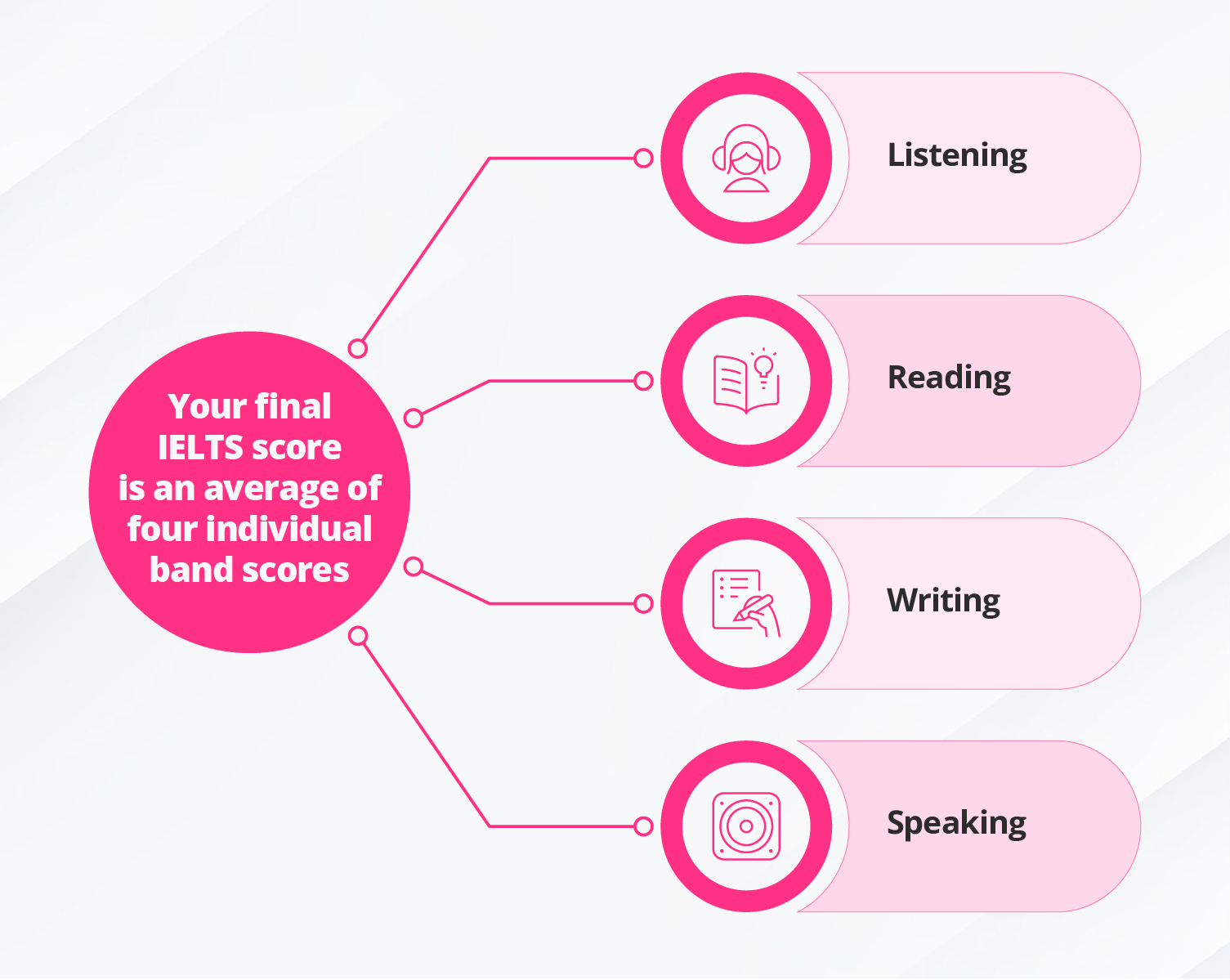
Each section is scored from band 0 to band 9. The average of all four is rounded to the nearest half or whole band.
What students often miss is that each subsection has its own method of scoring. For instance, Listening and Reading are purely based on the number of correct answers; while Writing and Speaking depend heavily on examiner judgement, structure, coherence, grammar, and vocabulary.
Let’s break it down clearly.
Understanding the Listening Band Score
Listening consists of 40 questions. Each correct answer is worth one mark and contributes to your raw score. This raw score is then converted into a band from 1 to 9.
You hear different accents, real-life conversations, monologues, academic discussions and short talks. The listening test checks how well you understand:
- Opinions and attitudes
- Main ideas and supporting information
- Specific details
- Changes in tone
- Contextual meaning
Even a small error like a misspelt word can reduce your score because every correct answer directly affects your final band.
Here’s how your raw marks usually convert:
- Around 35 to 40 correct answers give you a band 8 to 9
- Around 30 correct answers give you a band 7
- Around 23 to 26 correct answers give you a band 6
The takeaway is simple: accuracy matters more than speed. Listening rewards consistency.
Understanding the Reading Band Score
Reading also has 40 questions, but the scoring varies slightly depending on whether you take the Academic or General Training version.
Academic passages are more analytical and research-oriented, while General Training passages are drawn from everyday texts such as notices, brochures, articles, and workplace materials.
The conversion pattern generally follows this logic:
- High accuracy is required for a band 7 or above
- Inferential questions carry more weight indirectly because they’re harder
- Skimming and scanning improve speed, but the score ultimately depends on correct answers
Reading tests your ability to:
- Recognise arguments
- Identify opinions
- Understand the writer’s tone
- Manage complex vocabulary
- Find information quickly
- Interpret diagrams and textual data
Just like Listening, one wrong answer can shift your band down. Precision is essential.
How Writing is Scored
Writing is the section where most students either excel or struggle. Unlike Listening and Reading, Writing is judged by human examiners using strict band descriptors. Each descriptor is evaluated carefully and contributes to your score.
There are four assessment areas:
1. Task Achievement / Task Response
For Task 1 in Academic, this includes how well you summarise the visual information.
For Task 2, it includes how well you address the question, present an argument, and support your ideas.
2. Coherence and Cohesion
This measures how logically your ideas flow, how well your paragraphs connect, and how naturally your writing reads.
3. Lexical Resource
This reflects your vocabulary range, word precision, collocations, and ability to express complex ideas clearly.
4. Grammatical Range and Accuracy
This checks sentence structure, grammar control, punctuation, and whether you can use diverse sentence patterns without errors.
Each of these four areas contributes equally to your final Writing band.
To score well in Writing, you need structure, clarity, relevant examples, and precise language rather than memorised templates.
How Speaking is Scored
Speaking feels like a casual conversation, but it’s assessed very carefully. Examiners analyse four key areas:
1. Fluency and Coherence
This is not about speaking fast, it’s about speaking smoothly, maintaining flow, and presenting your ideas logically.
2. Lexical Resource
This checks how flexible your vocabulary is, how well you explain ideas, and whether you can find the right words naturally.
3. Grammatical Range and Accuracy
This measures how confidently and accurately you use sentence structures without repeated errors.
4. Pronunciation
This includes clarity, word stress, rhythm, and overall comprehensibility. You don’t need a British accent, you just need to be understood easily.
Speaking is often the most misunderstood module. Many students assume it’s about accent or speed, but examiners are mainly checking your ability to communicate clearly and naturally.
What Each IELTS Band Actually Means
Band scores often cause confusion, so here’s a simple, real-world explanation:
Band 9:
Expert. You understand and express ideas with ease and precision.
Band 8:
Very good. Occasional slips occur in unfamiliar contexts.
Band 7:
Good. You handle complex English well and communicate effectively.
Band 6:
Competent. You have effective command but may make mistakes under pressure.
Band 5:
Modest. You manage basic communication but lack consistency.
Band 4 or below:
Limited or restricted use of English.
Most universities require between band 6 and band 7 depending on the course, while healthcare or specialised programmes may ask for band 7 or above.
How Your Overall Band Score is Calculated
All four sections are averaged out and rounded to the nearest half or whole band.
For example:
- Listening: 7
- Reading: 6.5
- Writing: 6
- Speaking: 7
Total = 26.5 ÷ 4 = 6.625
Rounded = 6.5 overall
If the decimal ends in .25, it’s rounded down.
If it ends in .75, it’s rounded up.
This is why balanced preparation matters, one low-scoring section can bring your overall band down.
Why the IELTS Scoring System is Designed This Way
IELTS is meant to judge how effectively you can study, work, or live in an English-speaking environment. The scoring system mirrors real-world language use:
- Understanding lectures
- Reading academic texts
- Writing essays and reports
- Communicating clearly with classmates, teachers, or colleagues
It’s not about memorisation. It’s about usable language.
Tips to Improve Your IELTS Band Score Strategically
A good band score comes from smart preparation, not endless grinding. Here are practical tips based on how the exam is scored:
For Listening
Focus on clarity, spelling, and prediction. Listening for keywords and context improves accuracy.
For Reading
Skim the passage first, then scan for specific answers. Practise identifying the writer’s opinion, which many candidates misinterpret.
For Writing
Plan before you write. Use clear paragraphs. Avoid repeating words. Explain your ideas logically.
For Speaking
Practise speaking naturally. Give more than one-line answers. Expand with examples or personal experiences.
Consistency is more valuable than memorisation.
Why Scoring Transparency Helps You Prepare Better
Once you understand how IELTS Bands are calculated, your preparation becomes far more focused. Instead of trying to master everything at once, you can target each scoring area individually:
- Improving coherence in Writing
- Expanding vocabulary for Speaking
- Enhancing accuracy in Listening
- Increasing reading speed without losing precision
This saves time, reduces stress, and makes your progress measurable.
Expert Help When You Need Guidance
If you ever feel confused about your band requirements or need structured guidance tailored to your goals, expert help makes a huge difference. Many students struggle not because they lack English skills, but because they’re unaware of how the scoring system works. The right mentorship helps you understand your weaknesses, work on them effectively, and reach the band score required for your dream programme or visa.
If you need Personalised IELTS Preparation, dedicated support, or counselling on international admissions, you can always reach out for one-to-one guidance with MetaApply IE. TestPrep allows you full access to seamless coaching of English Proficiency Test coaching.
Conclusion
The IELTS Scoring System is not complicated once you understand the logic behind it. Each section contributes equally to your overall score, and every band level tells universities and visa authorities how comfortably you can use English in real-life situations. With the right preparation strategy, strong practice habits, and clear understanding of what examiners expect, achieving your target band becomes entirely possible.
Whether you’re preparing for University Admissions, immigration, or professional registration, clarity about the scoring system becomes your biggest advantage. Fill in the form now to get started.
Frequently Asked Questions
The IELTS overall score is the average of the four module scores—Listening, Reading, Writing and Speaking—rounded to the nearest half or whole band.
A score of 6.0 to 7.5 is generally considered good for most universities, though top institutions may require higher band scores.
The scoring criteria for Writing and Speaking are the same, but the Reading band conversion differs because Academic texts are more complex.
IELTS scores are typically valid for two years from the date of the test.
No, there is no negative marking in IELTS. Every correct answer earns one mark, and incorrect answers do not reduce your score.
Related Blogs