Why Study in Albania in 2026?
IELTS Eligibility: Who Should Really Take IELTS (And Who Shouldn’t)

If you’ve landed on this page, chances are you’re not just asking “Am I eligible for IELTS?”, you’re really asking something deeper. Is IELTS meant for me? Is this the right test at this stage of my life? Will it actually move me closer to my goals, or am I just following the crowd?
Interestingly, most blogs online never address this honestly. They’ll tell you there’s “no age limit” or “no minimum qualification” and stop there. Technically true. Practically useless. IELTS eligibility is not about age, passport, or degrees. It’s about intent, readiness, direction, and consequence. And that’s exactly what this blog is about.
Let’s talk about who actually should opt for IELTS and who should pause, rethink, or prepare better before jumping in.
What Is IELTS Eligibility Really Asking?
Search engines will tell you IELTS eligibility is simple: anyone can take the test. But students don’t search “IELTS eligibility” because they want permission. They search because they’re uncertain.
Uncertain whether their English is good enough.
Uncertain whether IELTS is compulsory for their country or university.
Uncertain whether one bad attempt will ruin their future.
Uncertain whether now is the right time.
Eligibility, in the real world, is about risk vs reward.
If you take IELTS at the wrong time, with the wrong preparation, or without clarity, you don’t just lose a test fee, you lose confidence, momentum, and sometimes an entire intake.
So instead of asking “Can I take IELTS?”, the better question is:
“Should I take IELTS now and will it work in my favour?”
Who Is Eligible for IELTS According to Official Rules?
Let’s clear the official part quickly, because that’s the easiest. There is no minimum age, no academic qualification requirement, and no nationality restriction to take IELTS. School students, undergraduates, working professionals, career switchers, and even retirees can appear for the test.
But this openness is exactly what makes IELTS confusing. When everyone is “eligible”, nobody knows when they’re ready. And readiness is where most test-takers fail.
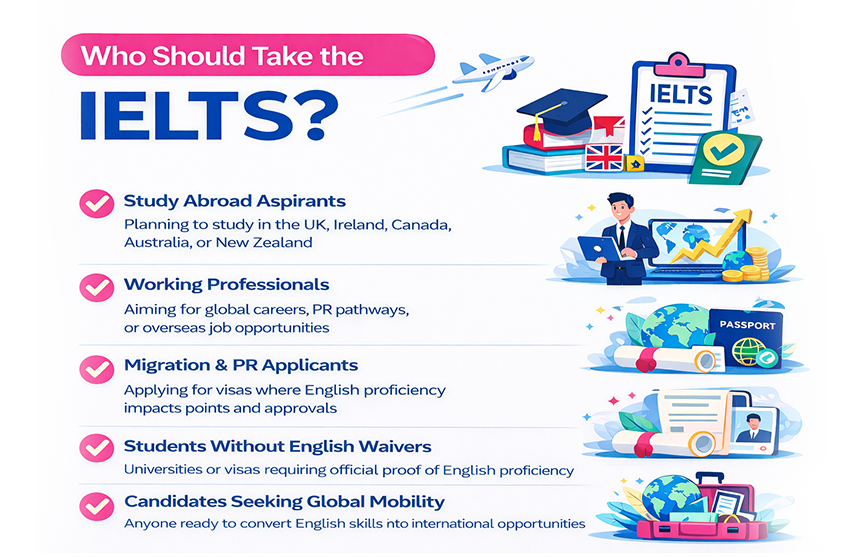
Who Should Actually opt for IELTS?
Let’s talk about the profiles for whom IELTS genuinely makes sense. If you’re planning to study abroad in an English-speaking country like the UK, Ireland, Australia, New Zealand, or Canada, IELTS isn’t optional, it’s foundational. Not just for admission, but for visas, scholarships, and sometimes even part-time work permissions.
But here’s the nuance nobody explains, not all study-abroad aspirants should take IELTS immediately.
If you’re still unsure about your country, course, or intake, taking IELTS too early can backfire. Scores expire. Policies change. Universities update requirements. What worked this year may not work next year.
The ideal IELTS Candidate is someone who has at least 70% clarity on their next step, even if everything isn’t finalised yet.
IELTS for Working Professionals: Is It Worth It?
This is one of the most searched but least honestly answered questions.
If you’re a working professional planning overseas employment, migration, or global exposure, IELTS can be a powerful career lever, but only if your target pathway demands it.
For PR routes (especially Canada, Australia, and the UK), IELTS isn’t just a language test; it’s a points multiplier. A half-band difference can change your CRS score, your invitation chances, and your waiting time by years.
But if your goal is internal mobility within a multinational company, or short-term overseas projects, IELTS may not even be required.
Eligibility here isn’t about English, it’s about return on effort. That’s why professionals benefit immensely from guided test selection and score targeting rather than generic preparation.
Are Students with Average English Eligible for IELTS?
This question silently haunts most applicants. Let’s be blunt: IELTS is not an English fluency test, it’s a skills test under pressure. Many fluent speakers score poorly. Many average speakers score surprisingly high with the right strategy.
Eligibility here is not about how well you speak English socially. It’s about whether you can understand task expectations, manage time, and structure responses in a way IELTS rewards.
Students from regional boards, vernacular-medium schools, or non-English backgrounds are not at a disadvantage, unless they underestimate the exam or overestimate their current ability.
What disqualifies candidates is not “weak English”, but poor preparation decisions.
Who Should Not Take IELTS (Yet)?
This is where most coaching centres go silent. But real guidance requires honesty.
You should pause before taking IELTS if:
You’re applying just because “everyone else is”.
You haven’t decided your country, course, or intake window.
You’re emotionally burnt out or under extreme academic pressure.
You believe one attempt will define your intelligence or worth.
IELTS is not a test you “just try once and see”. Every attempt shape confidence. A rushed or underprepared attempt often creates psychological barriers that are harder to fix than grammar mistakes.
Sometimes the most strategic move is not taking IELTS immediately but preparing deliberately.
Is There an Age Limit for IELTS?
Officially, no. Practically, age influences outcomes, not eligibility.
School students often struggle with task maturity, especially in Writing Task 2. Older candidates sometimes struggle with speed and listening concentration.
Neither group is ineligible, but both require tailored preparation approaches, not generic crash courses.
IELTS does not discriminate by age, but it rewards awareness.
IELTS Eligibility for UK, Canada, Australia, and Ireland: Is It the Same?
Another high-search question with a misleading assumption.
Yes, IELTS is accepted across major destinations, but the type of IELTS, band requirements, and section-specific scores vary widely.
UK Visas may require IELTS for UKVI.
Canadian PR prioritises CLB conversions.
Australian migration values Listening heavily.
Irish universities may waive IELTS under specific conditions.
Eligibility isn’t about “having IELTS”, it’s about having the right IELTS Score, for the right pathway, at the right time. This is where most self-preparing candidates lose opportunities without even realising it.
Academic vs General IELTS: Are You Eligible for Both?
Technically, yes. Strategically, no.
Choosing between Academic and General is not a preference, it’s a compliance decision. Taking the wrong version can make your score unusable, even if it’s high.
Many students retake IELTS not because they scored poorly, but because they took the wrong test. Eligibility here depends entirely on your end goal and this is exactly why test decisions should never be isolated from counselling.
What Does IELTS Eligibility Mean for Scholarships and Universities?
Here’s a lesser-known truth: universities don’t just look at your IELTS score, they look at score distribution. An overall 7.0 with a 5.5 in Writing can quietly kill scholarship chances. A balanced 6.5 across sections may outperform a higher but uneven score.
Eligibility, therefore, is not binary. It’s competitive. And competition demands preparation that goes beyond mock tests, it demands score engineering.
Can You Be “Eligible” But Still Fail IELTS?
Absolutely. And it happens every day. Eligibility only lets you sit for the exam. It does not guarantee outcomes. The real differentiator is not intelligence, education, or English exposure, it’s how well your preparation aligns with IELTS psychology.
Students who understand why answers are marked wrong outperform those who simply practise more. That’s the difference between casual prep and guided prep.
Why IELTS Eligibility Should Never Be Decided Alone
The biggest mistake students make is treating IELTS as a standalone task.
In reality, IELTS is a strategic checkpoint in a much larger journey, study abroad, migration, career mobility, or global education. Deciding when to take it, which version to take, what score to target, and how to prepare should never happen in isolation.
This is why students who receive integrated guidance, test prep aligned with counselling and application strategy tend to clear IELTS faster, with fewer attempts and less stress.
The Real Question Isn’t “Am I Eligible?”- It’s “Am I Positioned to Win?”
If you’ve read this far, you already know the answer.
IELTS eligibility is not about permission. It’s about positioning.
Positioning yourself to score what your future demands.
Positioning yourself to avoid unnecessary retakes.
Positioning yourself to convert a test score into an admission, visa, or opportunity.
That’s where expert-led preparation changes everything.
IELTS Is a Gatekeeper, But Only If You Let It Be
For some, IELTS feels like a hurdle. For others, it becomes a confidence booster, a differentiator, a passport to global opportunities. The difference lies not in eligibility, but in how intentionally you approach it.
If you’re unsure whether now is the right time, which IELTS version you need, or what score you should realistically target, that uncertainty is not a weakness, it’s a sign that you should talk to someone who’s done this thousands of times before.
Because the right guidance doesn’t just help you take IELTS. It helps you use IELTS to move forward. And that’s where real outcomes begin.
Your IELTS Journey, Backed by Experts at MetaApply IE
If you’re serious about studying abroad and want to ensure that IELTS becomes a stepping stone, this is where the right support makes all the difference. At MetaApply IE, our expert counsellors take care of every aspect of your study abroad journey, from helping you choose the right course, college, and destination to guiding you through applications, financial aid, and Visa Preparation. Alongside this, our dedicated TestPrep programmes are designed to align your IELTS score with your academic and career goals, while our career counselling ensures that your decisions today support where you want to be tomorrow. If you believe studying abroad can truly shape your future, MetaApply IE is here to simplify the process, remove uncertainty, and help you move forward with clarity and confidence, every step of the way.
Frequently Asked Questions
Anyone can take the IELTS exam regardless of age, academic background, or nationality. However, eligibility to use an IELTS score depends on your purpose such as university admission, visa requirements, or migration pathways and the specific criteria set by institutions or governments.
No, there is no official age limit to appear for IELTS. Candidates under 16 are also allowed, though IELTS is primarily designed for higher education, professional, and migration purposes, making it more suitable for older students and working professionals.
No academic qualification is required to take IELTS. You do not need to have completed school or college to sit for the exam. However, universities and visa authorities may have their own academic eligibility criteria beyond IELTS.
Yes. IELTS does not test advanced English knowledge but evaluates how effectively you can use English in academic, professional, or real-life contexts. With the right preparation strategy, even candidates with average English proficiency can achieve competitive band scores.
IELTS is mandatory for most English-speaking countries, but not in all cases. Some universities offer waivers, and certain job roles or countries may accept alternative tests. Whether IELTS is compulsory depends on your destination, course, visa type, and long-term goals.
Related Blogs