
Your Ultimate Checklist Before You Fly to Study Abroad in 2026
Medical Education Abroad: Simplified Guide to Becoming an International Doctor

Medical education abroad has transformed from being a last-resort option into a well-planned, aspirational choice for Indian students who want quality medical training without the limitations of the Indian system. With limited government seats, intense NEET competition, and private medical college fees touching ₹1 crore or more, thousands of deserving students are left searching for realistic alternatives every year.
This is where studying medicine abroad comes into the picture. Countries across Europe, the UK, Central Asia, and beyond now offer affordable, English-taught medical programmes with modern infrastructure, strong clinical exposure, and globally recognised degrees. For students who qualify NEET but don’t secure a seat in India, Medical Education Abroad offers clarity, accessibility, and a clear path to becoming a globally practising doctor.
In 2026, choosing to Study Medicine Overseas is no longer about compromise. It’s about strategy, exposure, and long-term career mobility.
The Reality of Studying Medicine in India Today
Before understanding why medical education abroad is booming, it’s important to look at the situation in India.
Every year, over 20 lakh students appear for NEET, competing for a limited number of MBBS seats. Government colleges offer affordability but extreme competition, while private colleges offer seats at unaffordable prices. Despite years of preparation, many capable students are forced to either drop a year or give up on their dream entirely.
This imbalance between demand and availability has pushed students to look beyond borders. Medical universities abroad have recognised this gap and created structured, transparent admission pathways that focus on eligibility rather than extreme rank-based elimination.
Why Indian Students Are Choosing Medical Education Abroad?
The shift towards studying medicine abroad is driven by practical benefits rather than trends. Let’s break down the core reasons.
NEET Qualification Without Unrealistic Cut-Offs
NEET remains mandatory for Indian students planning to Study MBBS Abroad. However, unlike India, most foreign universities do not demand extremely high ranks. If you qualify NEET, you meet the eligibility criteria for the majority of internationally recognised medical universities.
This makes the process merit-based yet inclusive.
Affordable Tuition Fees
One of the biggest advantages of medical education abroad is cost. While private MBBS programmes in India can cost anywhere between ₹50 lakh to ₹1 crore, studying medicine abroad typically ranges between ₹5–30 lakh per year, depending on the country and university.
Many universities offer transparent fee structures, instalment options, and affordable living costs, making quality medical education financially realistic for middle-class families.
Strong Clinical Exposure
Medical Universities Abroad emphasise hands-on learning. Students gain early access to hospitals, simulation labs, EMR-based training systems, and real patient interaction. Exposure to diverse populations enhances diagnostic skills and prepares students for global healthcare systems.
Globally Recognised Degrees
Most reputed medical universities abroad are recognised by regulatory bodies such as:
- National Medical Commission (NMC)
- World Health Organization (WHO)
- Educational Commission for Foreign Medical Graduates (ECFMG)
- General Medical Council (GMC)
This ensures that your degree remains valid across countries and allows you to pursue licensing exams worldwide.
Direct Pathways to Global Medical Exams
Students studying medicine abroad can prepare for international exams such as:
- USMLE (USA)
- PLAB (UK)
- AMC (Australia)
- FMGE/NEXT (India)
Several universities integrate Exam Preparation into their curriculum, reducing additional coaching pressure.
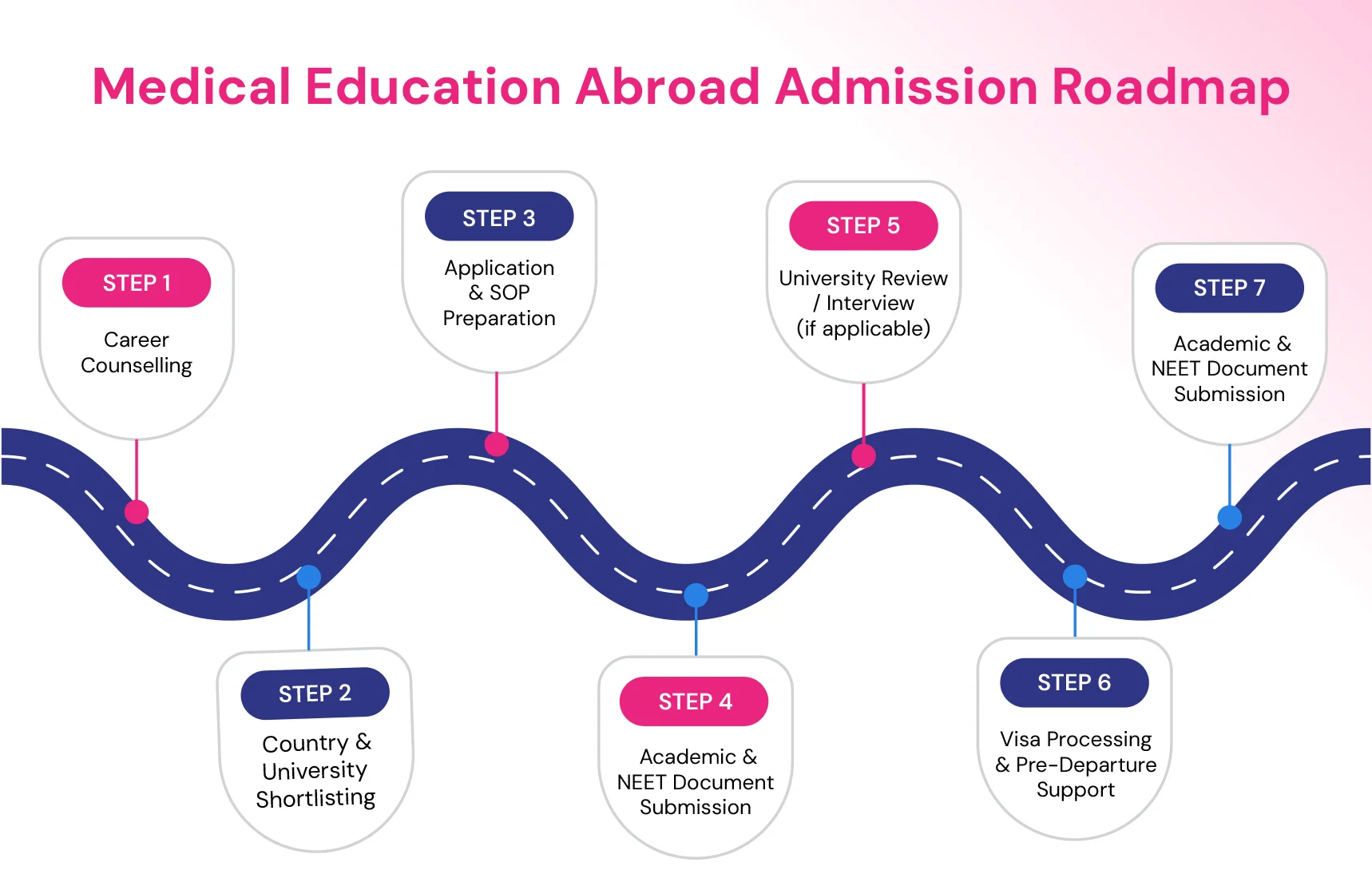
How Medical Education Abroad Works: A Simple Admission Process
Contrary to popular belief, the admission process for studying medicine abroad is structured and transparent when guided correctly.
Top Destinations for Medical Education Abroad
Every country offers a different academic environment, cost structure, and career pathway. Choosing the right destination depends on your goals, budget, and long-term plans.
Medical Education in the United Kingdom
The UK is known for its academic excellence, research-driven approach, and structured clinical training. Medical students gain exposure to the NHS, one of the world’s most advanced healthcare systems. UK medical degrees are highly respected globally, and the PLAB pathway provides a clear route to practising Medicine in the UK.
Medical Education in the United States
The US follows the MD pathway, which includes pre-medical studies followed by medical school. Although competitive, the US offers access to cutting-edge technology, world-class hospitals, and unmatched research opportunities. Ideal for students aiming for top-tier global medical careers.
Medical Education in Russia
Russia has been a trusted destination for Indian medical students for decades. Universities offer NMC-approved MBBS programmes taught in English, with strong laboratory facilities and affordable tuition. Living costs are also relatively low, making it a popular choice.
Medical Education in Georgia
Georgia is known for its safety, modern infrastructure, and European-standard medical education. Universities follow transparent academic systems and offer globally recognised degrees. Indian students benefit from simple admissions and a supportive environment.
Medical Education in Hungary
Hungary offers EU-recognised medical degrees that open doors across Europe. Universities focus on academic rigour, clinical internships, and research exposure, making Hungary ideal for students targeting European healthcare systems.
Medical Education in Turkey
Turkey combines modern hospital infrastructure with English-taught MBBS programmes. The country’s growing reputation for quality medical education and affordable fees makes it an emerging favourite among international students.
Medical Education in Central Asian Countries
Countries such as Kazakhstan, Uzbekistan, Kyrgyzstan, and Azerbaijan offer some of the most affordable MBBS programmes globally. Many universities are NMC-recognised and provide strong international student support, making them ideal for budget-conscious aspirants.
Common Challenges in Medical Education Abroad and How to Overcome Them
Every international journey comes with concerns, but the right guidance eliminates most risks.
Language Barriers
Students are guided towards English-medium universities to avoid learning-curve issues.
Visa Approval Concerns
With proper documentation, mock interviews, and expert handling, visa success rates improve significantly.
Fake or Unrecognised Universities
Partnering with verified, accredited universities ensures degree validity and long-term safety.
Cultural Adjustment
Pre-departure orientations help students adapt smoothly to new countries and lifestyles.
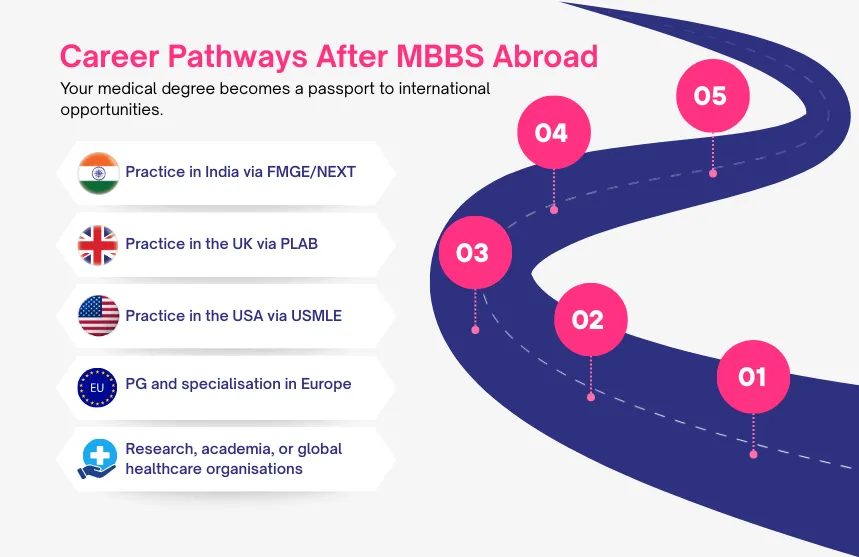
Career Options After Completing Medical Education Abroad
Medical education abroad opens multiple global career pathways.
How MetaApply IE Simplifies Medical Education Abroad
Choosing the right guidance partner is crucial when planning medical education abroad. At MetaApply IE, we provide end-to-end support tailored specifically for medical aspirants.
Our services include:
- Expert medical counselling
- Country and university shortlisting
- SOP, LOR, and application assistance
- Scholarship and financial guidance
- Visa preparation and mock interviews
- Pre-departure and post-arrival support
- Career counselling
- TestPrep for IELTS, TOEFL, PTE, OET, SAT, ACT, GRE, and GMAT
Our counsellors understand global medical regulations, eligibility requirements, and licensing pathways, ensuring you move forward with clarity and confidence.
Your Medical Dream Has No Borders
If Becoming a Doctor is your dream, don’t let seat shortages or financial barriers stop you. Medical education abroad offers quality, affordability, global exposure, and future-proof career options. With the right planning and expert guidance, your journey to becoming a globally recognised doctor can begin today.
MetaApply IE is here to help you take that first step with confidence, transparency, and a structured roadmap.
Frequently Asked Questions
Yes. After completing your degree, you must clear FMGE/NEXT to practise in India.
Yes. In most cases, it is significantly cheaper than private medical colleges in India.
Yes. NEET qualification is compulsory for Indian students.
Most universities are recognised by NMC, WHO, GMC, and ECFMG.
How do I choose the right country and university? Through personalised counselling, structured evaluation, and expert guidance from MetaApply IE.
Related Blogs