
MBBS in India VS MBBS Abroad- A Key Comparison Between Both Options

Hemani Tandon
Published on March 21, 2026

The NEET results will be out soon—and no matter what your score is, you should not feel disheartened. You have it your best shot, and that effort counts. However, when it comes to securing a medical seat in India, the reality can feel harsh. With intense competition, limited government seats, soaring private college fees, and cut-offs that climb every year, the chances sometimes feel slim to none. You may be experiencing uncertainty, family pressure, financial concerns, or the fear of losing a precious year. It is completely natural to question your next step for the dream of becoming a doctor.
This is exactly why many Indian medical aspirants begin considering their options of pursuing MBBS abroad as a viable alternative. Today, in this blog, we are going to explore a clear, practical comparison between MBBS in India vs MBBS abroad. So, without further ado, let’s break down both options and help you decide what truly aligns with your goal and how you can still live your dream to Be A Doctor.
MBBS in India VS MBBS Abroad- A Quick Comparison
Becoming a Doctor is more than just earning a degree—it is a lifelong commitment to serving society. If you are planning to pursue MBBS, one of the biggest challenges you will face is, clearing the NEET bit still not being able to secure a seat in India. While this is one of the key deciding factors for students to pursue MBBS Abroad, there are a lot of other reasons as well. And today, in this section, we are going to have a breakdown between your journey to be a doctor in India vs your MBBS journey abroad.
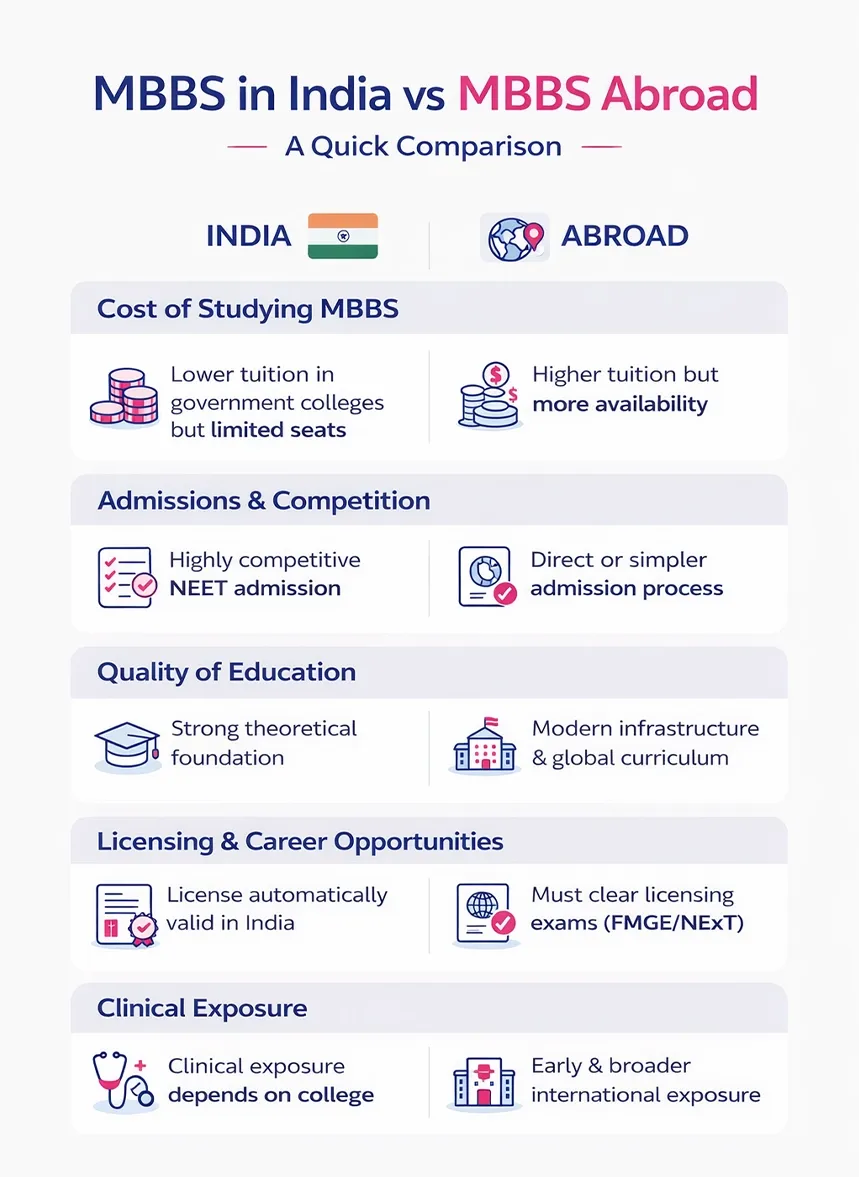
1. Cost of Studying MBBS
Cost- In India
If you secure a seat in government medical college in India, your tuition fees are highly affordable. Government institutions offer subsidised education, making MBBS accessible for merit students.
However, the situation changes drastically in private medical colleges. Tuition fees in private institutions can range from ₹50 lakh to over ₹1.5 crore for the entire course. In addition, some colleges charge capitation or donation fees, which significantly increase the financial burden.
Living expenses in India are generally manageable, especially if you study in a non-metro city.
Cost- Abroad
Studying MBBS Abroad can be more affordable than private medical colleges in India, especially in countries such as Russia, Georgia, Kazakhstan, or the Philippines. Total tuition fees in many of these destinations range between ₹15 lakh to ₹40 lakh for the entire programme.
That said, you must factor in additional costs such as accommodation, travel, visa renewals, medical insurance, and daily living expenses. In countries like the UK, USA or Australia, the cost can be significantly higher.
The key takeaway: MBBS abroad can be cost-effective compared to Indian private colleges—but careful financial planning is essential.
2. Admissions & Competition
Admissions & Competition- In India
In India, Admission to MBBS is entirely based on the NEET-UG examination. With more than 20 lakh students appearing for NEET every year and limited government seats available, competition is extremely intense. If you aim for prestigious institutions such as:
- All Indian Institute of Medical Sciences (AIIMS)
- Jawaharlal Institute of Postgraduate Medical Education and Research (JIPMER)
You must achieve a very high rank.
Even private colleges require NEET qualification, though cut-offs are lower compared to top government institutions in India.
Admissions & Competition- Abroad
To Study MBBS Abroad, you must still qualify NEET to meet the eligibility criteria set by the National Medical Commission (NMC). However, the cut-offs are usually lower compared to Indian government colleges.
Most foreign universities offer direct admissions based on academic performance and NEET qualification, without additional entrance examinations. The process is generally less competitive and more straightforward.
The crucial point here is to ensure that the university is approved by the NMC; otherwise, you may face difficulties practising in India later.
3. Quality of Education
Quality of Education- In India
India is home to some of the finest medical institutions in the world Prestigious institutes like AIIMS and JIPMER are recognised for their rigorous academic structure, experienced faculty, and strong research ecosystem.
Medical education in India follows a well-defined curriculum that emphasises theoretical depth along with practical hospital training. Due to the country’s vast population, you gain exposure to a wide spectrum of diseases and complex cases. However, the quality of infrastructure, laboratories, and academic mentorship can vary significantly across government, state, and private institutions, especially in lower-tier colleges.
Quality of Education- Abroad
Many Foreign Medical Universities are known for their modern campuses, technologically advanced laboratories, simulation-based learning facilities, and relatively smaller class sizes. In several countries, clinical exposure begins early, allowing you to integrate practical training with classroom learning from the initial years.
Smaller student batches often lead to more personalised academic support and closer interaction with faculty members. However, educational standards differ widely between universities and countries. Not all institutions provide equal clinical intensity or research scope. Before enrolling, you must carefully evaluate global recognition, hospital affiliations, curriculum structure, and graduate success outcomes to ensure long-term academic and professional value.
4. Licensing & Career Opportunities
Licensing & Career- In India
If you complete your MBBS from an Indian medical college, you can directly register with the National Medical Commission after completing your internship. With the implementation of the proposed NExT exam, both Indian and foreign graduates will eventually be assessed through a common licensing framework.
Once licensed, you can begin practicing or appear for postgraduate entrance examinations in India.
The pathway is direct and structured.
Licensing & Career- Abroad
If you complete MBBS abroad and wish to practice in India, you must clear the Foreign Medical Graduate Examination (FMGE) or the Next-Generation Licensing Exam (NExT), as applicable.
The pass percentage of FME has historically been moderate, meaning that thorough preparation is essential. Without clearing the licensing exam, you cannot practise in India.
On the other hand, Studying Abroad may open pathways to licensing exams in other countries such as the UK or USA, if that aligns with your career goals.
The decision should therefore depend on where you intend to practise long-term.
5. Clinical Exposure
Clinical Exposure- In India
One of the strongest advantages of studying MBBS in India is the sheer volume of patients you encounter during your training. Government hospitals witness enormous daily patient inflow, which exposes you to a broad spectrum of medical conditions across departments. From common illnesses to rare and complex cases, you gain hand-on learning opportunities almost every day.
This diversity significantly strengthens your diagnostic ability, clinical judgement, and confidence in handling real emergencies. By the end of your internship, you are likely to have independently assisted in numerous procedures, managed critical patients, and experienced real-world healthcare challenges first-hand.
Clinical Exposure- Abroad
Clinical exposure abroad can be highly structured, technologically advanced, and academically guided, depending on the country and university you choose. Many well-established Medical Universities are affiliated with reputed teaching hospitals where training follows international protocols and evidence-based medical practices. You often begin practical exposure early in the course, integrating theory with real-life clinical applications from the initial years.
Smaller student groups ensure closer supervision by senior consultants, allowing you to actively participate rather than merely observe. Access to advanced diagnostic tools, simulation labs, and modern treatment technologies enhances your procedural confidence. While patient volume may differ from India, the systematic training approach, global standards, and hands-on mentorship often make the overall clinical learning experience more refined and globally aligned.
MApply—Guiding You to Complete Your Medical Dream Abroad
Your dream of wearing the white coat should never end because of one exam score. While MBBS in India is highly competitive and financially demanding in private colleges, MBBS abroad has emerged as a smarter, more accessible pathway for many aspiring doctors like you. With the right country, recognised university, and proper guidance, you can receive quality education, global exposure, and structured clinical training—all at an affordable cost.
This is where MApply becomes your trusted partner. From shortlisting NMC-approved universities to securing admissions, visa support, and financial planning, we guide you at every step. We help you choose the right, Affordable MBBS Destination Abroad so you can confidently live your dream of becoming a doctor—and dedicate your life to healing humankind.
Interested in Study Abroad?
MetaApply can help - fill the form
Enquire Now
Frequently Asked Questions
MBBS in Indian government college is affordable, but private colleges are extremely expensive. Many MBBS abroad options are more cost-effective than Indian private institutions, depending on the country and university you choose.
MBBS abroad can be better if you do not secure a government seat in India. It offers affordable tuition, modern infrastructure, and global exposure, provided you choose an approved and recognised university.
Yes, NEET qualification is compulsory if you want to study MBBS abroad and later appear for FMGE or NExT to practise in India. Without NEET, you are not eligible for licensing.
There is no single “number one” country for MBBS. The best destination depends on affordability, recognition, education quality, and your career goals. Countries like the UK, USA, and Russia are popular choices.
No field in MBBS is truly easy. Some students find non-surgical specialisations less physically demanding than surgical branches. The right field depends on your interest, strengths, and long-term career vision.