The Smartest Countries to Study Hotel Management in 2026 (Before Seats Fill Up)
How to Apply for a Student Visa to Germany?

Planning to study in Germany? You’re not alone. Thousands of ambitious students worldwide decide to study in Germany each year, and it is understandable. Germany provides one of the most enriching academic experiences in Europe with its globally rated universities, free or low-cost education, and a graduate job market that is performing well. However, you cannot afford to leave one important step out before you pack your bags and begin your new chapter, which is obtaining your Germany Student Visa.
The process of applying for a student visa might appear daunting initially: various forms, visits to an embassy, blocked account, checking documents, etc. One can get lost easily in this chain. It is on this basis that knowing theVisa Application Process, from start to finish, is so crucial. No matter whether you are applying for a National Visa (full-time study) or a Prospective Student Visa (a visa to secure admission post-arrival), details matter, as you do not want your application to be declined due to insufficient information.
By the time you finish this guide, you will have a clear roadmap to move comfortably from your university acceptance letter to your seat in a German classroom without the stress and confusion most applicants experience. And should you need professional advice on how to simplify and streamline your visa process, we will also guide you on how to do that.
Why Study in Germany?
Germany has established itself as one of the most preferred study destinations in the world, not only based on its academic excellence but also because of the complete package it offers to international students. Germany really is a place that offers quality, affordability, and opportunity with its tuition-free universities, its culture of research, multicultural friendliness, and work opportunities after studies.
This is the reason why students worldwide are opting to Study in Germany in 2026:
1. Global Recognition through World-Class Education
German universities are among the best in the world in terms of academic excellence and research innovation. A German degree is also globally recognised and appreciated by employers, thus, you will have a competitive advantage when working in Europe, Asia, or any other country.
2. Free or Low-Priced Education
Affordability is one of the largest benefits of Studying in Germany. German Universities levy minimal or no tuition fees at their public universities, including for international students. All you have to do is make a small semester contribution, which covers administration and student services.
3. Diverse Variety of Programmes Taught in English
You do not have to be a fluent German speaker to study there. Most leading universities have a broad spectrum of undergraduate and graduate programmes in English, particularly courses in engineering, computer science, business, and international relations. Nevertheless, it is still worth learning basic German to improve everyday life and enhance employability upon graduation.
4. High Research and Innovation
Germany is often described as a country of innovators and inventors — in automobiles, pharmaceuticals, and green technology. Its higher education institutions work directly with industries, research centres, and the government to drive innovation. You will have an opportunity to gain practical experience as a student, in the form of research projects, lab work, and internships, allowing you to apply classroom knowledge to real-world tasks.
5. Above-Average Career Prospects and Post-Study Work
Germany has a strong economy and a low unemployment rate; this makes it one of the best countries to jumpstart your career. Under a student visa, you are allowed to work part-time (up to 120 full days per year) while pursuing your studies. Upon graduation, you may apply for an 18-month post-study work permit to find a job related to your degree.
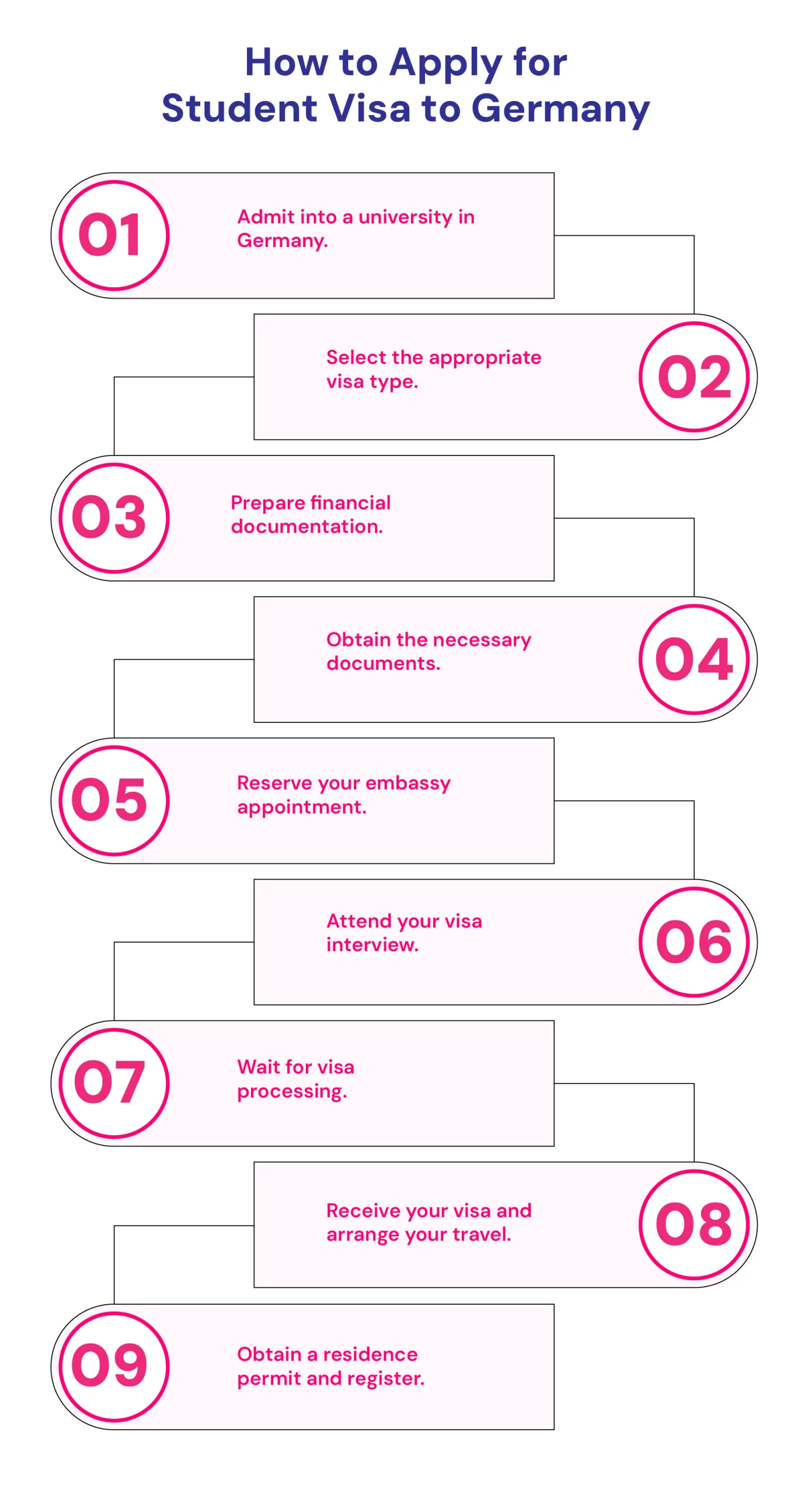
The process of applying to Germany to get a student visa is much simpler when you know what to do and in what sequence to do it. This is how you can do it easily, whether it is obtaining admission or settling in Germany.
Step 1: Admit into a university in Germany.
Apply to the university of your choice and obtain an official admission letter — the first and most crucial requirement for your visa.
Step 2: Select the appropriate visa type.
If you are already admitted, apply for an International Student Visa (National Student Visa). If you are awaiting confirmation, select the Prospective Student Visa.
Step 3: Prepare financial documentation.
Open a blocked account with the necessary amount (approximately €11,904 per year) or present a scholarship or sponsorship as proof of funds.
Step 4: Obtain the necessary documents.
Prepare your passport, admission letter, financial documents, language test results, academic certificates, health insurance, and motivation letter.
Step 5: Reserve your embassy appointment.
Book a date at your nearest German Embassy or Consulate well in advance because appointments can only be available weeks ahead during peak season.
Step 6: Attend your visa interview.
Submit all your documents and provide responses to questions regarding your course, finances, and study plans. Be clear, confident, and truthful in your answers.
Step 7: Wait for visa processing.
Visa processing usually takes 4–12 weeks. Monitor your application status online and submit any additional documents promptly if required.
Step 8: Receive your visa and arrange your travel.
After approval, ensure you check your visa details, book your flight, and carry all the necessary documents when travelling to Germany.
Step 9: Obtain a residence permit and register.
Upon arrival, register your address and apply for a residence permit at the local immigration office to pursue your studies legally.
Documents Required to Get a Student Visa to Germany
Below is a comprehensive checklist of required documents for the standard student visa and some common mistakes to avoid.
| Document | Details/Notes |
|---|---|
| Letter of Acceptance (LOA) | Must be issued by a recognised DLI. |
| Valid Passport | Must remain valid throughout your stay in Canada. |
| Proof of Financial Support | Show funds for tuition + living expenses (~CAD 20,635 per year as of 2026). |
| Passport-sized Photos | As per IRCC specifications. |
| Statement of Purpose (SOP) | Explains your study goals, choice of course, and future plans. |
| Provincial Attestation Letter (PAL) | Mandatory from 2024 onwards for many applicants. |
| Medical Exam & Police Clearance | Required for applicants from certain countries. |
| Language Proficiency Test (IELTS/TOEFL) | Some institutions may require proof of English or French proficiency. |
| Biometrics Receipt | Proof of having given fingerprints and a photograph. |
Conclusion
Applying for a student visa to Germany is a detailed process, but once you understand the steps, it’s completely manageable. From securing your university admission to submitting your documents at the embassy and finally registering in Germany, each step brings you closer to studying in one of the world’s most innovative and respected education systems.
If you’re ready to start your journey but want expert guidance at every stage, from choosing the right university and course to visa filing, interview prep, and accommodation, MetaApply IE makes it simple. As a trusted study abroad platform, MetaApply IE connects you with top German universities and helps you navigate the visa process with ease, saving you time, stress, and guesswork.
Frequently Asked Questions
Generally about 4-12 weeks after your submission, though it may vary by country/mission and individual case.
Not always, if you have a recognised German or EU scholarship, or a sponsor with a formal undertaking (Verpflichtungserklärung). But for many self-funded applicants, yes, blocked account is required.
IELTS per se is not always required by visa authorities, but if your programme is English‐taught and university demands it, you must provide proof of English proficiency, which then becomes part of your visa file.
For non-EU students, typically up to 120 full days or 240 half days per year, but confirm with your visa/residence permit.
If rejected, you may have options: you can reapply with stronger documentation, check specific appeal/objection rights under your country’s mission. Note: From July 1 2026, Germany will abolish the informal remonstration (internal appeal) procedure.
Related Blogs