
Why Do Early Planning Matters to Study Abroad?
GMAT Preparation Guide for Indian Students: Your Step-by-Step Roadmap to Success

If you’re an Indian student with dreams of studying at a top global business school, the GMAT (Graduate Management Admission Test) is one of the most decisive milestones in your journey.
But let’s be honest, the GMAT is not merely an exam; it’s a test of patience, consistency, and smart strategy. Whether you’re aiming for a 700+ score, a scholarship, or just that dream admit letter, this GMAT Preparation Guide for Indian students is designed to help you make informed decisions, save time, and get actual results.
Here’s the good news: it’s completely possible to crack the GMAT with the right approach, no matter where you’re starting from. The key lies in strategy, consistency, and understanding how the exam works, not just hard study. Let’s answer all your queries so you can take the right steps towards a successful career.
What is the GMAT and Why is it Important for Indian Students?
The major question that comes to mind is what does the GMAT actually test? The GMAT is a globally recognised entrance exam used by thousands of business schools, assessing your readiness for postgraduate management study.
It’s a computer-adaptive test, meaning it adjusts the difficulty of questions as you progress.
The four sections include:
- Quantitative Reasoning – Maths, problem-solving, and data sufficiency.
- Verbal Reasoning – Reading comprehension, critical reasoning, and grammar.
- Integrated Reasoning (IR) – Data interpretation and analysis across sources.
- Analytical Writing Assessment (AWA) – One essay analysing an argument.
For Indian students, the GMAT is more often a gateway (figuratively speaking!) to better opportunities, stronger scholarships, and global exposure. Business schools worldwide use GMAT scores to compare applicants from different academic backgrounds, so a strong score signals your ability to handle rigorous coursework.
Why Does the GMAT Matter More for Indian Students?
Every year, Indian applicants form one of the largest pools for Top MBA Programmes. With high competition from academically strong peers, the GMAT becomes your chance to stand out.
A score of 680–730+ often places you in the competitive range for top B-schools around the world. But the true value isn’t just the number, it’s how you leverage your GMAT score as part of your overall profile.
A solid score:
- Boosts your credibility among international applicants.
- Opens access to scholarships and assistantships.
- Demonstrates analytical rigour and language proficiency.
- Strengthens your visa prospects, as high scores often indicate academic readiness.
When Should You Start GMAT Preparation (and How Long Does It Take)?
Timing is everything when it comes to GMAT prep. If your goal is to join an MBA intake in 2026, your ideal preparation window is now.
| Profile | Preparation Duration | Hours per Week (approx.) |
|---|---|---|
| Full-time student | 3–4 months | 25–30 |
| Working professional | 6–8 months | 10–15 |
| Re-attempt or career-switcher | 9+ months | 8–10 |
Remember, GMAT preparation is all about how smartly you use your study hours. Here’s a quick rule of thumb: If you’re targeting a 700+ score, you’ll need around 120–150 hours of effective study time, broken into concept-building, timed drills, and full-length mocks.
Who Should Take the GMAT?
The GMAT is ideal for:
- Indian graduates (engineering, commerce, or arts) aspiring to Study Management Abroad.
- Working professionals seeking an international MBA.
- Students planning for a Master’s in Management, Finance, or Business Analytics.
Who might consider waiting?
If your English proficiency or reading speed is low, it’s best to work on these foundations first.
Also, if you’re unsure of your post-study goals or destinations, finalise them before committing to the exam.
How to Prepare for GMAT Step-by-Step?
Let’s break down the process into actionable steps that work.
Step 1: Take a Diagnostic Test
Before you buy a single prep book, take a Free Official GMAT Mock on mba.com.
This tells you your baseline score and identifies your weaker sections.
Step 2: Define Your Target Score
Align your GMAT goal with your dream schools.
- Top-tier B-schools: 710–750+
- Mid-tier global schools: 650–700
- Scholarships: 700+ typically gives an edge
Step 3: Create a Study Plan
Allocate time for each section based on your strengths.
For Indian students, Quant is often the stronger area, so devote more hours to Verbal and Integrated Reasoning.
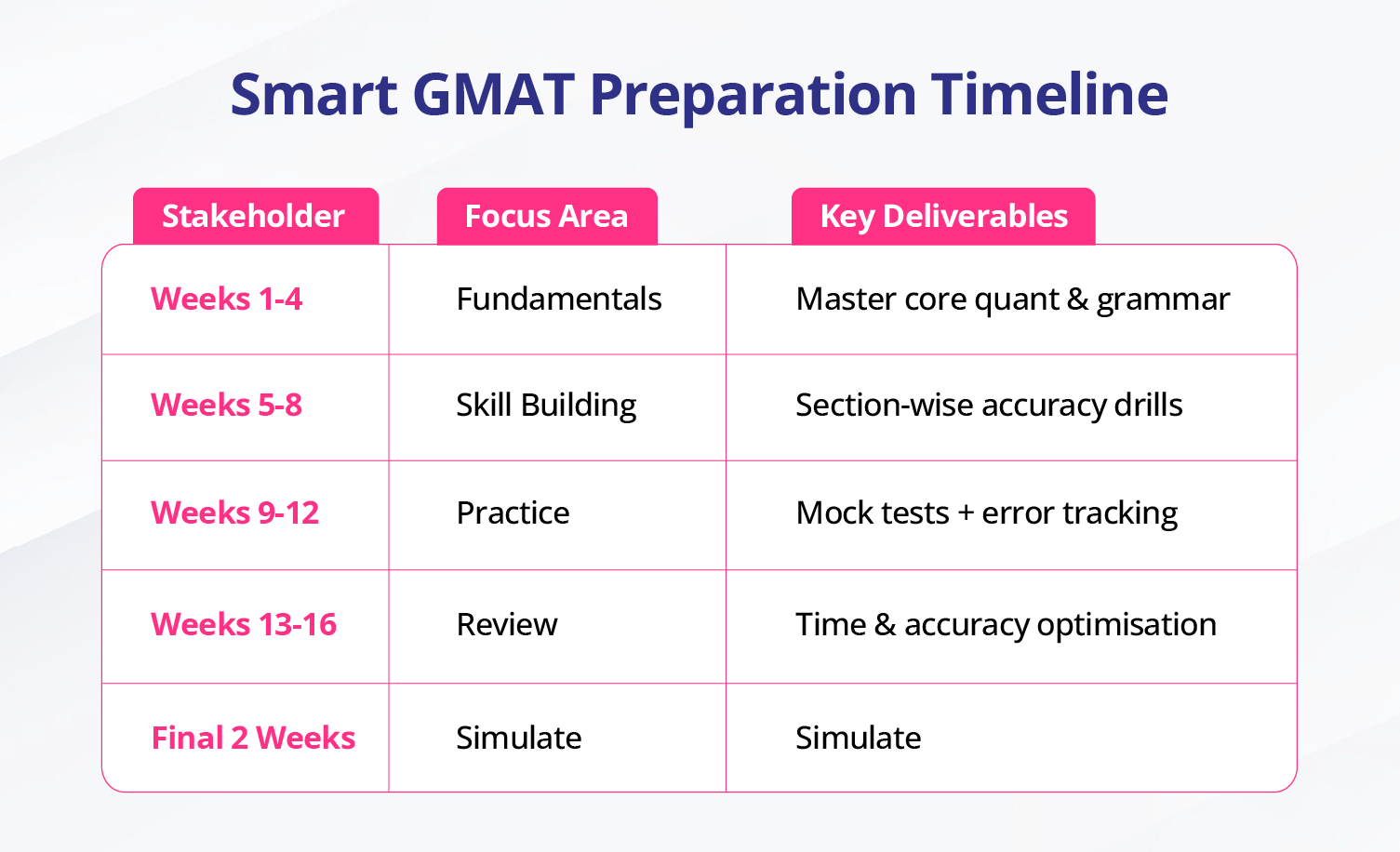
Step 4: Build Strong Fundamentals (Weeks 1–4)
- Refresh your core maths (ratios, percentages, probability, geometry).
- Learn Sentence Correction rules (idioms, modifiers, tenses).
- Strengthen Critical Reasoning using question-type recognition.
- Read one business article daily, like “The Economist”, “Harvard Business Review”, etc.
Step 5: Practice Intensively (Weeks 5–12)
- Attempt sectional drills, focus on timing and accuracy.
- Maintain an error log to record every mistake.
- Use reliable resources: GMAT Official Guide, Veritas Prep, or Manhattan Prep.
- Take 1 mock test every two weeks.
Step 6: Review and Refine (Weeks 13–16)
- Focus on high-yield topics: Inequalities, Critical Reasoning assumptions, Reading inference questions.
- Analyse mock test analytics, to understand which section causes score volatility.
- Work on time-per-question strategy:
- Quant: ~2 minutes
- Verbal: ~1.8 minutes
- IR: ~2.5 minutes
Step 7: The Final Push (Last 2 Weeks)
- Stop new learning; focus on revision.
- Do two final full-length mocks.
- Simulate real test-day conditions (no breaks, timed strictly).
- Plan logistics like ID, appointment, route, hydration, snacks.
Pro tip: Treat your final mock like the real exam. It conditions your brain for the exact stress level.
Where Students Often Go Wrong (and How to Fix It)
Many Indian students preparing for the GMAT often make a few avoidable mistakes that end up costing them valuable points. The first is underestimating the Verbal section. While Quant may seem more comfortable, Verbal has the power to significantly pull down overall scores, so it deserves at least 40% of your preparation time. Another common misstep is ignoring mock analysis. Simply taking mocks isn’t enough; true improvement happens when you break down your mistakes, understand patterns, and refine strategies. Poor time management is another major pitfall, you can’t fix pacing issues on test day, so practising under strict time conditions right from the beginning is key. Many students also use too many study resources, thinking more material equals better results. In reality, sticking to two or three trusted sources keeps preparation focused and confusion-free. Finally, neglecting mental health during GMAT prep can have serious effects. Preparation fatigue is real, balancing study with rest, exercise, and proper sleep ensures long-term performance and focus.
How MetaApply IE Helps You Go Beyond Just GMAT Preparation
At MetaApply IE, we understand that GMAT prep is only one part of your study-abroad dream. What truly matters is what comes after.
Our expert counsellors help you:
- Identify the right course and destination based on your profile.
- Build a personalised GMAT study roadmap aligned with your university goals.
- Get TestPrep Support, Career Counselling, and application mentoring.
- Secure scholarship guidance, visa documentation, and profile building support.
We don’t just guide you for the GMAT, we help you create a winning study abroad journey, from score improvement to final admission.
If you’ve read this far, you already know one thing, your GMAT dream deserves structure, support, and expert guidance. At MetaApply IE, we’ve helped countless Indian students like you move from uncertainty to clarity, from average mock scores to real 700+ results.
So, if you’re serious about your GMAT journey and your global education goals, Fill in Our Form Today. Our counsellors will connect with you, assess your profile, and design a personalised GMAT and study abroad roadmap, completely free to start with.
Your dream B-school is waiting. Let’s get you there.
Frequently Asked Questions
Most Indian students need 4–6 months of focused preparation. Working professionals may stretch it to 8 months for steady progress.
For competitive MBA schools abroad, 700+ is excellent. For mid-tier schools, 650+ is sufficient with a strong profile.
Yes, with structured planning. Early morning or weekend study slots work best.
You can self-study, but coaching offers strategy, mock analysis, and time discipline that helps push scores beyond 700.
Up to five times per year, with at least 16 days between attempts.
Related Blogs