
Discover the Leading Universities in Switzerland
Duolingo English Test Pattern: Complete 2026 Guide for High Scores

If you’re preparing for the Duolingo English Test, understanding its pattern is the single biggest advantage you can give yourself before the exam. Most students focus on practice questions, vocabulary lists, and mock tests but what really improves performance is understanding why each question appears, how the adaptive difficulty works, and what the scoring algorithm expects from you. The Duolingo English Test pattern for 2026 is more refined, faster, smarter, and more skill-oriented than previous years, and knowing its structure allows you to approach the test with strategy instead of guesswork.
This blog breaks down the complete test pattern in a conversational and value-driven way, so you not only know what to expect but also understand how to use this pattern to achieve the score your chosen university requires. You’ll find real student-style explanations, question behaviour insights, scoring logic, tables, infographics, snippets, and practical tips, everything written to help you score higher and ultimately move closer to studying abroad.
Understanding the Duolingo English Test Format
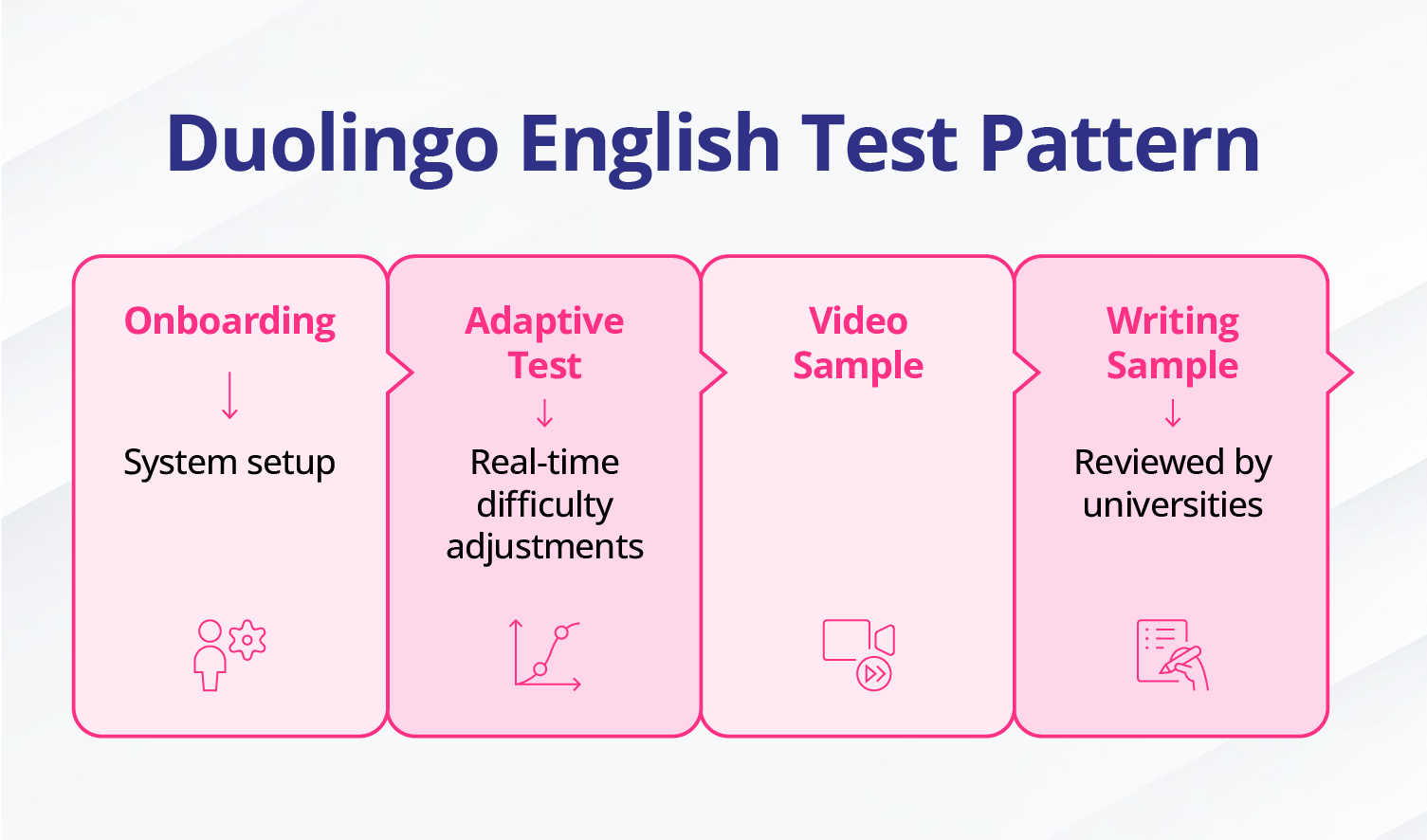
The Duolingo English Test is divided into three parts. While the test looks short, every minute has been designed to evaluate your English holistically.
Structure Overview
- Onboarding (5 minutes)
- Adaptive Test (45 minutes)
- Writing & Speaking Sample (10 minutes)
The adaptive test is the only part that contributes to your score, but the writing and speaking videos are shared with universities, which makes them incredibly important for admissions officers. A strong performance here creates a positive impression, especially for competitive courses.
How the Adaptive Pattern Works
The adaptive section is the brain of the Duolingo English Test. It adjusts to your proficiency in real time. If you answer accurately, difficulty increases; if you miss a few answers, the system recalibrates and presents moderately easier questions.
This dynamic behaviour helps the test analyse four skill categories:
- Literacy
- Comprehension
- Conversation
- Production
Your score is not an average. Instead, Duolingo’s algorithm uses statistical modelling to connect your performance across these four categories and determine your final score on a scale of 10–160.
Question Types Included in the Duolingo Test Pattern
The question types appear in random order, and no two tests are identical. However, the core structure remains constant.
Read and Select
You see words on the screen and select only the real English words. This tests your vocabulary awareness and precision.
Listen and Select
You hear audio clips and choose real English words. This evaluates phonetic comprehension and listening accuracy.
Read and Complete
A passage appears with certain words missing letters. This checks spelling awareness and contextual understanding.
Read Aloud
You read a sentence into your microphone. This judges clarity, pronunciation, and fluency.
Speak About a Topic
You respond to a prompt by speaking for 30–90 seconds. The test checks how naturally, coherently, and confidently you express ideas.
Write About a Topic
A short prompt appears, and you must write 50–100 words. This evaluates grammar, sentence formation, coherence, and lexical range.
Listen and Summarise
You listen to an audio clip and summarise it in writing. This tests comprehension, structure, and integration of listening + writing skills.
Dictation
You hear a sentence and type it exactly. This checks listening accuracy + writing precision.
Duolingo English Test Pattern Table
| Section | Time | Skills Tested | What Happens |
|---|---|---|---|
| Onboarding | 5 mins | – | ID check, webcam test, mic test |
| Adaptive Test | 45 mins | Literacy, Comprehension, Conversation, Production | Mixed question types, difficulty adapts |
| Writing & Speaking Samples | 10 mins | Production | Long-form answers shared with universities |
Scoring Pattern Explained
The Duolingo Scoring Model is one of the most analytical among English proficiency tests. Instead of assigning marks to individual questions, it interprets your performance across skills.
Scores are given across four categories:
- Literacy (Reading + Writing)
- Conversation (Speaking + Listening)
- Comprehension (Reading + Listening)
- Production (Writing + Speaking)
Each range from 10-160.
A strong overall score requires consistency, not perfection. Duolingo rewards:
- Clear, structured speaking
- Accurate writing with minimal errors
- Solid comprehension
- Ability to respond under time pressure
Why the Pattern Matters for High Scores
Most students lose marks not because they lack language skills, but because they don’t understand how the pattern works. The adaptive nature of Duolingo means that the first 10 minutes of your test heavily influence the difficulty of the rest. If you answer with consistency early on, you climb into the higher scoring tier.
Knowing the pattern helps you pace yourself better, identify your strengths, and respond more strategically.
For example:
If you know speaking contributes to two skill categories, you will naturally prioritise clarity and completeness over long pauses or fillers.
Understanding the question flow also helps reduce panic, especially when the test suddenly becomes difficult (which means you’re doing well).
Key Strategies Aligned with the Pattern
- Stay consistent early on
- Use structured speech
- idea
- expansion
- example
- closing line
- Avoid memorised templates
- Write clean sentences
- Listen actively
- nouns
- verbs
- transitions
Duolingo’s algorithm quickly picks up patterns. Accurate early responses raise your scoring ceiling.
When you speak, follow a simple flow:
The system detects repetitive patterns and unnatural phrasing.
Short, grammatically correct sentences score better than long, complicated ones filled with errors.
During listening tasks, focus on keywords including:
These help you summarise accurately.
Why Understanding the Pattern Helps with Admissions
Beyond the score, your speaking and writing samples make a difference when admissions officers evaluate your application. They listen for clarity, coherence, and confidence. A strong sample strengthens the final decision and shows that you can communicate effectively in an academic setting.
Knowing the pattern reduces stress, improves performance, and ultimately increases your chances of receiving offers from top universities.
Let’s Simplify Your TestPrep
Understanding the Duolingo English Test Pattern is not just helpful, it is essential. When you know what the test expects, how it adapts, which tasks influence which skill, and how universities perceive the writing and speaking samples, your preparation becomes sharper, faster, and more effective. With the right approach, the DET becomes one of the most efficient ways to demonstrate English proficiency for global education.
At MetaApply IE, our expert counsellors help you go beyond exam preparation. From choosing the right course and university to guiding you through financial aid, applications, visa preparation, and TestPrep support, we make sure every part of your study abroad journey is smooth and successful. If studying abroad is your next step or if you want clarity on what’s right for you, fill in the form today. Our team will guide you with personalised advice, trusted expertise, and complete end-to-end support to help you achieve your global goals.
Frequently Asked Questions
A 45-minute adaptive exam followed by a 10-minute unscored (but reviewed) writing and speaking sample.
Around 45–55 tasks depending on your accuracy.
It feels challenging only if you consistently score well. That’s how adaptive testing works.
Most universities ask for 110+. Competitive programmes may require 125+.
Yes, Duolingo updates the algorithm and question delivery regularly, but the main structure remains the same.
Related Blogs