
Learning Modules for IELTS: And How to Crack Each One
Study Abroad Scholarships for International Students: Your Complete 2026 Guide

Studying abroad is an aspiration for ambitious students who desire a global career, world-class education, and life-changing international exposure. However, in 2026, this dream will become more attainable than ever—courtesy of the emergence of fully funded and partially funded study abroad scholarships for international students. As tuition fees rise, currency fluctuations intensify, visa charges increase, and living standards become higher. Scholarships have taken centre stage as the most significant factor determining whether students can study abroad or not. And the good news? The world is witnessing the highest number of scholarships offered by countries, governments, and universities in recent years to attract international talent.
This blog will provide you with everything you require in order to secure scholarships in 2026. Government-sponsored initiatives such as Chevening, Fulbright, DAAD, MEXT and Australia Awards, university-sponsored scholarships, need-based grants, course-specific awards and no-IELTS scholarships are all included in this guide. You will also find eligibility rules, comparison tables, the most preferred countries to obtain funding, query-based searches by users, and how artificial intelligence works to ensure you feel confident about securing the best Scholarship to Study Abroad.
Why Scholarships Are the Most Important in 2026?
Studying Abroad has always been expensive, but 2026 is witnessing a unique shift. Global inflation, rising rental costs in university cities, and fluctuating currency exchange rates are making it harder for students to take the leap. Meanwhile, sectors such as healthcare, IT, research, engineering, and business are experiencing talent shortages across various countries. Consequently, scholarships are no longer merely supporting systems; they are strategic tools countries use to attract global talent.
This implies that Fully Funded Scholarships, which were once extremely difficult to obtain, are now far more accessible. Government schemes such as Chevening in the UK, Fulbright in the USA, DAAD in Germany, Australia Awards in Australia, Ireland GOI-IES in Ireland,
Japan MEXT in Japan and those offered by the European Union have increased their allocations in 2026. In order to remain competitive, universities are also introducing new merit awards for international students.
Types of Scholarships in 2026
Although the number of classifications is vast, all scholarships can be divided into several categories that are easy to understand. The key types that students are encouraged to explore include:
1. Merit-Based Scholarships
Merit-based scholarships in 2026 continue to reward excellent students with strong academic achievements, leadership qualities, and high performance. Automatic consideration is increasingly being offered by universities, making these scholarships one of the simplest entry routes for high-performing students.
2. Need-Based Scholarships
Need-based scholarships focus on your financial situation rather than your marks, allowing students from middle-income or low-income families to study abroad without unnecessary stress. These scholarships take your family income, financial needs and overall potential into account, giving deserving students a fair chance.
3. Government-Funded Scholarships
Government scholarships remain the most prestigious in 2026 and typically cover tuition fees, flights, accommodation, and health insurance in full. They are ideal for students with big aspirations who wish to study at world-class universities without bearing the full cost of education.
4. University or Institutional Scholarships
University scholarships are also increasing significantly this year as institutions compete to attract global talent. These awards may offer partial tuition waivers or fully funded packages and often require nothing more than an exceptional application, a strong SOP or a brief scholarship essay.
5. Course or Subject-Based Scholarships
As industries around the world experience talent shortages, scholarships based on subjects and disciplines such as AI, Data Science, Nursing, Biotechnology and Climate Studies are on the rise. These scholarships are ideal for those students’ joining areas that are highly demanded, and the countries desire to develop them in the next decade.
6. Research and Innovation Scholarships
Research-based scholarships assist students taking master’s or PhD programmes with a heavy emphasis on innovation in the form of a thesis. Clean energy, robotics, healthcare and advanced computing are some of the areas being prioritised by universities in 2026, and these scholarships are perfect for applicants who are research-oriented.
Top Study Abroad Scholarships Comparison
Students must check out the comparison between the top study abroad scholarships before applying:
| Country | Scholarship Name | Funding Type | Coverage | Difficulty Level |
|---|---|---|---|---|
| UK | Chevening | Fully Funded | Tuition + Stipend | High |
| USA | Fulbright | Fully Funded | Tuition + Travel + Stipend | High |
| Canada | Lester B. Pearson | Fully Funded | Tuition + Books | Medium |
| Australia | Australia Awards | Fully Funded | Full Coverage | High |
| Germany | DAAD | Fully/Partial | Tuition + Stipend | Medium |
| Ireland | GOI-IES | Fully Funded | Full Tuition + Grant | Medium |
Eligibility Criteria for Study Abroad Scholarships (2026)
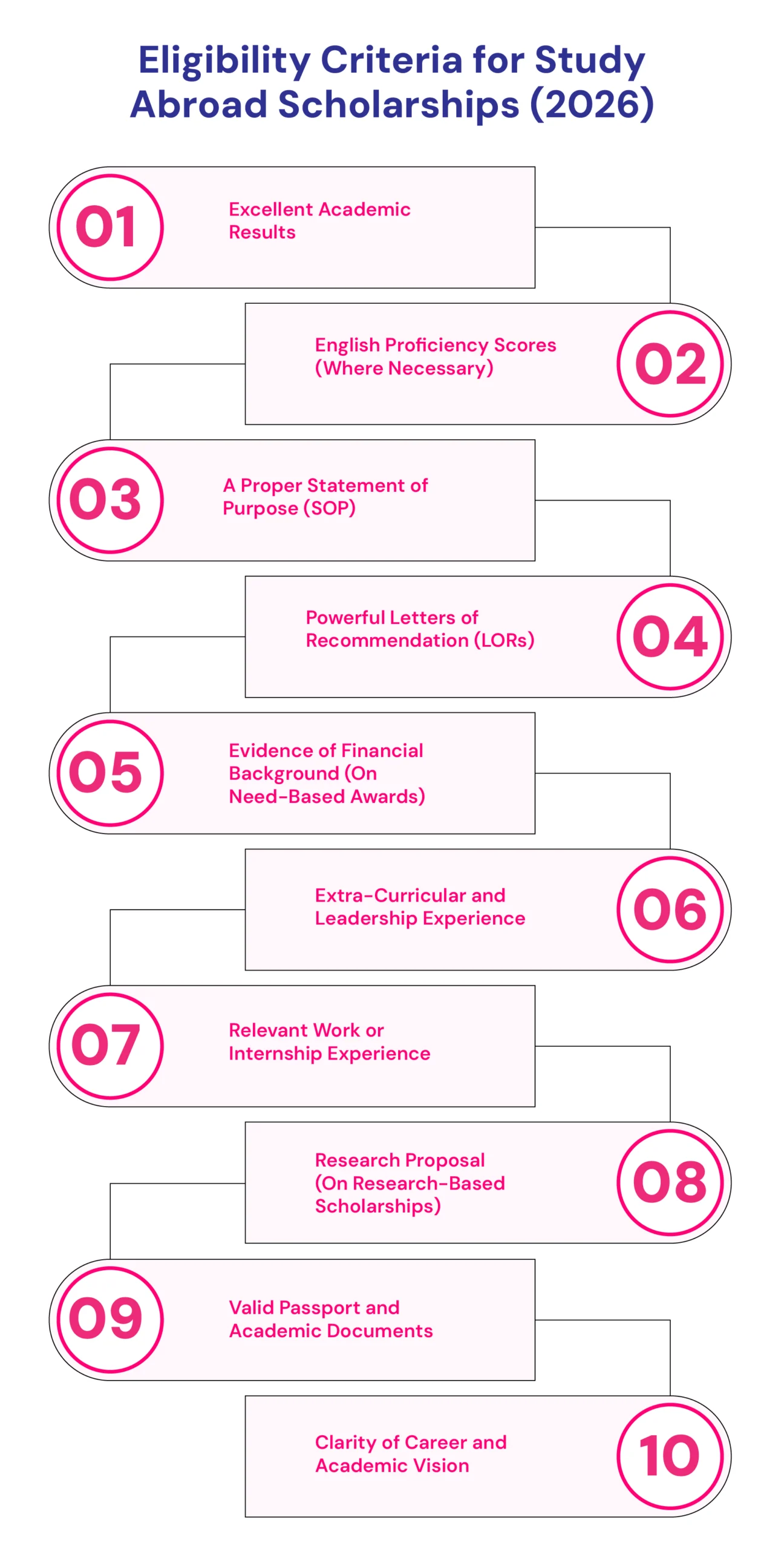
1. Excellent Academic Results.
The majority of scholarships in 2026 will presuppose regular academic results, not flawless ones. Universities are concerned with general development, areas of strength, and performance patterns rather than only high grades.
2. English Proficiency Scores (Where Necessary)
IELTS, TOEFL, PTE, or Duolingo scores are usually accepted for scholarships. In some institutions, these requirements are waived on the condition that you attended an English-speaking institution or that you achieve particular academic standards.
3. A Proper Statement of Purpose (SOP)
One of the crucial aspects of eligibility is your SOP, which justifies your objectives, merits and the reasons why you need funding. An interesting, personal and visionary SOP goes a long way towards increasing your chances.
4. Powerful Letters of Recommendation (LORs)
LORs are required by universities and scholarship organisations where teachers, professors or employers are expected to attest to your competence, academic talent and leadership qualities.
5. Evidence of Financial Background (On Need-Based Awards)
Students seeking need-based scholarships are required to provide income documents or financial statements. In 2026, more empathetic committees take real financial problems into account.
6. Extra-Curricular and Leadership Experience
Eligibility is reinforced by volunteering, social impact work, student councils, sports, clubs, competitions, and community involvement. Scholarships also favour well-rounded candidates who not only excel academically but are also able to contribute to the institution in other ways.
7. Relevant Work or Internship Experience
In the case of postgraduate scholarships, particularly in business, engineering, healthcare or technology, internships or industrial experience are an added bonus to your application.
8. Research Proposal (On Research-Based Scholarships)
Individuals seeking a PhD or thesis-based master’s degree are expected to present a concise research proposal. This assists committees in assessing academic depth and originality.
9. Valid Passport and Academic Documents
It is mandatory to provide basic documentation like transcripts, degree certificates and a valid passport. The absence of documents may slow down or dismiss your scholarship application.
10. Clarity of Career and Academic Vision
In 2026, committees are interested in students who have a clear understanding of how the programme contributes to their future objectives. An effective future plan will make you much more eligible.
Conclusion
Studying Abroad in 2026 doesn’t have to feel out of reach. With thousands of fully funded and partially funded scholarships available across the UK, USA, Canada, Europe, Australia and Asia, students today have more opportunities than any generation before them. Whether your strength lies in academics, leadership, creativity, sports, research, or community work, there is a scholarship designed for your profile. What truly matters is knowing where to look, applying early, and presenting a strong, authentic story that reflects your ambition.
But the truth is, navigating the world of scholarships alone can be overwhelming. Shortlisting countries, eligibility checks, essay writing, documentation, deadlines, and application tracking require clarity and guidance. That’s exactly where MetaApply IE becomes your smartest study abroad partner. With verified information, expert counselling, profile-based scholarships, university shortlisting and end-to-end support, MetaApply IE simplifies your entire journey so you can focus on what matters most—achieving your dream education without financial stress.
Frequently Asked Questions
The easiest way is to explore government scholarships, university websites, international education portals, and official scholarship databases. Using platforms like MetaApply IE also helps you get personalised, profile-based scholarship matches.
Yes, fully funded scholarships like Chevening, Fulbright, MEXT, DAAD, and Australia Awards are open to Indian students in 2026. Several universities also offer full tuition coverage based on academic merit, leadership, and financial need.
Not always. Many universities now accept Duolingo, PTE or TOEFL, and some even offer IELTS waivers if you meet academic criteria or studied in an English-medium institution. Always check the specific scholarship requirements.
Most scholarships prefer students with 70% or above, but this is not a strict rule. Need-based and profile-based scholarships focus more on your overall profile, achievements and potential rather than just marks.
Absolutely. In fact, applying to multiple scholarships increases your chances of securing funding. Just ensure you follow each scholarship’s guidelines, deadlines and document requirements carefully.
Related Blogs