
Discover the Leading Universities in Switzerland
What exactly the ACT Syllabus Expects from You?

At first glance, the ACT exam syllabus looks comfortingly familiar. English, Maths, Reading and Science are subjects you’ve studied for years. But the ACT is not interested in how well you remember concepts from school. What it is really testing is how quickly you can recognise patterns, process information, and make accurate decisions under intense time pressure. The syllabus is deliberately structured to simulate the academic demands of university life, where deadlines are tight and clarity of thought matters more than long explanations.
Students who understand this early stop treating the American College Testing (ACT) like just another entrance exam. They begin to see it as a performance test, where efficiency, strategy and mental stamina decide outcomes. This shift in mindset alone often becomes the turning point between an average score and a competitive one.
Why Does Understanding the ACT Syllabus Eases Your Mental Peace?
The ACT syllabus is not designed for rote learning. In fact, memorisation plays a surprisingly small role in success. What matters far more is understanding how the exam uses the syllabus to test your thinking. Each section is crafted to reward students who can prioritise, eliminate wrong choices quickly, and move on without emotional attachment to difficult questions.
When students rely only on content revision, they often feel prepared but underperform on test day. Those who understand the syllabus behaviour, however, approach the exam with clarity. They know where time should be invested, where it should be saved, and how to avoid common traps. This clarity transforms preparation from exhausting practice into focused training.
What Does the ACT English Syllabus Actually Measure?
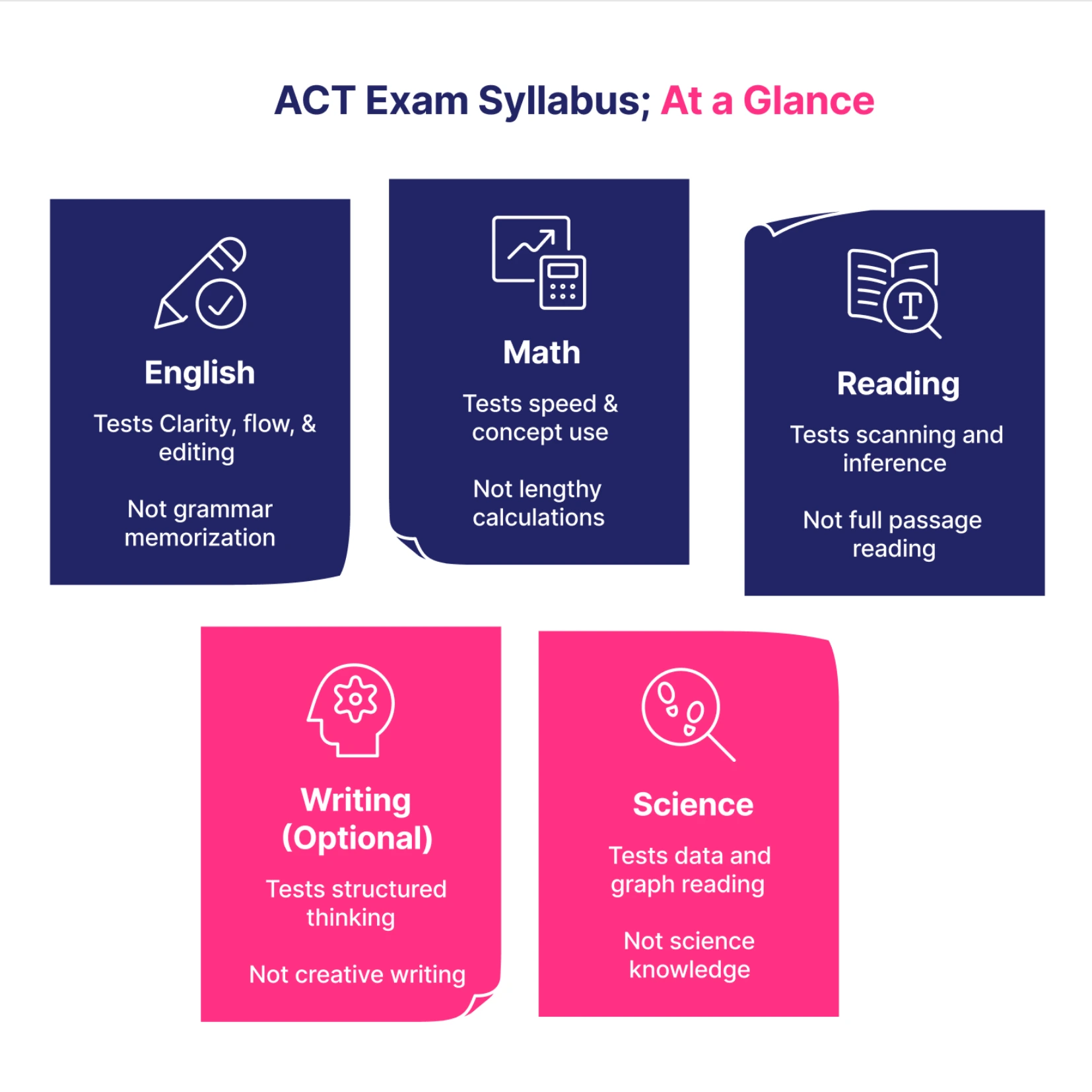
The ACT English Syllabus is often mistaken for a grammar test. In reality, it is a test of language efficiency and editorial judgement. The exam wants to see whether you can improve a piece of writing the way an editor would, by making it clearer, tighter and more logical.
You are not rewarded for knowing obscure grammar rules. You are rewarded for choosing the option that sounds most natural, communicates the idea most effectively, and fits the author’s intent. This is why students who read actively and think critically tend to perform better than those who rely on grammar books alone. The syllabus subtly pushes you to think like a communicator, not a student.
Why Do Students Lose Easy Marks in ACT English?
Most students lose marks in ACT English not because they do not know the rules, but because they overthink. The syllabus is designed to test instinctive clarity, not lengthy analysis. When students slow down to analyse every option, they waste time and invite doubt.
High scorers learn to trust pattern recognition. They understand how the ACT repeats certain sentence structures, transition errors and clarity issues. With the right preparation, these patterns become instantly recognisable, allowing students to move through the section with confidence and speed.
How Is ACT Mathematics Actually Different from School Maths?
ACT Mathematics feels familiar, but it behaves very differently from classroom maths. The syllabus includes concepts you have studied before, yet the exam expects you to apply them rapidly and selectively. Not every question is meant to be solved. The ACT deliberately includes time-consuming problems to test your judgement.
Students who succeed in this section understand that smart skipping is not a weakness; it is a strategy. The syllabus rewards those who can identify high-value questions, solve them quickly, and avoid getting stuck. This approach turns the section from overwhelming to manageable.
Why Is Strategy More Important Than Accuracy in ACT Maths?
Accuracy matters, but strategy determines how many questions you even get a chance to answer. The ACT Maths syllabus is structured so that questions increase in difficulty as the section progresses, but not all hard questions are worth the same amount of time.
Students who prepare strategically learn when approximation is enough and when precision is required. They also learn to let go of questions that drain time without proportionate reward. This strategic discipline often leads to significant score improvements, even without learning new concepts.
Why Is ACT Reading Not Really About Reading Everything?
The ACT Reading syllabus often surprises students because it does not reward slow, detailed reading. Instead, it rewards targeted reading. You are expected to locate information quickly, understand context efficiently, and answer questions with minimal re-reading.
Students who try to read every passage like a novel struggle with time. Those who learn how to scan with purpose, identify question types, and return to specific lines perform far better. The syllabus is designed to test information retrieval, not literary appreciation.
What Does ACT Science Actually Expect from You?
Despite its name, the ACT Science syllabus is not a test of scientific knowledge. It is a test of reasoning. You are presented with unfamiliar experiments, charts and data, and asked to draw conclusions based solely on the information provided.
This section often becomes a confidence breaker for students who expect formula-based questions. However, once students realise that prior science knowledge is largely irrelevant, the section becomes far less intimidating. The syllabus rewards calm analysis, not subject mastery.
Why Do Non-Science Students Often Do Well in ACT Science?
Interestingly, students from non-science backgrounds often perform well in ACT Science because they approach the section logically rather than emotionally. They focus on understanding relationships, trends and comparisons instead of worrying about unfamiliar terminology.
The syllabus is designed so that every answer can be found within the data itself. With the right guidance, students learn how to ignore distractions and focus only on what the question demands. This makes ACT Science one of the most trainable sections of the exam.
Is the ACT Writing Syllabus Worth Your Attention?
For students applying to competitive universities, the ACT Writing section can add meaningful value. The syllabus evaluates how well you can analyse multiple perspectives, organise your thoughts, and express them clearly under time pressure.
The ACT is not looking for impressive vocabulary or complex ideas. It is looking for structured thinking. Students who learn the right framework often outperform expectations, even if writing has never been their strongest skill.
How Does the ACT Syllabus Reflect University-Level Thinking?
One of the reasons universities value ACT scores is because the syllabus mirrors real academic demands. Timed reading, data interpretation, logical reasoning and structured writing are skills students will use repeatedly in university.
When you prepare for the ACT properly, you are not just preparing for an exam. You are building habits that will support your academic success abroad. This is why a strong ACT score is often seen as a reliable indicator of student readiness.
Why Do So Many Students Plateau Despite Practising Regularly?
Many students practise consistently yet see no improvement because their preparation lacks direction. The ACT syllabus requires feedback-driven refinement, not endless repetition. Without understanding where time is lost or why errors repeat, progress stalls.
Structured preparation introduces accountability. It helps students identify personal weaknesses, adjust strategies, and practise with intention. This targeted approach is what converts effort into results.
When Is the Right Time to Start ACT Preparation?
The best time to start preparing for the ACT syllabus is when you want control, not panic. Starting early allows students to experiment with strategies, build endurance, and refine performance gradually. Starting late forces rushed decisions and unnecessary stress.
The ACT rewards preparation that is calm, strategic and consistent. With the right mentoring, even a few focused months can make a significant difference.
Are You Truly Preparing for the ACT Syllabus or Just Staying Busy?
This is a question every ACT aspirant should ask themselves honestly. There is a big difference between staying busy and improving. True preparation aligns every practice session with how the ACT syllabus behaves on test day.
If your goal is not just to attempt the ACT but to use it as a gateway to top universities and scholarships, then your preparation needs to be equally intentional.
Ready to Turn the ACT Syllabus into a Real Advantage?
If you want a preparation plan that is personalised, syllabus-mapped and results-driven, this is where the right guidance matters. Our TestPrep experts work closely with students to convert potential into performance.
Fill in the form, speak with our counsellors, and take the first step towards an ACT score that truly strengthens your application.
Not only this, at MetaApply IE, our expert counsellors take care of all your study abroad needs. From helping you choose the right course, college and destination to managing applications, financial aid and visa interview preparation, we support you at every step. With dedicated TestPrep and Career Counselling, we make your study abroad journey clear, confident and completely hassle-free.
Frequently Asked Questions
The ACT exam syllabus includes four compulsory sections: English, Mathematics, Reading and Science, with an optional Writing test. Each section focuses more on analytical skills, speed and accuracy rather than rote learning, making strategic preparation essential for high scores.
The ACT syllabus is not necessarily easier than the SAT, but it is more time-pressured. Students who are comfortable with fast-paced exams, data interpretation and direct questions often find the ACT syllabus more suitable than the SAT format.
The core ACT syllabus remains largely consistent each year. However, question patterns, difficulty distribution and time management expectations evolve slightly, which is why updated preparation strategies are important for current test cycles.
On average, students need three to six months of focused preparation to master the ACT syllabus. The duration depends on the student’s starting level, target score, and whether preparation is self-guided or supported by expert mentoring.
ACT coaching helps students understand how the syllabus is tested in real exam conditions. With personalised strategies, timed practice and expert feedback, coaching significantly improves efficiency, confidence and overall ACT scores.
Related Blogs