
Canada Study Visa Processing Time in 2026- All You Need to Know

Komal Kumari
Published on June 16, 2026

It is that time of the year when your dream of studying abroad becomes a little more realistic. All the processes that you had follow till now, shortlisting the right course and university, applying within the deadline, clearing the English language test, and even securing funds, now comes one last major step of your study abroad journey before you pack your bags, say your final goodbyes, and leave the country. Yes, it is time to start your student visa process.
As you are going to Study in Canada, it is crucial for you to know the Canada study visa processing time, procedure, requirements, and other crucial information. And so, today, in this blog, we are going to cover all the crucial information that you need for your Canada Study Visa. So, without further ado, let’s get to the point.
What Exactly is a Canada Study Visa?
Before you calculate timelines, you need to understand what you are applying for. When you plan to study in Canada, you are actually applying for a study permit, issued by Immigration, Refugees and Citizenship Canada (IRCC).
Your study permit allows you to Stay in Canada legally as a student. Depending on your nationality, you may also receive a visitor visa (TRV) or an eTA alongside it, which permits you to enter Canada.
Your processing time starts only when you submit a complete application. Missing documents can reset timelines and cause delays, something you absolutely want to avoid.
Canada Study Vida Processing Time in 2026
Now let’s address your biggest concern:
How long does a Canada study visa take in 2026?
Processing times vary depending on your country of residence, application volume, and the time of year you apply. On average, you can expect:
- From India: 8-12 weeks
- From UK: 4-6 weeks
- From the Middle East and other regions: 6-14 weeks
- From inside Canada: 4-10 weeks
If you apply between May and August for the September Intake, processing may take longer due to high application volumes. That is exactly why applying early gives you a practical advantage.
SDS vs Non-SDS: Which is Faster in 2026?
You may have heard about the Student Direct Stream (SDS) and wondered whether it still exists and whether itis faster.
Previously, SDS was a fast-track visa route introduced by Immigration, Refugees, and Citizenship Canada for students from specific countries, including India. If you met strict criteria—such as paying your full firs-year tuition, purchasing a Guaranteed Investment Certificate (GIC), achieving higher IELTS Scores, and completing upfront medicals—your application could be processed in as little as 20 calendar days.
However, SDS was discontinued in late 2024.
This means that in 2026, all applications are processed under the regular study permit (Non-SDS) stream.
So, which is faster now?
Since SDS no longer exists, there is no separate “fast-track” category. Your processing speed now depends entirely on:
- How early you apply
- How complete and well-organised your documentation is
- Whether additional background checks are required
- Seasonal application volumes
In simple terms, what makes your visa faster in 2026 is not the category, it is your preparation.
Step-by-Step Canada Study Visa Procedure
To help you stay organised, here is how your visa journey typically unfolds:
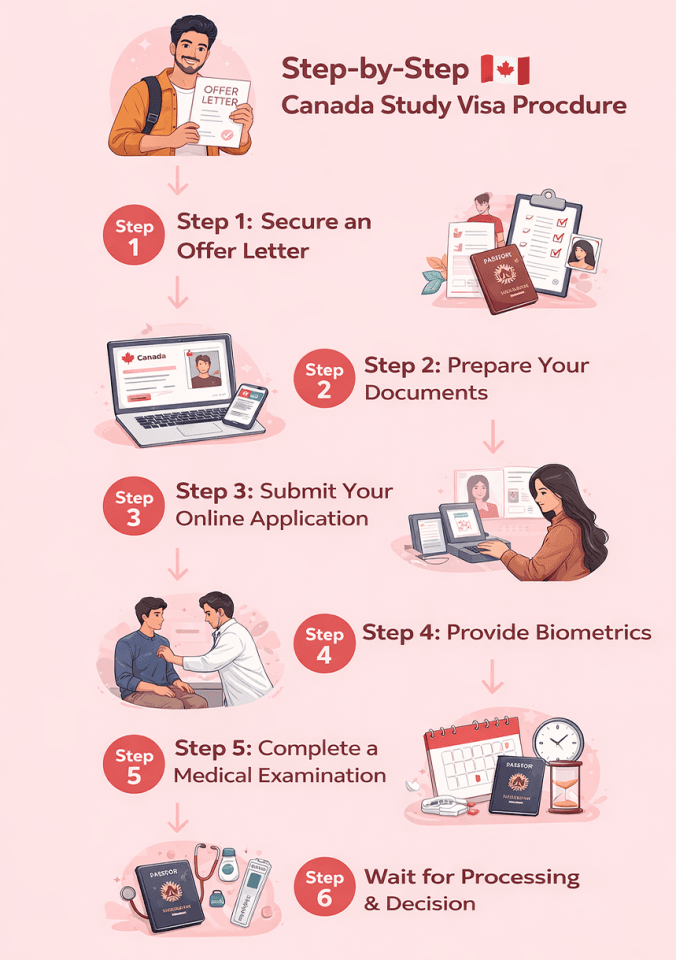
Step 1: Secure an Offer Letter
You must receive an offer from a Designated Learning Institution (DLI) in Canada.
Step 2: Prepare Your Documents
You will need:
- Valid passport
- Offer letter
- Proof of funds
- Statement of Purpose
- English language Test scores
- Academic transcripts
- Passport-size photographs
Step 3: Submit Your Online Application
You apply via the official IRCC portal and pay the application fee.
Step 4: Provide Biometrics
You will be asked to give fingerprints and a photograph at a Visa Application centre.
Step 5: Complete a Medical Examination (If Required)
Certain applicants must undergo a medical test by an approved panel physician.
Step 6: Wait for Processing & Decision
IRCC reviews your documents, finances, academic intent, and background information.
Once approved, you receive a Port of Entry Letter of Introduction, and your visa is issued accordingly.
What Affects Your Processing Time?
You should understand that delays usually happen for specific reasons, such as:
- Incomplete or inconsistent financial documentation
- Unclear source of funds
- Delayed biometrics appointments
- Peak intake season backlog
- Additional security checks
A well-prepared and accurate file significantly improves your chances of smoother processing.
Proof of Funds Requirements in 2026
To be approved, you must demonstrate that you can cover:
- Your first year’s tuition fees
- Living expenses as per Canadian guidelines
- Travel costs
Your funds should be clearly documented, traceable, and sufficient. Weak financial proof is one of the most common reasons for refusal.
When Should You Apply?
Ideally, you should apply at least three to four months before your course begins.
For example:
- September intake: Apply by May or early June
- January intake: Apply by September or October
If you delay your application, you risk unnecessary stress, possible deferral, and last-minute travel complications.
Common Mistakes You Must Avoid
As you prepare your Canada Study Visa Application; avoid:
- Submitting partial bank statements
- Writing a generic Statement of Purpose
- Ignoring official documentation guidelines
- Assuming processing will always be quick
- Waiting until peak season to apply
Your visa application must clearly demonstrate that you are a genuine student with strong academic intent and financial stability.
Apply Your Canada Study Visa with MetaApply IE
You have already invested time, effort, and emotion into your Study Abroad journey—now it is time to make sure nothing holds you back at the final stage. Your Canada study visa is not just another form to fill; it is the approval that turns your University offer into a real departure date.
This is here MetaApply IE steps in. From reviewing your documents and strengthening your Statement of Purpose to ensuring your financial proof meets IRCC standards, you receive and end-to-end support tailored to your profile. No guesswork. No last-minute panic. Just clear guidance and strategic planning.
Beyond visas, our experts support you with university applications, scholarships, education loans, accommodation guidance and pre-departure assistance.
If you are serious about Studying in Canada in 2026, this is your moment. Apply smartly, apply confident, and let our experts help you secure your future abroad.
Interested in Study Abroad?
MetaApply can help - fill the form
Enquire Now
Frequently Asked Questions
In 2026, Canada study visa processing time generally ranges from 4 to 14 weeks, depending on your country of application and the intake season. Applications from India typically take 8-12 weeks, while UK applications may take around 4-6 weeks.
The success rate varies by country, institution choice, and application quality. Strong academic profiles, clear financial documentation, and a well-written Statement of Purpose significantly improve approval chances. While no fixed percentage is guaranteed, well-prepared applications have high approval potential.
A Canadian student visa (study permit) is usually valid for the length of your programme plus an additional 90 days. This extra time allows you to prepare to leave Canada to apply for a post-graduation work permit.
Yes, you can stay in Canada after studying by applying for a Post-Graduation Work Permit (PGWP), provided your institution and programme are eligible. The PGWP allows you to gain Canadian work experience, which may support permanent residency applications later.
Courses aligned with Canada’s labour market needs improve settlement prospects. Popular options include healthcare, information technology, engineering, business analytcs, and skilled trades. Choosing a programme linked to in-demand occupations can strengthen your long-term career and immigration opportunities.