
Breakdown Between Ivy League and Public Universities- Which is Better?

Komal Kumari
Published on March 25, 2026
When you picture your future, you likely see yourself learning beyond borders, building a career that carries global value and experiencing education at its highest standard. Choosing to study abroad is not just about earning a degree. It is about stepping into classrooms where ideas shape industries, cultures connect seamlessly, and ambition is encouraged daily. As you explore the possibility to study at top ranked universities abroad, you begin to weigh more than rankings or reputation. You think about opportunity, exposure and the doors that your university choice can unlock long after graduation.
From world renowned public universities driving innovation at scale to elite institutions like the Ivy League and TU9 known for academic leadership, each path represents a powerful gateway to success. What matters is understanding which environment aligns best with your goals, your strengths, and the future you envision for yourself on a global stge. Today, in this blog, we are going to have a complete breakdown between the Top Ranked Public Universities and Ivy League Universities to see what are the admission requirements and the future opportunities after graduation. So, let’s have a clear comparison between the world’s best universities divided into two categories.
Understanding Top Ranked Public Universities Abroad
Top ranked public universities abroad are globally respected institutions funded largely by governments and known for accessible excellence. You may find many of them across countries like the USA, Germany, Canada, Australia, and parts of Europe. Here’s a list of top ranked public universities to study abroad.
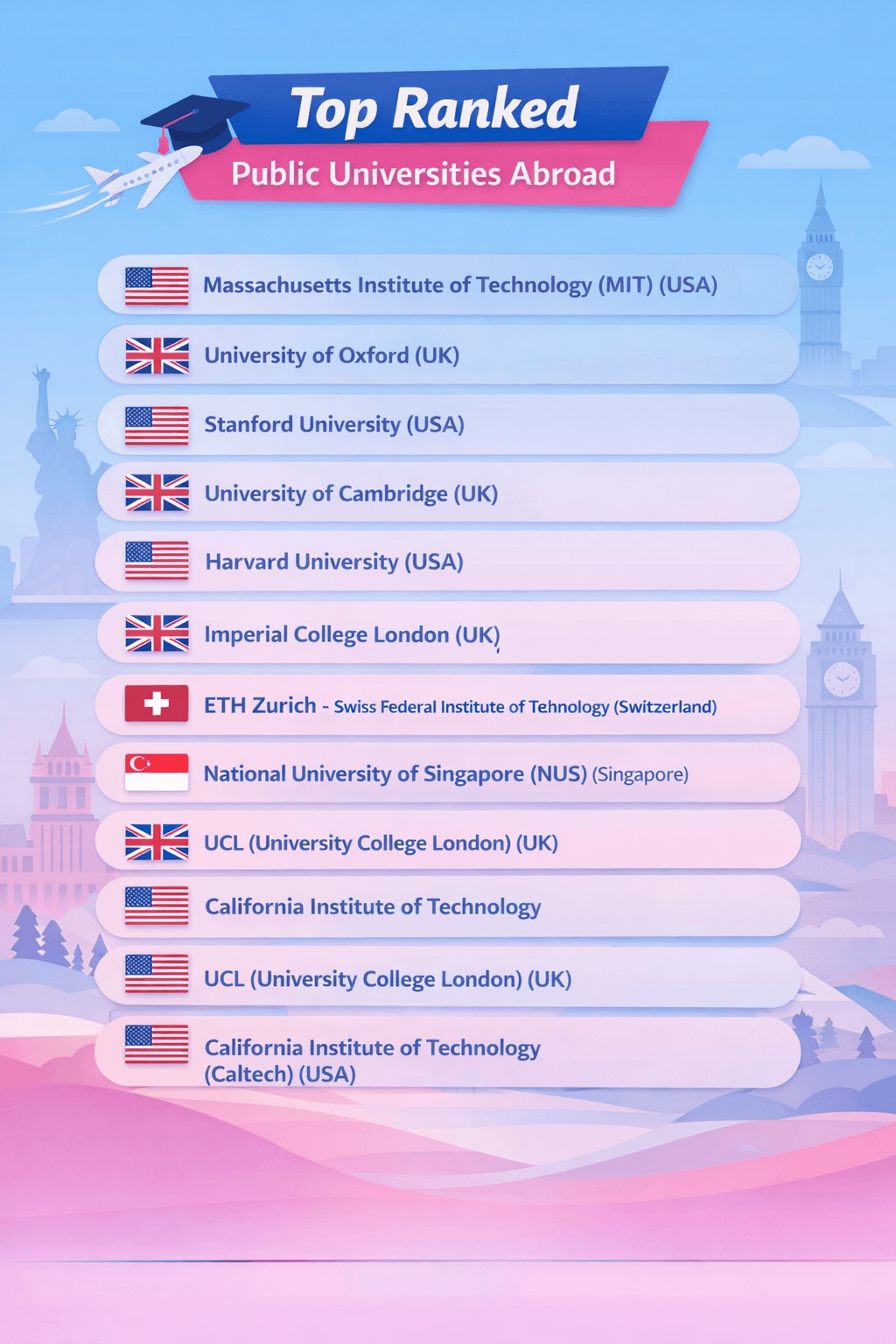
These universities consistently rank among the best for research, innovation, and graduate employability.
Requirements to Study at Top Ranked Public Universities Abroad
When you aim to study at top ranked universities abroad in the public sector, you are typically expected to meet academic and language benchmarks rather than institutional legacies. Common requirements include:
1. Academic Records
You are required to submit official transcripts from secondary education (Class 10th and 12th) or a bachelor’s degree for postgraduate programme. Top Ranked Public Universities Abroad generally look for an academic average between 80 to 95 percent or a strong GPA, depending on the country and institution.2. Language Proficiency Tests
If English is not your first language, you must demonstrate proficiency through recognised tests such as IELTS, usually with a score of 7.5 or above, TOEFL or PTE, as required by the university and programme.3. Standardised Tests
For undergraduate- SAT or ACT scores are often required, particularly when you apply to public universities in the United States. For postgraduate- GRE or GMAT scores may be requested, especially for programmes in science, technology, engineering, management, and business.4. Application Documents
You need a well-structured Statement of Purpose or motivational letter, an updated CV or resume for postgraduate courses and academic references or Letters of Recommendation that highlight your strengths and potential.5. Extracurriculars
You are encouraged to showcase leadership roles, sports achievements, volunteering, or social initiatives that reflects your all-round development and initiative.6.Visa and Financials
You must provide proof of funds covering tuition fees and living expenses along with a valid passport and supporting visa documents.Future Benefits for You When you decide to Study Abroad in Top Ranked Public Universities, it allows you to:
- Access world class research facilities and large academic ecosystems
- Learn alongside a diverse international student community
- Benefit from strong industry collaborations and internships
- Build global employability with recognised public credentials
- Manage Education Costs more strategically in many countries
This path is ideal if you seek depth, diversity, and long-term value from your study abroad journey.
Exploring Ivy League Level Universities
When you aim for the highest level of academic excellence, Ivy League universities represent institutions known for intellectual rigour, global influence, and leadership driven learning environments. These universities attract top talent worldwide and offer unparalleled exposure, research depth, and career shaping opportunities.
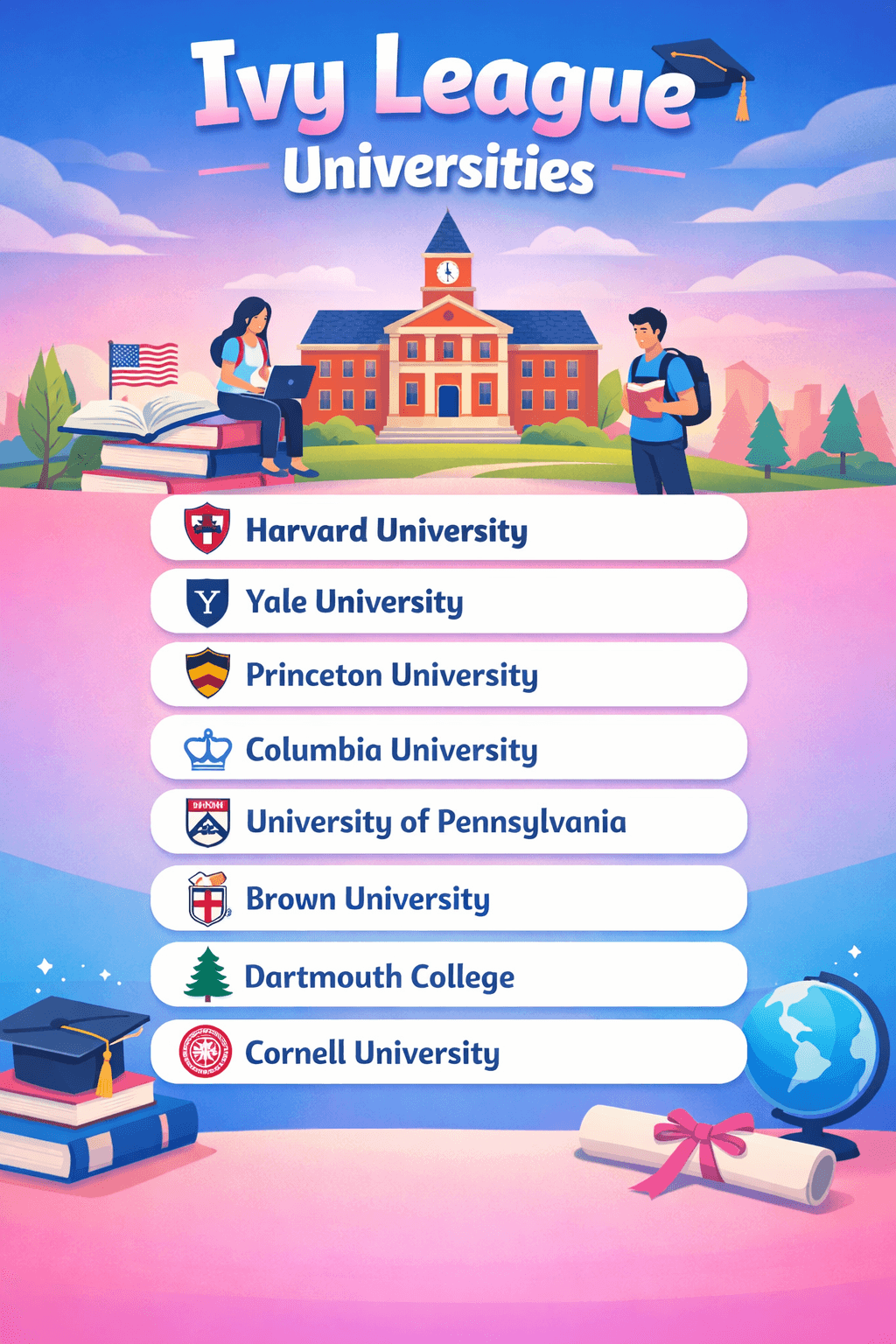
These institutions are recognised for academic rigour, influential alumni networks, and research leadership.
Requirements to Study at Ivy League Universities
When you target Ivy League Universities, admissions are holistic and highly competitive. Here’s an overview of Admission Requirements to Study at Ivy League Universities. You are generally evaluated on:
1. Academic Excellence
You are expected to demonstrate outstanding academic performance, often with a near perfect GPA. Successful applicants typically challenge themselves through advanced coursework such as Honours, AP or IB programmes, showing both consistency and intellectual curiosity.2. Standardised Tests
Although several Ivy League schools follow a test optional approach, strong SAT or ACT score can significantly strengthen your application and reflect academic preparedness at a global standard.3. Extracurricular Profile
You are encouraged to show depth rather than breadth. Universities value sustained commitment, leadership, and impact in a few meaningful activities such as community service, sports, research, or unique personal initiatives.4. Application Essays
Your Personal Statement and supplementary essays play a crucial role. They should reflect your passion, clarity of purpose, values and the way you think, rather than just listing achievements.5. Letters of Recommendation
Two to three well-chosen academic or professional references should highlight your academic ability, character, and potential to thrive in a demanding environment.6. English Proficiency for International Students
You are also required to submit proof of English proficiency, usually through TOEFL or IELTS, meeting university specific score requirements.7. Interviews
Alumni led interviews offer you the opportunity to communicate your motivation, personality, and long-term aspirations.8. Documentation
You must submit official transcripts, a resume or CV where applicable and financial Documentation Required for Visa Processing.Future Benefits for You Studying at an Ivy League university or equal institutions allow you to:
- Gain access to influential academic and professional networks
- Learn in smaller cohorts with personalised faculty attention
- Strengthen your profile for leadership roles and advanced research
- Benefits from global brand recognition across industries
- Engage in high impact innovation and policy shaping environments
This route suits you if you thrive in highly selective settings and aim for global leadership trajectories.
Public Universities VS Ivy League Universities- A Comparison
For your ease, here’s a comparison between top ranked public universities and Ivy League universities abroad.
| Aspect | Top Ranked Public Universities Abroad | Ivy League Universities |
|---|---|---|
| Global Recognition | Known for research excellence and academic scale | Known for prestige, heritage and leadership |
| Admissions Focus | Merit based and academically driven | Holistic and profile driven |
| Learning Environment | Diverse, large and research oriented | Selective, personalised and mentorship focused |
| International Exposure | Strong multicultural student communities | Elite global peer networks |
| Career Outcomes | Industry ready graduates with global mobility | High visibility roles and leadership pathways |
| Research Opportunities | Broad funded research across disciplines | Specialised, high impact research ecosystems |
| Value Proposition | Accessible excellence with global reach | Concentrated excellence with brand influence |
Choose the Right Global University with MetaApply IE
As you compare Ivy League institutions and top ranked public universities abroad, it becomes clear that the right choice is not about labels alone. It is about finding an academic environment that complements your ambitions, learning style, and long-term goals. Each pathway offers global exposure, academic excellence, and career defining opportunities when chosen with intent.
Your Study Abroad journey becomes significantly stronger when guided by expertise. With MetaApply Premium Counselling, you receive end-to-end support that covers everything from personalised university shortlisting and application strategy to admissions, Scholarships, and visa assistance. Every step is handled with precision, ensuring you stay focused on your future rather than the process.
For higher achieving students who aim for the best education abroad, it is the MetaApply IE experts understanding their aim and helping them accomplish that. So, if you are a scholar too, then MetaApply IE is here to help you. Connect with our counsellors today.
Interested in Study Abroad?
MetaApply can help - fill the form
Enquire Now
Frequently Asked Questions
Yes, you can get into the Ivy League as a CBSE student. Universities assess your academic rigour, grades, essays, extracurricular achievements, and recommendations. Strong performance, intellectual curiosity, and a compelling profile matter more than the board itself.
Yes, Harvard offers need based financial aid that can cover up to 100 percent of tuition and living costs. If you demonstrate financial need, your ability to study abroad is never limited by income or nationality.
Cornell is often considered comparatively accessible among Ivy League universities due to its larger intake. However, admissions remain highly competitive, and you still need strong academics, meaningful extracurricular involvement and well-written essays to stand out.
IITs and Ivy League universities serve different purposes. IITs excel in technical education and competitive entrance-based merit, while Ivy League institutions offer broader interdisciplinary exposure, global networks, and holistic development. The better choice depends on your goals.
A 3.7 GPA is no bad for the Ivy League, but it is on the lower end for admitted students. Strong essays, leadership, unique achievements, and academic rigour can meaningfully strengthen your application alongside your grades