
dMAT Exam 2026: Syllabus, Registration & Preparation Guide for Indian Students

Komal Kumari
Published on August 7, 2026

If your undergraduate degree is in engineering, business, commerce, economics, or finance and you're applying for a Master's in Germany from Summer Semester 2027 onward, this dMAT exam for Indian students guide is exactly what you need. The dMAT Exam Germany added to the APS India documentation process on 29 June 2026 is now a step affected applicants can't skip.
This dMAT exam 2026 guide focuses on the exam itself: what's actually on it, how it's scored, how to register, and how to prepare, since there's no textbook syllabus to fall back on. Registration for dMAT the first India sitting closes on 15 September 2026, so if you haven't checked your eligibility yet, that's the first thing to sort out.
Not sure the dMAT even applies to you? Talk to a MetaApply counsellor before you start prepping. The affected-fields list has some grey areas, especially for interdisciplinary degrees.
What Is the dMAT Exam?
The Digital Master Test 2026 cycle marks the first time this standardised, computer-based academic aptitude test has been offered in India. It's developed by g.a.s.t., the same organisation behind TestDaF and TestAS, in cooperation with the Universities of Ulm and Kassel, with backing from the DAAD. It isn't a university entrance exam and it doesn't replace APS document verification. It sits alongside your APS Application as an additional certificate that gives German Universities a standardised way to compare academic aptitude across very different education systems.
dMAT at a glance:
| Detail | Information |
|---|---|
| Full name | Digital Master Test / Digital Master Assessment Test |
| Conducted by | g.a.s.t. (Gesellschaft für Akademische Studienvorbereitung und Testentwicklung) |
| Mode | Computer-based, at approved test centres |
| Language | English |
| Duration | Around 3 hours (90 minutes Core Module + 90 minutes Subject Module) |
| Fee | €150 (approx. ₹16,500, varies with the daily exchange rate) |
| First India test date | 26 September 2026 |
| Registration deadline | 15 September 2026 |
| Result date | 12 October 2026 |
| Next cycle | Q1 2027 (exact date not yet announced on d-mat.de) |
| Validity | Does not expire. You take it once. |
Who Needs to Take the dMAT?
You need a dMAT certificate only if all of the following apply:
- You're applying for a Master's programme in Germany (not Bachelor's or PhD)
- Your undergraduate degree falls under Engineering, Business/Management, or Commerce/Accounting/Finance/Economics
- Your target intake is Summer Semester 2027 or later
- You don't fall under an exemption, including students who completed APS registration or shipped documents before 29 June 2026, and those on confirmed exchange or partnership programmes
Interdisciplinary degrees (data science, business analytics, engineering management, fintech) sit in a grey zone. APS India classifies these against the official degree title on your transcript, not the informal programme name. Check your specific classification before you register rather than assuming either way.
dMAT Exam Pattern & Syllabus 2026
Here's the part that trips most students up: the dMAT Exam Syllabus isn't a subject-wise list you can revise from a textbook. It's an aptitude test, so preparation means getting familiar with the task types and building speed and accuracy, not memorising chapters.
The exam has two parts.
Core Module (identical for every applicant)
Three subtests, each 25 minutes with 20 items, and no calculators, notes, or scratch paper allowed at any stage:
- Figure Sequences. A series of matrices where a shape changes position, colour, or orientation by a fixed rule. You work out what comes next.
- Mathematical Equations. Simple algebraic systems solved through mental substitution alone. For example, given 7 + A = 14 and B − 3 = A, you'd work out A = 7, then B = 10.
- Latin Squares. A logic grid, always 5×5 with the letters A to E, where you fill in a missing letter using elimination rather than trial and error.
Subject Module
For the APS India route, this is the General Academic Module, the same for every applicant regardless of their bachelor's field. You're given a short academic text or scenario (spanning maths, science, engineering, business, or social science) followed by application-based questions. It tests reasoning from the material you're given, not prior subject knowledge.
Every question across both modules is single-choice, and there's no negative marking. Official guidance is to answer every question, even as a guess, since a blank answer earns nothing. Scores are reported on a 0–200 scale with 100 as the average, shown separately for each module and then combined into a total. A high score doesn't guarantee admission, and a low score doesn't block your APS certificate either. Each university decides independently how much weight to give it.
How to Register for the dMAT Exam
Registration and applying for the dMAT are the same process, done entirely online through the official g.a.s.t. portal.
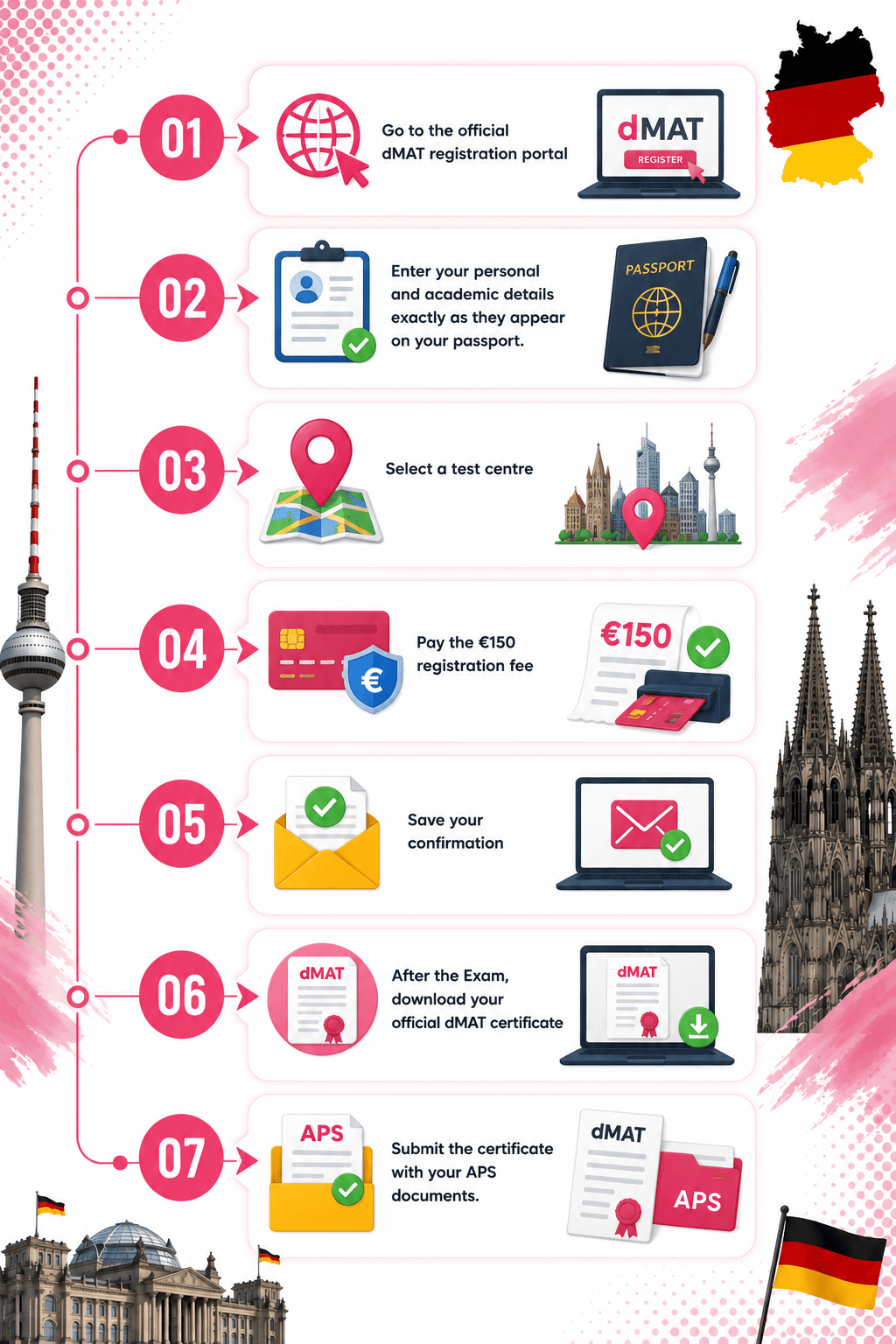
- Go to the official dMAT registration portal, linked from d-mat.de/en/dmat-in-india, and create an account using a valid email address.
- Enter your personal and academic details exactly as they appear on your passport. g.a.s.t. checks this against your ID at the test centre and won't admit a mismatch.
- Select a test centre from the available list. Seats are first-come, first-served, and centres in high-demand cities fill up quickly, so don't leave this close to the deadline.
- Pay the €150 registration fee online through the portal.
- Save your confirmation (screenshot or PDF) for your records. You'll get access to your test-taker portal immediately.
- After the exam, log back into your test-taker portal to download your official dMAT certificate, showing your Core Module score, Subject Module score, and combined total.
- Submit the certificate with your APS documents. APS India will reference your dMAT result on your final APS certificate.
dMAT Exam Preparation Guide 2026: How to Crack It
Good dMAT exam Germany preparation is mostly about format familiarity, timing discipline, and controlled practice conditions, not content revision, since there's no fixed syllabus to cram. A few things that actually move the needle:
- Use the official g.a.s.t. / d-mat.de preparatory materials first. They're the only sample questions confirmed to match the real format. The dMAT only launched in India with the 2026 cycle, so there are no genuine "previous year papers" despite what some sites claim.
- Practise Figure Sequences and Latin Squares without a pen in hand. Since the real exam allows no scratch paper, training yourself to solve mentally from day one avoids a shock on test day.
- Time yourself strictly. With roughly 75 seconds per item across the Core subtests, students who linger on one tricky question consistently run out of time on the rest.
- For the General Academic Module, practise reading a short passage and answering inference-based questions quickly. This is closer to comprehension and applied reasoning than to any single academic subject.
- Always answer every question. With no negative marking, an educated guess is strictly better than leaving an item blank.
- Don't over-invest in expensive "syllabus-based" coaching. Because the format is fixed and public, structured mock practice under timed conditions delivers more improvement than trying to revise content that isn't actually being tested.
If you'd rather have a structured plan than build one yourself, MetaApply dMAT Smart Prep Programme covers both modules with diagnostic testing, full-length mock exams, and mentor-led review, built specifically around this exam format rather than adapted from GRE or GMAT prep.
Conclusion
Between figuring out whether the dMAT even applies to your degree, decoding a test format with no traditional syllabus, and keeping your prep on schedule alongside APS and university deadlines, this exam has more moving parts than it first appears. MetaApplyIE counsellors can confirm your eligibility, and our dMAT Smart Prep Programme is built specifically around the Core and General Academic Modules, not repurposed GRE or GMAT material.Interested in Study Abroad?
MetaApply can help - fill the form
Enquire Now
Frequently Asked Questions
Only conditionally. It applies if you're an Indian applicant with an undergraduate degree in engineering, business, commerce, finance, or economics, applying for a Master's programme for Summer Semester 2027 or later. Bachelor's and PhD applicants, students outside these fields, and those covered by specific exemptions don't need it.
Through the official g.a.s.t. portal linked from d-mat.de/en/dmat-in-india. You create an account, enter your passport-matching details, pick a test centre, and pay the €150 fee online. Registration for the first India sitting closes 15 September 2026.
Applying and registering are the same step. There's no separate "application" stage. You complete the entire process, from account creation to payment, on the official dMAT portal referenced above.
Focus on format familiarity over content revision: work through the official g.a.s.t. preparatory materials, practise all three Core subtests under strict timing with no notes or calculator, and take full-length mock tests to build pacing. Since there's no negative marking, always answer every question.
Using the Modified Bavarian Formula (the standard uni-assist uses for a 10-point CGPA scale), a 7.5 CGPA converts to roughly a 2.2 to 2.3 German grade, which falls in the "gut" (good) band. That clears the typical 2.5 cutoff most German Master's programmes set, though the most selective programmes at institutions like TUM or RWTH Aachen often prefer 2.0 or better. Always confirm the exact conversion and cutoff with your target university, since some use a slightly different minimum passing grade in the formula.
There's no single "best" answer since it depends on your background and interests, but Germany's official shortage-occupation data consistently points to a few fields with strong demand and clearer visa pathways: software/IT, data science and AI, and engineering disciplines like mechanical, electrical, automotive, and renewable energy. Many of these roles are accessible with English alone, while healthcare and skilled trades typically expect German proficiency. Your Subject Module choice and university shortlist should still be driven by your own academic strengths, not just the shortage list.
No. The dMAT certificate is valid indefinitely and you take the exam only once. There's no need to retake it for future application cycles.
No. There's no penalty for a wrong answer, and since a blank question earns nothing, official guidance is to attempt every item even when you're unsure.