
Eligibility for Studying MBBS Overseas: Everything Indian Students Need to Know Before Applying

Abhishek Mukhopadhyay
Published on December 16, 2025

You're most likely serious in studying medicine overseas if you're reading this. Perhaps you aspire of becoming a doctor, donning the white coat, and at last saving lives, the most important thing. However, there's one important thing you need to get right before applying to an MBBS school abroad: check your eligibility.
The genuine, pragmatic, and meticulous form of eligibility criteria, the one that determines whether your application is approved, if your degree is legitimate, and whether you can eventually practice medicine in India or overseas, rather than the generic sort you find hidden in a random brochure.
This blog will break down everything you must know about the eligibility requirements for Studying MBBS Overseas, the myths around NEET, and how to actually secure your seat the right way.
Why Does Eligibility Criteria Matters for Students?
Each year, lakhs of Indian students aim to study MBBS Abroad. Why? Because medical seats in India are limited, expensive, and highly competitive. But here’s what most people miss, getting admission abroad isn’t the hard part; what they usually miss out is what exactly are the eligibility criteria to get the admission.
Universities abroad may offer you admission even if you skip certain steps, but if you ever want to return and practise medicine in India, you’ll need to comply with Indian medical regulations. This is where things can get tricky.
So, before you pay that application fee or book that counselling session, you must understand:
- What qualifications you need,
- Whether NEET is compulsory or optional for your case,
- What age and subject requirements exist, and
- How to secure your admission smoothly.
Let’s break it down clearly.
Core Eligibility Criteria for MBBS Abroad
1. Age Requirement
You must be at least 17 years old on or before 31 December of the year of admission. There’s no universal upper age limit abroad, but some countries and universities cap it around 25 years. Always check the specific university’s policy.
2. Academic Qualification
You must have completed 10 + 2 (or equivalent) from a recognised board with the following subjects:
- Physics
- Chemistry
- Biology (or Biotechnology)
- English
The minimum marks required are:
- 50 % aggregate in PCB (Physics, Chemistry, Biology) for general category students.
- 40 % for SC/ST/OBC categories.
If you’re aiming for a highly ranked university, try to score 60 % + in PCB - it strengthens your profile and improves your visa success rate.
3. NEET Requirement - Mandatory or Not?
This is where most confusion begins.
Here’s the truth in simple terms:
- If you plan to practise medicine in India after completing MBBS abroad, you must qualify NEET-UG before leaving India.
- If you do not plan to practise in India and instead want to stay abroad for further study or employment, NEET may not be compulsory, though some countries still prefer it for admission.
Remember: NEET is your safety net. Without it, your degree might not be recognised by the National Medical Commission (NMC) when you return to India.
The NEET score is valid for one academic year, and the general category cut-off usually hovers around the 50th percentile, while for reserved categories, it’s about 40th percentile. So even if the foreign university doesn’t demand it, qualify NEET to secure your long-term options.
4. English Language Proficiency
Many MBBS Programmes Abroad are taught entirely in English. However, some universities will ask for proof of your language ability, especially in countries where English is not the native language.
Accepted tests include:
- IELTS (usually 6.0 – 6.5 overall)
- TOEFL (minimum 80 IBT)
- Or an English-medium certificate from your school (if you studied in English).
5. Valid Passport and Visa Readiness
A valid passport is mandatory, but that’s just the start. You’ll also need:
- A student visa for the destination country.
- Proof of sufficient financial resources to cover tuition and living expenses.
- A medical fitness certificate and health insurance (in most cases).
These are not just travel formalities, they form part of your admission eligibility package.
Here is a Quick Eligibility Checklist for Your Understanding.
| Eligibility Criteria | Minimum Requirement | Purpose |
|---|---|---|
| Age | 17 years by 31 Dec of admission year | Basic entry condition |
| Education | 10 + 2 with PCB & English | Core academic foundation |
| Marks | 50% (General), 40% (Reserved) | Required for admission |
| NEET-UG | Qualifying marks if practising in India | For NMC recognition |
| English Proficiency | IELTS 6.0 or school certificate | For English-taught courses |
| Passport & Visa | Valid passport + student visa | Legal eligibility to study abroad |
| Medical Fitness | Health certificate & insurance | Part of visa & university criteria |
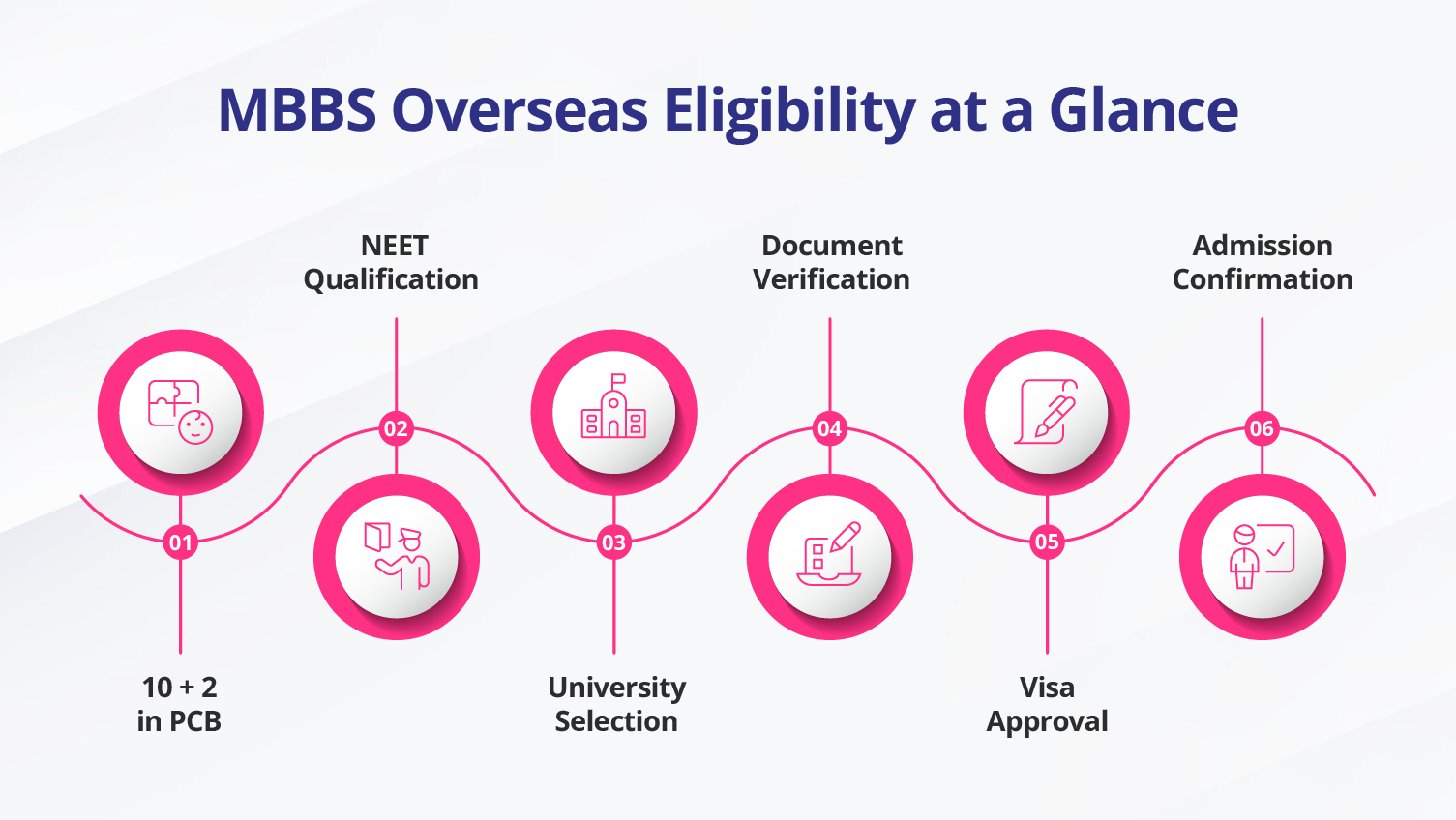
Securing a Seat: Step-by-Step Guide
Meeting eligibility criteria is one part; actually, securing your seat is another. Here’s the process you should follow once you’re sure you qualify.
Step 1: Confirm Your Eligibility Early
Before shortlisting universities, match your marks, age, and NEET status with the requirements of your target countries. It avoids later rejection.
Step 2: Shortlist Universities
Based on recognition, budget, and language, shortlist from trusted options such as:
- Avicenna International Medical University
- International European University
- Saratov State Medical University
- Derzhavin Tambov State University
- Grigol Robakidze University
- Alte University
- International Black Sea University (IBSU)
- David Tvildiani Medical University
- Western Balkans University
- Medical University of the Americas
- University of Lancashire
- Astrakhan State Medical University
All these institutions accept international students, including Indian applicants who meet the eligibility and documentation standards.
Step 3: Check Recognition
Ensure the university is listed with the World Directory of Medical Schools (WDOMS) or approved by the National Medical Commission (NMC). Recognition is what determines whether your degree will be accepted later in India.
Step 4: Apply Online with Complete Documents
Prepare scanned copies of:
- 10 + 2 mark-sheet
- NEET scorecard (if applicable)
- Passport copy
- Passport-sized photographs
- Medical certificate
- Proof of funds
Submit your application before the deadline. Most universities have rolling intakes, but earlier submissions often mean better seat chances.
Step 5: Receive Offer Letter and Pay Fees
Once accepted, you’ll receive a Letter of Admission. Pay the initial fee or tuition deposit as mentioned.
Step 6: Apply for Visa
Use the offer letter to Apply for your Student Visa. Include bank statements, insurance and medical test reports.
Step 7: Prepare for Departure
Once the visa arrives, finalise accommodation, travel, and document copies. Carry notarised versions of your certificates.
Step 8: On-Arrival Registration
Most countries require international students to register with immigration or the health authority within a few days of arrival. Always comply to avoid legal or academic issues.
How to Strengthen Your Application Beyond Eligibility
Even after meeting the basic requirements, you can still enhance your profile:
- Attach a Statement of Purpose (SOP) describing your motivation and long-term medical goals.
- Include recommendation letters from school teachers.
- Get medical tests done early to avoid visa delays.
- Maintain consistent communication with your university’s international office.
- Prepare for the visa interview, many rejections occur due to weak answers on funding or career plans.
MetaApply IE Career Counselling and Visa Assistance teams can help you through these crucial stages.
Turning Eligibility into Admission
Eligibility isn’t just a box to tick. It’s the foundation of your entire medical career. When you get it right, from your 10 + 2 marks to your qualification and documentation, you set yourself up for success. When you get it wrong, you could lose years of effort and money.
That’s why students choose MetaApply IE. Our expert counsellors not only guide you on eligibility but also help you find the right university, secure financial aid, prepare for visa interviews, and transition smoothly into your course.
If you’re ready to make a difference, this is your moment. Fill out the form now and let MetaApply IE help you turn your MBBS dream into reality.
Interested in Study Abroad?
MetaApply can help - fill the form
Enquire Now
Frequently Asked Questions
Yes, some universities accept applications without NEET, but if you ever wish to practise in India, you’ll need to have cleared NEET before leaving. Without it, your degree won’t be recognised by the NMC.
Generally, 50 % in Physics, Chemistry and Biology for General Category students and 40 % for Reserved Category.
Minimum 17 years by 31 December of the admission year. The upper limit varies by country but rarely exceeds 25 years.
Not always. Many universities in Europe and Asia accept Indian students without these tests if their school education was in English.
5. Can I get a scholarship for MBBS abroad? Yes. Several countries and institutions offer partial tuition waivers for high-achieving students. Eligibility depends on your academic profile.