
MBBS in UK for Indian Students in 2026: Requirements, Scholarships & Career Scope

Mansi Jhindal
Published on January 7, 2026
Being a doctor is among the strongest desires an Indian student may have – and the decision regarding the country in which to pursue medicine is usually the most significant step of all. In recent years, the number of Indian students who have changed their destination to one of the world’s most academically successful, globally recognised, and medically influential nations—the United Kingdom—has reached thousands.
But with the opportunity comes confusion — How much does MBBS in the UK Cost? How do I apply? What is UCAT? Do I need NEET? Is it possible to do MBBS in the UK without NEET? What are the Top Medical Universities? What is the syllabus? Is it a recognised degree in India? Every single day, search engines are flooded with these questions as students attempt to process a variety of websites, conflicting information, outdated blogs, and long official instructions that may be daunting.
You may wish to ask questions like, can I study MBBS in the UK without NEET, or what a doctor earns in the UK, or any other questions—you will find answers to all here. And not mere answers, but thoughtful ones, fresh information, information that focuses on students, and practical suggestions.
Why Study MBBS in the UK?
The UK is known for its contributions to medicine across the world. From the discovery of the first antibiotics to the latest studies in organ transplantation, the country has always led the way in medical research.
The best reasons why Indian students are choosing UK MBBS:
Internationally Accepted Medical Degrees UK MBBS degrees (MB ChB, MBBS, BMBS) are accepted and recognised by the NMC, WHO, GMC, and leading medical councils around the world.
Real-World, Case-Based Learning Problem-based learning (PBL) and clinical exposure begin in Year 1 in UK medical schools, allowing students to obtain practical training at an early stage.
High Career Scope UK-trained doctors are allowed to practise in the UK, Europe, USA (with USMLE), Australia, India, and most other countries.
Great Teaching Hospitals The NHS, National Health Service, is one of the best in the world and is linked to universities, guaranteeing unparalleled clinical training.
Good Post-Study Work Opportunities Under the Graduate Route Visa, medical graduates receive 2 years of additional employment opportunities in the UK.
Top Medical Salaries in the World Entry-level doctors in the NHS receive between £28,000 and £55,000 a year, which increases greatly with specialisation.
MBBS in UK Eligibility Indian Student
UK medical schools are known worldwide for their high standards, meaning eligibility for MBBS there is more rigorous than in many other countries. Indian students must meet academic, entrance exam, and language test requirements, as well as documentation and interview criteria, to qualify. Each of these criteria is explained in detail below with tips, examples, and frequently asked student questions.
Academic Eligibility (Class 12 Requirements)
Most medical schools in the UK require a high level of academic background in science since the MBBS Course is rigorous from the very beginning.
- Minimum Class 12 Requirement:
- Should have 10+2 in Physics, Chemistry, Biology.
- At least 85–90 per cent overall in these subjects.
- Most of the leading colleges require 90–95 per cent in Biology and Chemistry in particular.
- Some universities prefer but do not require Mathematics.
Accepted Boards:
- CBSE
- ICSE
- State Boards (higher marks may be mandatory)
- Cambridge International Boards and IB
- Students with Bio + Maths Benefit
Institutions such as Imperial and UCL value applicants who studied Biology, Chemistry, and Mathematics because it demonstrates more critical thinking skills.
Why high marks matter?
Medical Admissions in the UK are very competitive owing to the few seats and the clinical exposure that is given to students at an early stage.
Application Procedure for MBBS in the UK (Step-by-Step)
The process of applying to a medical school in the UK is very organised.
Choose Your Universities: UCAS allows students to apply to up to 4 medical courses.
Register for UCAT/BMAT: The UCAT score is often required in most universities.
Gather Required Paperwork: Passport Class 10 & 12 Mark Sheets NEET Scorecard (recommended) Statement of Purpose Letters of Recommendation CV Proof of Funds English Proficiency Score UCAS Personal Statement
Submit UCAS Application: Medicine typically has applications that close by 15 October each year.
Interview (MMI Format) Medical schools conduct:
- Multiple Mini Interviews (MMI)
- Situational judgement assessments
- Personal motivation checks
Get Conditional/Unconditional Offer.
Apply for UK Student Visa (Tier 4): Students are required to demonstrate financial evidence of fees + living expenses.
Study in the UK & Start Your MBBS.
MBBS in UK vs MBBS in India
Students are advised to check out the difference between studying MBBS in UK vs MBBS in India mentioned below:
| Feature | MBBS in UK | MBBS in India |
|---|---|---|
| Duration | 5–6 years | 5.5 years |
| Entrance Exam | UCAT / BMAT | NEET |
| Tuition Fees | High (₹1.4–2.8 Cr) | Moderate |
| Recognition | Globally accepted | India-only (unless clearing licensing exams) |
| Clinical Exposure | Advanced (NHS hospitals) | Moderate |
| Earnings | High | Limited initially |
Post-MBBS Career Opportunities in the UK
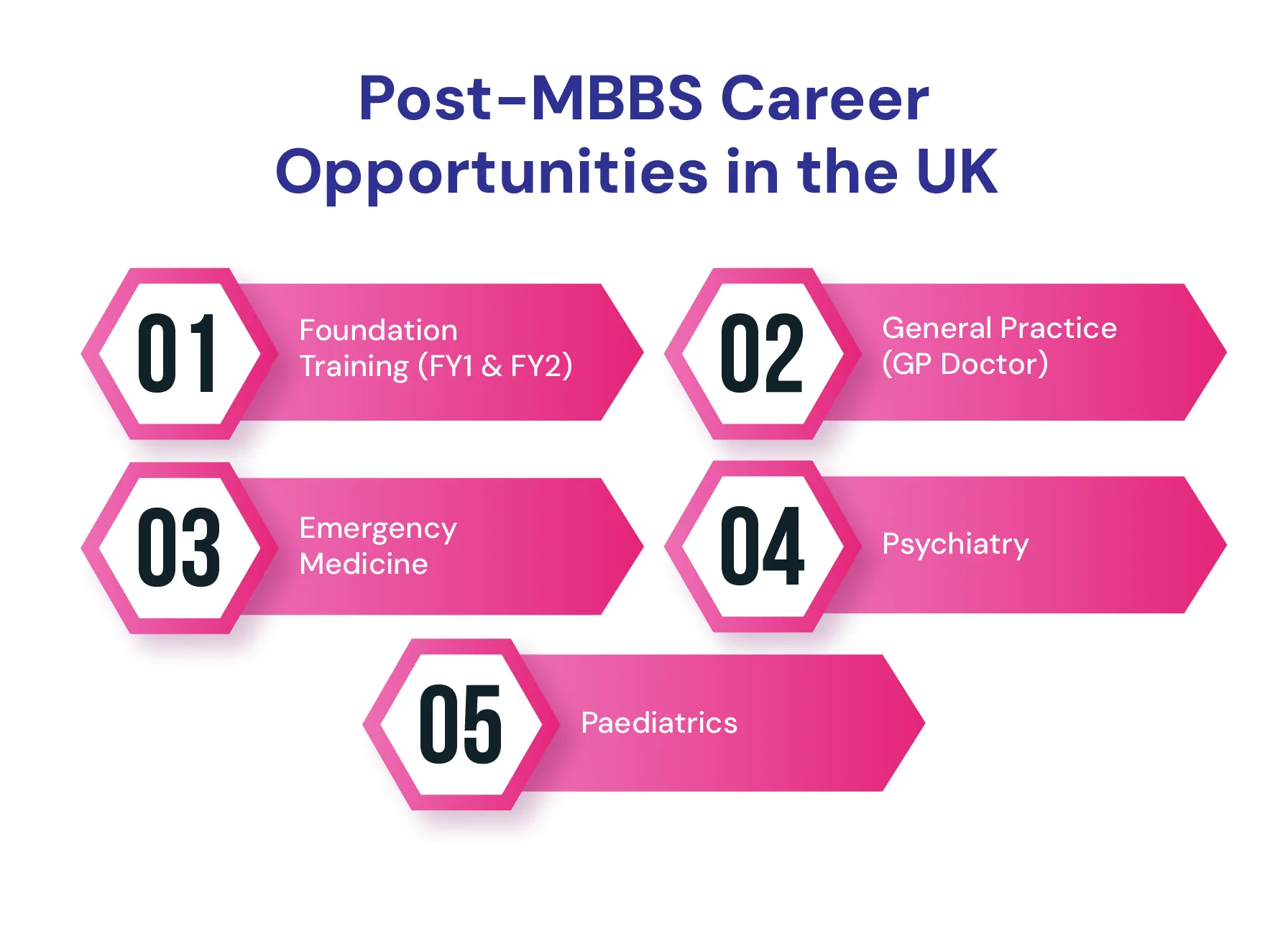
After graduating with their MBBS degree in the UK, students open up a large pool of career opportunities in medicine and healthcare in the UK and worldwide. The following are some of the most popular and in-demand ones:
Foundation Training (FY1 & FY2) Two-year clinical training programme where graduates are required to spend two years in NHS hospitals to acquire practical experience in various medical units.
General Practice (GP Doctor) A large number of MBBS graduates pursue careers as General Practitioners (family doctors) in the UK. The demand for GP positions is very high, with high salaries and fixed working hours.
Emergency Medicine Serving in A&E (Accident and Emergency) departments as an emergency doctor. This profession is dynamic and provides strong development.
Psychiatry Psychiatry in the UK ranks among the high-opportunity sectors with huge earning prospects due to the lack of trained psychiatrists.
Paediatrics Paediatrics, neonatology, or child health are available as specialisations to graduates wishing to work with children.
Scholarships for MBBS in the UK
High-performing Indian students have the opportunity to receive medical scholarships.
- Rhodes Scholarship (Oxford)
- Gates Cambridge Scholarship
- Imperial College London Faculty Scholarships
- King’s College London Medical Scholarships
- Edinburgh Global Scholarships
- Chevening Scholarships (postgraduate specialisation)
Conclusion
Studying MBBS in the UK is more than just a prestigious academic pathway—it’s a launchpad to a truly global medical career. With world-class universities, extensive clinical exposure, and multiple opportunities for specialisation, Indian students can build a future that is academically solid, professionally rewarding and globally mobile. The UK’s structured training system, transparent career progression, and international recognition ensure that your medical degree opens doors across continents.
If you're planning your MBBS journey, having the right guidance from start to finish makes all the difference.
This is where MetaApply IE comes in.
From shortlisting top UK medical universities and assisting with UCAS applications to helping you prepare for visas, exams, scholarships and interviews—MetaApply IE simplifies your study abroad process end-to-end. With expert counsellors, personalised recommendations and real-time updates on admissions, you don’t just apply—you apply smarter.
Interested in Study Abroad?
MetaApply can help - fill the form
Enquire Now
Frequently Asked Questions
Yes. After completing MBBS and obtaining GMC registration, Indian students can work as Foundation Year doctors in NHS hospitals. You can also apply for the UK Health and Care Worker Visa, which makes practising medicine in the UK easier and long-term.
Admission to UK medical schools is competitive, but Indian students can secure a seat with strong academics, a good UCAT/BMAT score, English proficiency (IELTS/TOEFL), and a well-written personal statement. Many universities also accept foundation or pathway programmes, which increase your chances of getting admitted.
Yes. UK MBBS degrees are globally recognised, and the curriculum aligns with international standards. Graduates who want to practise in India must clear the FMGE/NExT exam, after which they can register with the National Medical Commission.
Specialisations such as General Medicine, Internal Medicine, Paediatrics, Psychiatry, Radiology, Anaesthesiology, and Emergency Medicine are currently in high demand across the NHS, offering strong job security and growth.
Yes. After working in the UK for a few years on a Health and Care Worker visa, you can apply for Indefinite Leave to Remain (ILR). Many international doctors build long-term careers and settle permanently through this route.