
Study in UK vs USA 2026: Which Destination Offers Better Opportunities?

Abhishek Mukhopadhyay
Published on November 11, 2025

If you’re asking, “Should I study in the UK or the USA in 2026?”, here’s the nutshell: the UK often offers shorter master’s programmes, clearer post-study work visas, and lower overall costs for many courses; the USA offers flexibility, broader electives, and greater post-graduate work options (especially for STEM). But your decision pivots on your priorities like the cost, field of study, work/immigration goals, lifestyle preferences and much more.
In this blog, we’ll walk through who benefits more where, answer the most searched “why/when/how” queries, show you crisp comparisons, and help you see which path suits you best.
Who Should Study Where? – The Quick Answer Table
| Student Profile | UK May Suit You Better | USA May Suit You Better |
|---|---|---|
| Prefer shorter, affordable master’s | 1-year degrees | Usually 2 years |
| Want flexibility to change subjects | Rigid course structure | Liberal curriculum |
| Prioritise research and STEM | Good | Excellent |
| Budget-conscious | Lower living costs | Generally higher |
| Aim for long-term work visa | Competitive | OPT + STEM extension |
| Prefer compact lifestyle & travel | Europe proximity | Larger distances |
What’s Changing in 2026?
The post-pandemic education landscape has evolved rapidly, and by 2026, several policy changes are shaping how students choose between the UK and the USA:
- UK graduate route updates: The UK government reaffirmed the Graduate Route visa, though eligibility criteria are expected to tighten slightly for dependants.
- USA STEM focus expansion: The US continues to extend OPT categories for STEM fields, allowing graduates up to 36 months of work post-study.
- Digital visa systems: Both nations are rolling out more integrated online visa tracking and biometric verification, speeding up approvals.
- Rising tuition & housing costs: Both destinations have seen 8–12 % increases since 2023, but UK’s shorter degree duration helps offset total costs.
So, when deciding in 2026, it’s not just about where the opportunities are; but how each country’s system fits your personal timeline, finances, and ambitions.
Why Study in the UK in 2026
1. One-Year Master’s Programmes Save Time and Money
Unlike the U.S., where a typical master’s runs two years, the UK packs the same academic depth into 12 intensive months. You graduate faster, spend less on accommodation and living, and can join the workforce earlier. For many, this means saving £15,000–£20,000 compared to longer U.S. courses.2. The Graduate Route Advantage
The Graduate Route visa allows international students to stay and work in the UK for two years (three for PhDs). It’s straightforward, points-based, and doesn’t require employer sponsorship initially — giving you breathing room to find your ideal job.3. Lower Living Costs in Many Cities
While London can be pricey, many UK university towns are affordable. Students typically spend between £1,000–£1,550 per month on living, including accommodation, food, and transport — still lower than major U.S. metros like New York or San Francisco.4. Compact Geography and Travel Perks
You can explore multiple European countries within a few hours’ flight. This exposure broadens your global perspective, and weekend travel is a real possibility.5. Globally Recognised Degrees
UK degrees carry prestige, not only across Europe but worldwide. Many employers value their concise structure and emphasis on practical learning.Why Study in the USA in 2026
1. Flexibility and Academic Freedom
The U.S. system encourages customisation. You can change your major, pick electives outside your discipline, and design a path that blends creativity with career goals, something the UK system doesn’t easily allow.2. Extended Work Opportunities (OPT and STEM OPT)
Students on an F-1 visa can gain 12 months of Optional Practical Training (OPT) after graduation, and if your course is STEM-certified, you can extend it by another 24 months. That’s potentially three years of valuable U.S. work experience.3. Access to World-Leading Research and Funding
The U.S. leads global research spending, meaning more assistantships, internships, and research grants. If you’re aiming for a PhD or plan to stay in academia, the U.S. remains the strongest option.4. Industry Networking and Scale
From Silicon Valley to Wall Street, U.S. campuses are intertwined with industry. The mentorship, networking, and recruitment opportunities are immense.5. Campus Life and Cultural Integration
American campuses are vibrant and inclusive, with clubs, sports, and international student offices ensuring you feel supported from day one.Cost of Studying in the UK vs USA 2026
| Expense | UK (Average) | USA (Average) |
|---|---|---|
| Tuition – Undergraduate | £14,000–£25,000 per year | $20,000–$45,000 per year |
| Tuition – Master’s | £18,000–£30,000 | $30,000–$60,000+ |
| Living Costs (Monthly) | £1,000–£1,550 | $1,200–$2,350 |
| Visa Fee | £822 | $160 + SEVIS ($350) |
| Health Surcharge | £1,035 per year | Included in insurance ($700–$1,200 per year) |
| Duration | 1–3 years | 2–4 years |
Note: All prices mentioned are approximate values. Students should check official government websites or the respective university websites for exact figures.
When Should You Choose UK or the USA?
Timing and goals are very important aspects of the study abroad journey. Understanding what you want to achieve and within what timeline will take you further in your career.
Choose the UK if you want to:
- Graduate quickly and start working sooner.
- Minimise expenses without compromising degree quality.
- Study a specialised subject with clear job outcomes.
Choose the USA if you want to:
- Explore multiple disciplines before settling.
- Gain longer work experience post-study.
- Build a long-term professional network or aim for research-based roles.
Timing matters. For UK intakes (January, September), application cycles are straightforward. U.S. universities, on the other hand, often use rolling deadlines, great if you’re applying late.
Where Will You Live and Study?
In the UK
Expect charming student towns, compact campuses, and efficient public transport. Weekend trips across Europe are affordable. The cultural scene is sophisticated, and academic pressure is intense but focused.
In the USA
Expect vast campuses, big-city energy, and diverse communities. U.S. college life balances academics with sports, arts, and social activities, ideal for holistic growth. However, distances are longer and healthcare costs higher, so budgeting is essential.
How the Visa & Work Process Differs (2026 Update)
UK Student Visa Process
- Receive your CAS (Confirmation of Acceptance for Studies).
- Apply for a Student Visa online and pay the healthcare surcharge.
- On completion, apply for the Graduate Route Visa (2 years post-study).
- Switch later to a Skilled Worker Visa if you find a job meeting salary and skill requirements.
USA F-1 Visa Process
- Receive Form I-20 from your university.
- Pay the SEVIS fee and book a visa interview.
- After graduation, apply for OPT.
- STEM students can apply for an additional 24-month OPT extension.
- Long-term employment may lead to H-1B sponsorship.
Pro Tip: For either country, ensure you prepare financial proof, offer letters, and visa documentation early.
Which Offers Better Career Outcomes?
This is where nuance matters:
- UK: Shorter degrees mean faster re-entry into the job market. The Graduate Route provides two years to secure experience, and UK qualifications are valued in Commonwealth and EU markets.
- USA: The OPT + STEM extension offers longer exposure (up to three years) in the U.S. job market, particularly advantageous for engineering, IT, finance, and healthcare.
In short:
- If you value speed and savings, lean UK.
- If you value depth and duration, lean USA.
Both routes can lead to successful global careers, provided you plan strategically.
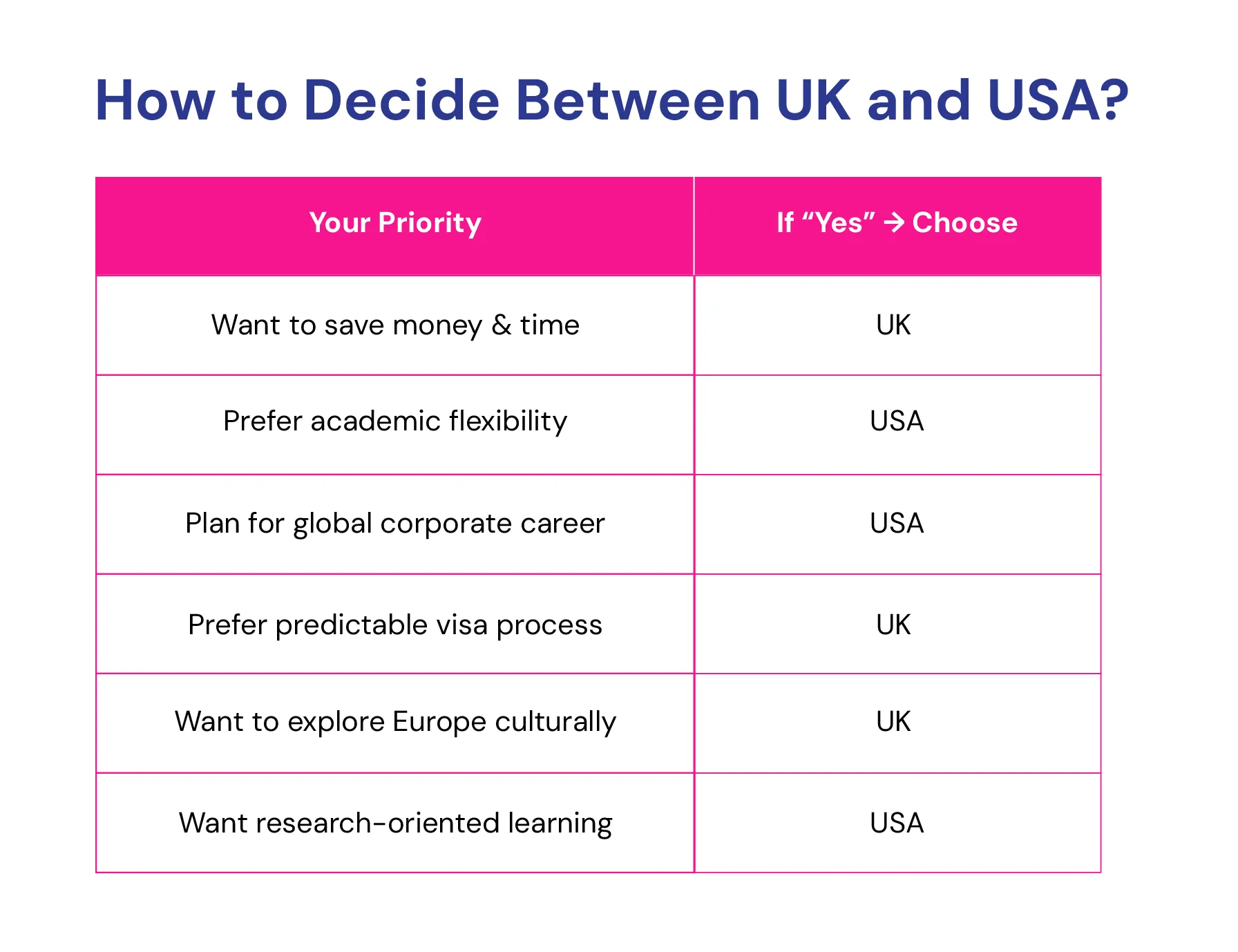
Once you tick your top three, your destination usually becomes clear. And if it doesn’t, that’s where MetaApply IE’s counsellors step in, to match your goals with the right path.
Feeling inspired but still unsure? Let us help you out
At MetaApply IE, our expert counsellors take care of every step; from shortlisting courses to visa documentation and interview preparation. We also provide TestPrep, Career Counselling, and Financial Aid Guidance so you’re never navigating blind.
Whether you choose the UK’s fast-track education or the USA’s flexible pathway, we’ll help you maximise opportunities and avoid costly mistakes. Fill out the form today to get your personalised study-abroad roadmap for 2026. Your dream university might already be within reach, all it takes is the right guidance.
Interested in Study Abroad?
MetaApply can help - fill the form
Enquire Now
Frequently Asked Questions
Yes, generally. The UK’s shorter duration means you spend less on tuition and living.
Both countries allow limited part-time work (usually 20 hours per week during term).
UK: 2–3 years (Graduate Route). USA: 1–3 years (OPT + STEM OPT).
Both have similar scrutiny levels, though the UK’s digital system is faster in many cases.
Absolutely. Many students apply to both and compare offers, scholarships, and visa timelines before choosing.