
Every Year, Thousands of Students Miss Their Shot at a UK Master's Degree; Are You Next?

Abhishek Mukhopadhyay
Published on April 2, 2026

September arrives in the United Kingdom with its usual quiet drama; freshers dragging suitcases across cobbled streets, lecture theatres filling with new voices, and campus cafés buzzing with ambition. For thousands of international students, it marks the beginning of a one-year Master’s journey that can redefine careers. Yet for every student who makes it, another sits at home with the same qualifications and the same dream, stalled by a missed deadline, a confused course choice, or an unexpected visa complication. The difference is rarely ability; it is preparation. A UK Master’s degree is globally respected, academically rigorous, and intensely career-focused, but the application process demands clarity, timing, and strategy. Get it right, and you step into one of the world’s most influential higher education systems to Study Masters in UK. Get it wrong, and the opportunity slips quietly away.
Why the UK? (And Why Right Now Matters More Than Ever)
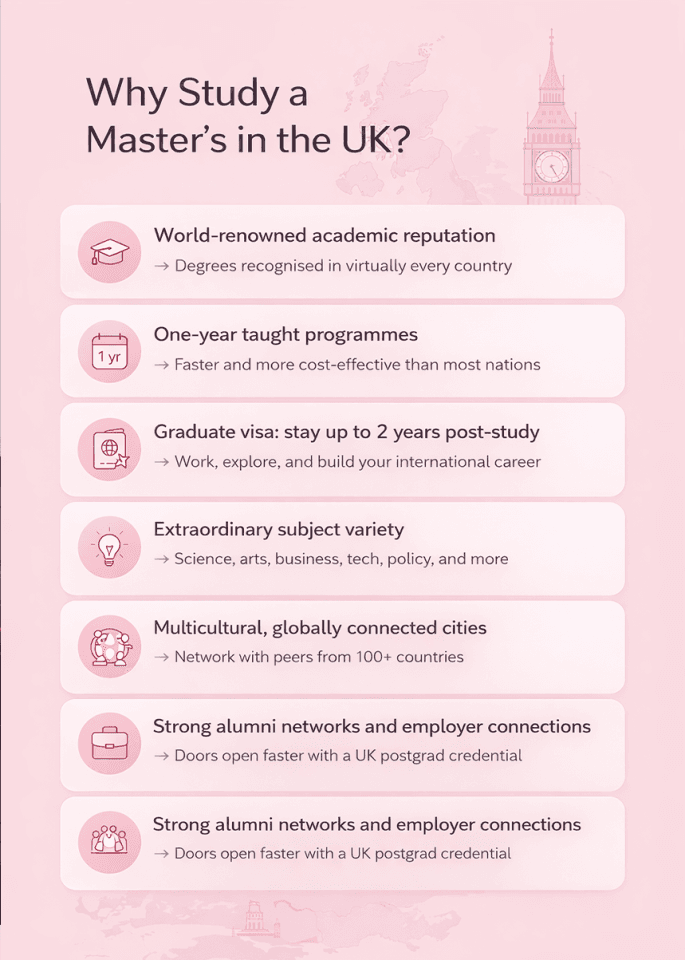
Here’s the real question: if you’re going to invest in a Master’s degree, why spend two years when you could transform your career in one?
That’s the UK advantage. Most taught Master’s programmes in the UK take just one year. One focused, intensive year that gets you back into the job market faster, with lower overall living costs and a quicker return on investment than many two-year systems elsewhere.
UK universities do reward perspective. You are expected to question, debate, challenge and produce original thinking. Your dissertation is all about your contribution to the field. Globally, employers recognise that distinction.
Then there is opportunity beyond graduation. The Graduate visa allows international students to stay and work in the UK for up to two years, or three for doctoral graduates, turning study into a genuine international career pathway.
Whatever your ambition, whether in data, diplomacy, design, business, engineering or public policy, there is a programme built for it.
Where Students Lag: The Honest Truth Nobody Tells You
The UK is competitive. Getting accepted onto the right programme requires planning that begins far earlier than most students realise. And the mistakes, when they happen are almost always the same ones, made by different people, year after year.
1. Starting Too Late
Deadlines for UK Master's programmes vary widely. Some of the most competitive programmes close applications in January or February for courses beginning the following September. If you're only starting to research in March, you've already missed the boat for many top choices. The students who get in and get in well; start their research at least 12 to 18 months before their intended start date.
2. Choosing the Wrong Programme
This one is painful to watch. Students spend so much energy focusing on an institution's name that they don't interrogate the actual course content, the teaching staff, the dissertation options, or the career outcomes of previous cohorts. A prestigious name attached to a course that doesn't align with your career goals is far less valuable than a well-matched programme at a slightly less famous institution. Research the course, not just the brand.
3. Underestimating the Personal Statement
The personal statement is where most international applicants lose the plot. It is not a CV in prose form. It is not a list of achievements dressed up in flowery language. A strong personal statement tells a coherent story; why this subject, why now, why this specific institution, and what you intend to do with it. Admissions tutors read hundreds. They remember the ones that feel genuinely considered and specific. Generic equals forgettable.
4. Leaving Funding Research to the Last Minute
Scholarships, bursaries, and government-backed schemes for international students exist in greater number than most people realise, but the deadlines for many of these fall significantly earlier than the course application deadlines themselves. Students who discover a scholarship in June for a September start will almost always find the window has closed. Funding research must run in parallel with course research, not after it.
5. Misunderstanding the Visa Process
A UK Student visa application requires a Confirmation of Acceptance for Studies (CAS) from your institution, proof of English language proficiency, evidence of sufficient funds, and more. It sounds straightforward. In practice, documentation requirements and interview preparation can catch students completely off guard if they haven't planned ahead. A rejected or delayed visa means a missed intake, often a full year's delay.
Common Student Pitfalls And How to Avoid Them
| The Pitfall | The Fix |
|---|---|
| Starting research too late | Begin 12-18 months before start date |
| Choosing by brand, not fit | Research course content and outcomes |
| Weak personal statement | Tell a specific, coherent story |
| Missing funding deadlines | Research scholarships in parallel |
| Underestimating visa process | Begin documentation immediately |
What You Must Do: A Practical Roadmap
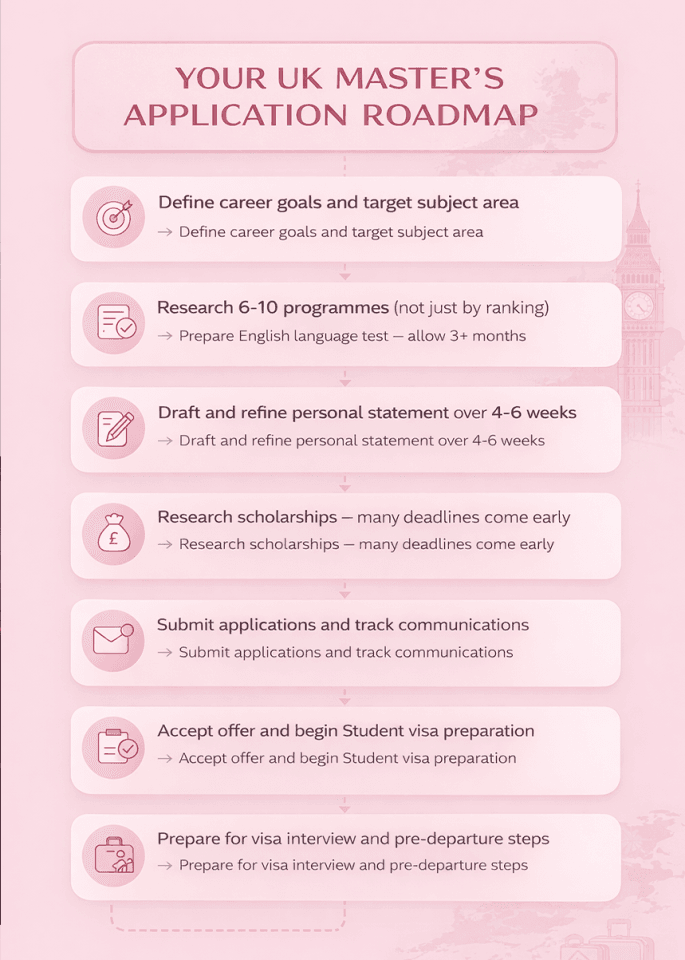
Right. Now that we've identified where things go wrong, here's the blueprint for getting it right.
Start With Clarity on Your Career Goals
Before you look at a single prospectus, ask yourself honestly: where do I want to be in five years? The answer to that question should drive every decision that follows; subject area, institution type, location within the UK, and even the type of Master's (taught versus research). Students who start with career clarity make better choices at every subsequent step.
Research Programmes Systematically
Build a shortlist of 6 to 10 programmes across a range of institutions. Look at the curriculum, the faculty's research interests, the assessments, the dissertation topics from previous cohorts, and the career trajectories of recent graduates. University websites, LinkedIn, and student review platforms are all useful here. Don't rely solely on league tables.
Craft a Personal Statement That Actually Stands Out
Give yourself at least four to six weeks to write and refine your personal statement. Draft it, walk away, come back with fresh eyes. Ask someone whose opinion you respect, ideally someone familiar with academic writing, to review it. Be specific about your motivations. Name the modules that excite you. Reference the research being done by the faculty you want to learn from. Specificity is the difference between an application that is remembered and one that is filed away.
Explore Every Funding Avenue
Look at both institution-specific scholarships and national-level funding. Government scholarships from your home country may also support overseas study. Professional associations in your field frequently offer grants for postgraduate students. This research takes time, but the return, potentially covering a significant portion of your costs, makes it absolutely worth it.
Plan Your Visa Timeline
Once you have a conditional or unconditional offer, begin your student visa preparation immediately. Gather your financial evidence, arrange your English language test results, and understand the biometric residence permit process. Do not leave this to the final weeks before your programme begins.
The UK Experience Beyond the Classroom
A Master's in the UK is not purely an academic endeavour and the best students understand this from the outset.
The UK is a genuinely extraordinary place to live as a student. British cities are among the most culturally diverse in the world. You will study alongside classmates from dozens of countries, attend lectures given by academics who are actively shaping their fields, and have access to museums, galleries, theatres, and professional networks that simply aren't available elsewhere.
Student unions in the UK are active and genuinely influential in campus life. There are societies for virtually every interest, professional mentorship programmes connecting students with industry, and careers services that are remarkably well-resourced. Make use of all of it. The students who get the most from a UK Master's are the ones who engage well beyond their department.
Part-time work is permitted for Student visa holders, up to 20 hours per week during term time. Many students use this not just for income, but to build UK-based professional experience, make industry contacts, and understand the local job market before their Graduate visa kicks in.
Is a UK Master's Worth It? (The Real Answer)
Yes, but only if you approach it with intent.
The students who struggle to articulate the value of their UK Master's are almost always the ones who drifted into it, who chose a programme because it seemed fine, applied without much research, and arrived without a clear sense of what they wanted to achieve. The return on a UK postgraduate degree is directly proportional to the deliberateness with which you pursue it.
For students who are intentional, who choose the right programme, make the most of the career resources available, build genuine relationships with peers and professors, and use their time in the UK to develop professionally as well as academically, the investment is transformative. Employers across industries and across the globe recognise and respect UK postgraduate qualifications. The alumni network you build will serve you for decades.
The question isn't really whether a UK Master's is worth it. The question is: are you going to approach it in a way that makes it worth it?
Your UK Dream Deserves Expert Hands: Let MetaApply IE Make It Happen
Navigating the journey to a UK Master's degree is genuinely exciting, but it is also complex, competitive, and full of the kind of fine print that can trip up even the most capable candidates.
At MetaApply IE, we offer expert counselling to help you find the right course, college, and destination. Our team supports you throughout the process, from application submission to securing financial aid and preparing for visa interviews. We ensure that every detail is taken care of, making your journey smooth and hassle-free. We also have TestPrep and Career Counselling services, because getting into the right programme is only the beginning, and what you do with it matters just as much.
Our expert counsellors take care of all your study abroad needs; from the moment you start exploring your options to the day you land at your destination. If you feel like you can make a difference and want to study abroad, or if pursuing your education abroad is the ideal choice for your career and your future, we are here to make it happen.
At MetaApply IE, we offer expert counselling to help you find the right course, college, and destination. Our team supports you throughout the process, from application submission to securing financial aid and preparing for visa interviews.
Don't be the student who looks back and wonders what might have been. Fill in the form today and be the one who got it right the first time.
Interested in Study Abroad?
MetaApply can help - fill the form
Enquire Now
Frequently Asked Questions
Most taught Master's programmes in the UK are completed in one year full-time. Research-based Master's and part-time options may take longer, but that one-year taught duration is one of the most attractive aspects of UK postgraduate study for international students.
Yes. Student visa holders are generally permitted to work up to 20 hours per week during term time and full-time during official vacation periods, a great way to gain UK-based professional experience alongside your studies.
Most institutions accept IELTS Academic, PTE Academic, TOEFL iBT, and in some cases Cambridge English qualifications. Each programme sets its own minimum score requirements, so always check the specific entry criteria for your chosen course.
The UK Graduate visa allows international students who have completed a degree at a recognised UK higher education provider to remain in the UK for two years after graduation (three years for doctoral graduates) to work or seek work. It's one of the most valuable post-study pathways available anywhere in the world.
Ideally, 12 to 18 months before your intended start date. Many competitive programmes and scholarship deadlines fall far earlier than most students expect. Starting early gives you the best shot at your preferred programme, your preferred funding, and a stress-free application experience.