
IELTS Full Form - Everything You Need to Know

Abhishek Mukhopadhyay
Published on January 20, 2026

There are moments in every student’s study abroad journey that feel like turning points: the day you decide your dream country, the day you shortlist universities, and the day you first Google “IELTS Full Form.” It seems like a simple search, but it’s often the beginning of a much bigger journey, one that leads to new countries, new careers, and a completely new life style.
Before you begin preparing, applying, or even choosing a destination, understanding what IELTS truly stands for and what it stands against, helps you move smarter, faster and more confidently. This blog gives you value-driven clarity so you can make better decisions and take action with certainty.
Let’s start strong.
What Does IELTS Stand For?
The IELTS Full Form is International English Language Testing System. It is a globally recognised exam designed to evaluate your English proficiency for:
- Study abroad
- Work visas
- Skilled migration
- Professional licensing
- Permanent residency
Why Does Knowing the IELTS Full Form Matter?
Because the full form itself tells you three critical things:
1. International It is accepted in more than 140 countries. Your score travels further than most exams.
2. English Language What’s evaluated is your practical, real-world language ability, not memorised rules.
3. Testing System A standardised, fair, globally calibrated system used for admissions, visas, jobs, and migration pathways.
This clarity helps you understand why the exam exists, who uses your score, and what you need to prepare for.
What IELTS mean for Students, Workers, and Migrants?
Most blogs treat IELTS as a one-size-fits-all exam. It isn’t. Here’s the real difference:
For Students IELTS checks academic readiness, your ability to understand lectures, communicate ideas, and participate in coursework.
For Working Professionals IELTS evaluates workplace communication, emails, discussions, reports, meetings, and client interaction.
For Migrants IELTS is used to measure your ability to settle independently and contribute to society.
For PR Applicants IELTS can directly influence points for PR applications in Canada, Australia, and New Zealand.
Understanding the full form tells you not just what IELTS is, but whether it’s the right exam for your goal.
IELTS Academic vs IELTS General - Which One Should You Take?
One of the most searched questions linked to “IELTS” is: “Which IELTS should I take - Academic or General?”
Quick Answer
- Choose IELTS Academic if you want to Study Abroad.
- Choose IELTS General Training if you want to work or migrate.
Simple Comparison Table
| Purpose | IELTS Academic | IELTS General |
|---|---|---|
| Study abroad | Yes | No |
| University/college admission | Yes | No |
| Migration/PR | No | Yes |
| Work visas | Depends | Common |
| Professional licensing | Often | Sometimes |
What Does the IELTS Exam Actually Assess?
Every IELTS Test measures four areas, but here’s what each one really checks:
- Listening
- Can you follow accents?
- Can you identify context?
- Can you interpret implied meaning?
- Reading
- Can you process information quickly?
- Can you identify arguments?
- Can you extract facts efficiently?
- Writing
- Can you express ideas clearly?
- Can you structure arguments logically?
- Can you write academically or professionally?
- Speaking
- Can you communicate naturally?
- Are you fluent, confident, and coherent?
- Can you explain, discuss, and debate ideas?
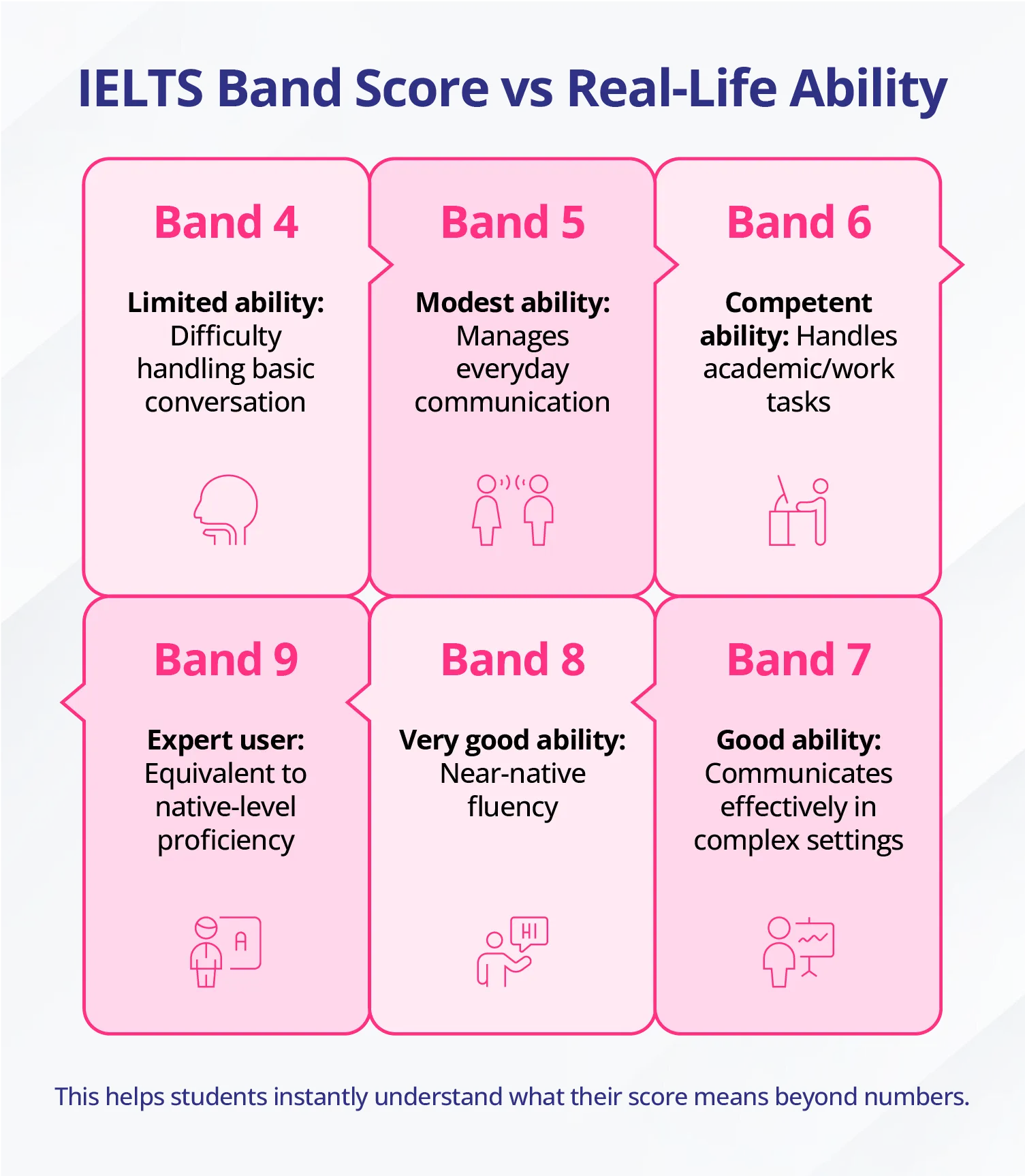
Why Do Countries Trust IELTS?
Because IELTS is:
- Standardised globally
- Designed by expert linguists
- Fair for non-native speakers
- Updated regularly to reflect real-world use
- Administered by British Council, Cambridge Assessment, and IDP
How IELTS Scores Impact Admission, Visa, and PR Success
Many students assume that IELTS is only relevant for university admissions, but in reality, your score plays a major role across multiple stages of your international journey. A higher IELTS Score not only improves your chances of securing conditional offers, admission into higher-ranked courses, and faster application processing, but it can also strengthen your scholarship prospects, with many universities considering applicants who score above 7.0. Beyond academics, a strong IELTS score helps streamline visa approvals by clearly demonstrating your communication skills, academic readiness, and overall preparedness for settlement. For those targeting permanent residency in countries such as Canada and Australia, achieving IELTS 7.0 can significantly boost your points, while an 8.0 often secures the maximum language points available.
What Makes IELTS Different from Other English Exams?
IELTS is different from other English exams because of its unique structure and practical approach to assessing real communication ability. Unlike many tests, IELTS includes a face-to-face speaking component that genuinely measures how well you communicate in real situations. It is globally recognised and accepted across major destinations such as the UK, Canada, the USA, Australia, New Zealand, Ireland, Germany, and many more. The scoring system is designed to be fair for non-native speakers, while the test itself focuses on both academic and real-life scenarios that mirror actual university and workplace tasks. With fast results, typically within 3 to 5 days for computer-delivered tests IELTS offers both credibility and convenience. It’s an experience crafted for real-world impact.
Your Complete IELTS-to-Admissions Partner: How MetaApply IE Powers Your Global Journey
At MetaApply IE, we turn ambition into action by simplifying every step between preparing for IELTS and securing admission abroad. This is where the right guidance becomes the difference between merely applying and truly succeeding. Our team helps you choose the ideal course, destination, and IELTS test type, while offering personalised TestPrep support tailored to your strengths. We shortlist universities that genuinely match your profile, assist with Scholarship Applications, and help you craft compelling statements and supporting documents.
From managing your applications and offer letters to preparing you for the visa process, we handle the details so you can focus on your goals. With expert Career Counselling and end-to-end support, we make Studying in the UK, Canada, the USA, Australia, Ireland, or Europe not only achievable, but seamless.
If you’ve read this far, you’re clearly serious about building a global career; all you need now is the right partner. Fill in the form and speak to our experts today. Your study abroad journey deserves a confident, well-guided start, and we’re here to make it happen.
Interested in Study Abroad?
MetaApply can help - fill the form
Enquire Now
Frequently Asked Questions
The full form of IELTS is International English Language Testing System. It is important because universities and immigration bodies use your IELTS score to evaluate whether you can communicate effectively in English. A good score increases your chances of admission, scholarships, and visa approval.
IELTS Academic is for students applying to universities or academic programmes. IELTS General Training is for migration, work visas, and professional purposes. Both test your listening, reading, writing, and speaking skills, but the reading and writing sections vary in difficulty and format.
Most universities in the UK, Canada, Australia, and New Zealand prefer or require IELTS scores for admission. Some institutions may offer waivers based on your previous education or English proficiency, but visa authorities may still require official IELTS results.
IELTS scores are valid for two years from the test date. A “good” score depends on your purpose, most universities accept 6.0–7.0 bands, while competitive courses may require 7.5 or above. Migration pathways often require specific band scores for each module.
Yes, the IELTS Academic test is available in an online format (IELTS Online) in selected regions, while IELTS General is typically centre-based. You can register through authorised test partners such as IDP or the British Council. Choose your preferred date, upload documents, pay the fee, and receive your confirmation instantly.