
TOEFL Full Form: Meaning, Exam Purpose and Format

Abhishek Mukhopadhyay
Published on January 21, 2026

If you’re exploring opportunities to study abroad, you’ve probably come across the term TOEFL at least a dozen times. Counsellors mention it, universities list it under “admission requirements”, and immigration pages treat it like a non-negotiable.
But before you dive into registering, preparing, or chasing score targets, one question always pops up first:
What is the full form of TOEFL?
Let’s begin there and then go far beyond the basics. Because understanding the meaning, purpose, and real value of TOEFL is the first step to taking control of your global education journey.TOEFL Full Form - Test of English as a Foreign Language
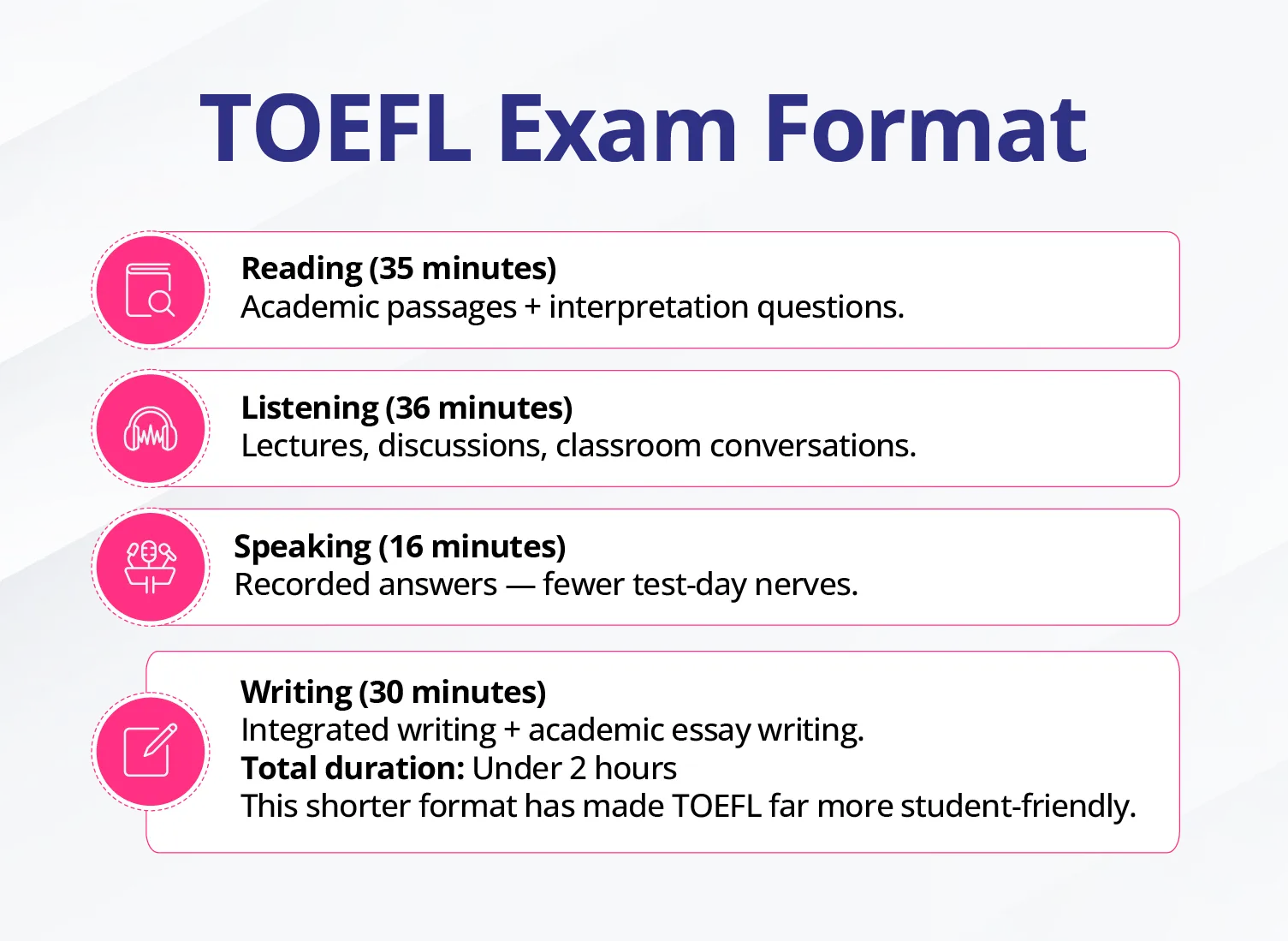
It is a globally accepted English-Proficiency Exam designed to evaluate how well you can use and understand English at a university level. The test measures all four academic communication skills:- Reading
- Listening
- Speaking
- Writing
The full form itself explains the exam’s purpose:
- Test - It is an official, standardised assessment.
- English - Your language proficiency is the focus.
- As a Foreign Language - It measures the ability of non-native speakers.
- Whether the exam applies to their study abroad goals
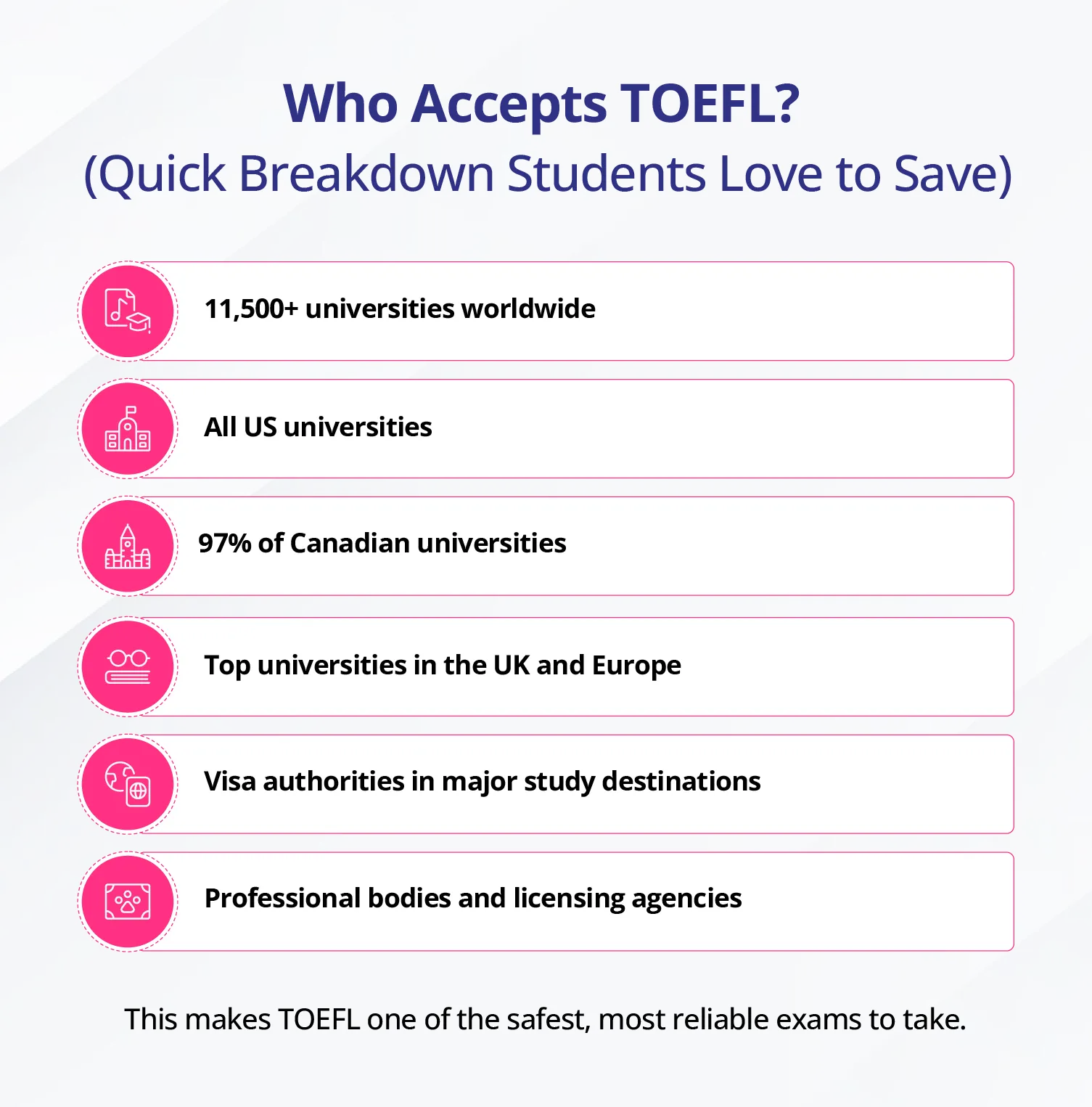
- Whether TOEFL is accepted in their dream destination
- Whether they should choose TOEFL instead of IELTS
- Whether the exam helps in visa or scholarship applications
TOEFL vs IELTS: Which One Should You Choose?
| Factor | TOEFL (Test of English as a Foreign Language) | IELTS (International English Language Testing System) |
|---|---|---|
| Preferred In | USA & Canada (primarily), also accepted worldwide | UK, Australia, NZ, Canada, and globally |
| Speaking Test | Recorded responses (computer-based) | In-person interview |
| Writing Style | More academic, structured | More general + academic mix |
| Scoring | 0–120 | 0–9 bands |
| Best For | Students comfortable with digital tests | Students preferring face-to-face speaking |
This comparison generally helps students understand the exam’s relevance, especially if their target country has a preference.
What Does TOEFL Actually Test?
Think of TOEFL as a real-life simulation of studying at an international university. Instead of simply checking grammar or vocabulary, it assesses whether you can genuinely cope with academic environments abroad. It evaluates your ability to understand long, lecture-style explanations, analyse research-heavy reading material, communicate clearly and confidently in English, and write structured, well-reasoned essays. It also measures how well you can take meaningful notes and use them logically, just like you would in an actual classroom. In essence, TOEFL is a test of how prepared you are to thrive in global university settings.
TOEFL iBT vs TOEFL Essentials: Which One is Better for You?
Most students today choose TOEFL iBT, the primary version accepted worldwide.
TOEFL iBT (Internet-Based Test)
- Preferred by universities
- More academic
- Widely accepted
- Highly structured and standardised
- Shorter, more flexible
- Tests general English
- Accepted by fewer universities
What Is a Good TOEFL Score?
Although score requirements vary, most universities prefer:- 80–90 : Acceptable for many undergraduate courses
- 90–100 : Competitive range
- 100–110+ : Strong score for top universities
- 110–120 : Excellent score for highly selective programmes
Who Should Take TOEFL?
You should choose TOEFL if:
- You’re applying to universities in the USA or Canada
- You feel confident with computer-based communication
- You prefer recorded speaking over in-person interviews
- You’re applying for postgraduate or STEM Programmes
- Your university explicitly prefers or recommends TOEFL
When Should You Take TOEFL?
Ideally:
- 8–10 months before your intake
- After completing basic English preparation
- Once you’ve short-listed at least 5 target programmes
Cost of TOEFL (Approximate)
TOEFL fees vary by country but typically range between ₹16,000–₹19,000 for Indian students.
Note: Exact fees depend on your region and test centre availability. Check official website for updates fees.
Why Should You Start Your TestPrep with MetaApply IE?
Choosing between TOEFL, IELTS, or any proficiency test can feel confusing, but it doesn’t have to be. If you’re serious about studying abroad and want clarity on exams, courses, countries, scholarships, and admissions, you don’t need to do this alone.
At MetaApply IE:
- Our expert counsellors guide you through the right exam choice, course selection, and university applications.
- We assist with TestPrep, documentation, SOPs, LORs, and admissions strategy.
- Our team helps you understand financial aid options, Scholarships, and fee structures.
- We prepare you for visa interviews and ensure your application is strong, complete, and competitive.
Interested in Study Abroad?
MetaApply can help - fill the form
Enquire Now
Frequently Asked Questions
TOEFL stands for Test of English as a Foreign Language, conducted by ETS (Educational Testing Service).
It depends on your strengths, TOEFL is better for students who prefer computer-based speaking and academic-style reading.
TOEFL scores remain valid for two years.
Yes. Many study destinations accept TOEFL scores for student visa purposes.
Yes, many UK universities accept TOEFL iBT for admissions.