
Which Country is Better to Study Abroad – Australia or Canada?

Abhishek Mukhopadhyay
Published on December 24, 2025

When it comes to choosing the right study abroad destination, two names consistently dominate global discussions - Australia and Canada. Both countries are powerhouses in education, employment, and lifestyle, attracting thousands of international students every year. But if you’re someone genuinely trying to figure out which country offers better value, growth, and long-term prospects, this comparison goes beyond the basics, because we’ll help you look at what really matters: outcomes, opportunities, and your return on investment.
Let’s face it, the world doesn’t need another generic “study in Australia vs study in Canada” blog. You’re here because you want clarity, numbers that make sense, and a perspective that helps you take action. So, let’s decode this decision step by step, from cost and career potential to lifestyle and migration prospects.
Why Students Compare Australia and Canada
Both countries are among the Top Five Global Study Destinations, offering world-class universities, post-study work rights, and multicultural environments. Yet, they differ significantly in cost structures, immigration policies, and academic cultures.
In short:
- Australia: Fast-paced, globally connected, high-cost but high-earning environment.
- Canada: Affordable, stable, and long-term PR-friendly destination.
Now, let’s dive deeper into what each offers with facts, not fluff.
Quick Comparison Table: Australia vs Canada for International Students
| Factor | Australia | Canada |
|---|---|---|
| Average Tuition Fees (Per Year) | AUD 20,000 – 45,000 | CAD 15,000 – 35,000 |
| Living Expenses (Per Month) | AUD 1,600 – 2,400 | CAD 1,200 – 2,000 |
| Post-Study Work Visa Duration | Up to 6 years (depending on course/region) | Up to 3 years |
| Permanent Residency Pathway | Competitive, skill-based | Structured, point-based and student-friendly |
| Average Graduate Starting Salary | AUD 70,000 – 85,000 | CAD 55,000 – 70,000 |
| Climate | Warm to temperate | Cold with distinct seasons |
| Work Rights (Student) | 48 hrs per fortnight | 20 hrs per week (full-time during breaks) |
| PR Conversion Rate (Approx.) | Moderate | High |
Note: All prices mentioned are approximate values. Students should check official government websites or the respective university websites for exact figures.
Education System: Outcome-Based vs Research-Driven
One of the first distinctions between studying in Australia and Canada lies in their educational approach.
- Australia emphasises industry-readiness. Courses often integrate internships, professional accreditation, and job placements as part of the curriculum. It’s built for those who prefer applied learning and quicker transitions into professional life.
- Canada, on the other hand, is known for its research depth and academic rigour. Universities prioritise innovation, critical thinking, and long-term academic growth. If you’re planning a career in research, technology, or academia, Canada’s universities often provide more structured funding opportunities and research assistance.
Bottom line:
Australia helps you work faster, while Canada helps you grow deeper academically.
Cost of Education and Living: The Real Numbers That Matter
When it comes to costs, many students assume Canada is always cheaper. That’s partly true, but there’s nuance here.
While Canadian tuition fees are generally lower, certain Australian regions offer competitive scholarships and part-time job opportunities that offset higher expenses. On average, a student spends AUD 40,000–60,000 annually in Australia, including living costs, whereas in Canada, it ranges between CAD 30,000–45,000.
But the cost of living to earning potential ratio often balances the scale. Australia’s minimum wage is among the highest in the world, which means international students working part-time can earn comparatively more than in Canada.
Quick tip: If your goal is to balance study and part-time work effectively, Australia might edge out Canada. However, if long-term affordability and PR are your focus, Canada wins.
Note: All prices mentioned are approximate values. Students should check official government websites or the respective university websites for exact figures.
Post-Study Work Opportunities: Who Gives You a Better Head Start?
Your post-study work permit plays a crucial role in shaping your ROI (Return on Investment).
- Australia allows graduates to stay between 2–6 years, depending on their degree level and the region where they studied. Regional areas even offer extended post-study work rights, a great opportunity to gain professional exposure and enhance PR eligibility.
- Canada grants a Post-Graduation Work Permit (PGWP) for up to 3 years, which is equally attractive, especially when combined with a clear and transparent PR pathway.
Verdict:
If your goal is to gain experience fast and move into full-time employment quickly, Australia offers greater flexibility. But if your goal is settlement and long-term residency, Canada’s PGWP system aligns better.
Employment & Industry Exposure: Where the Jobs Are
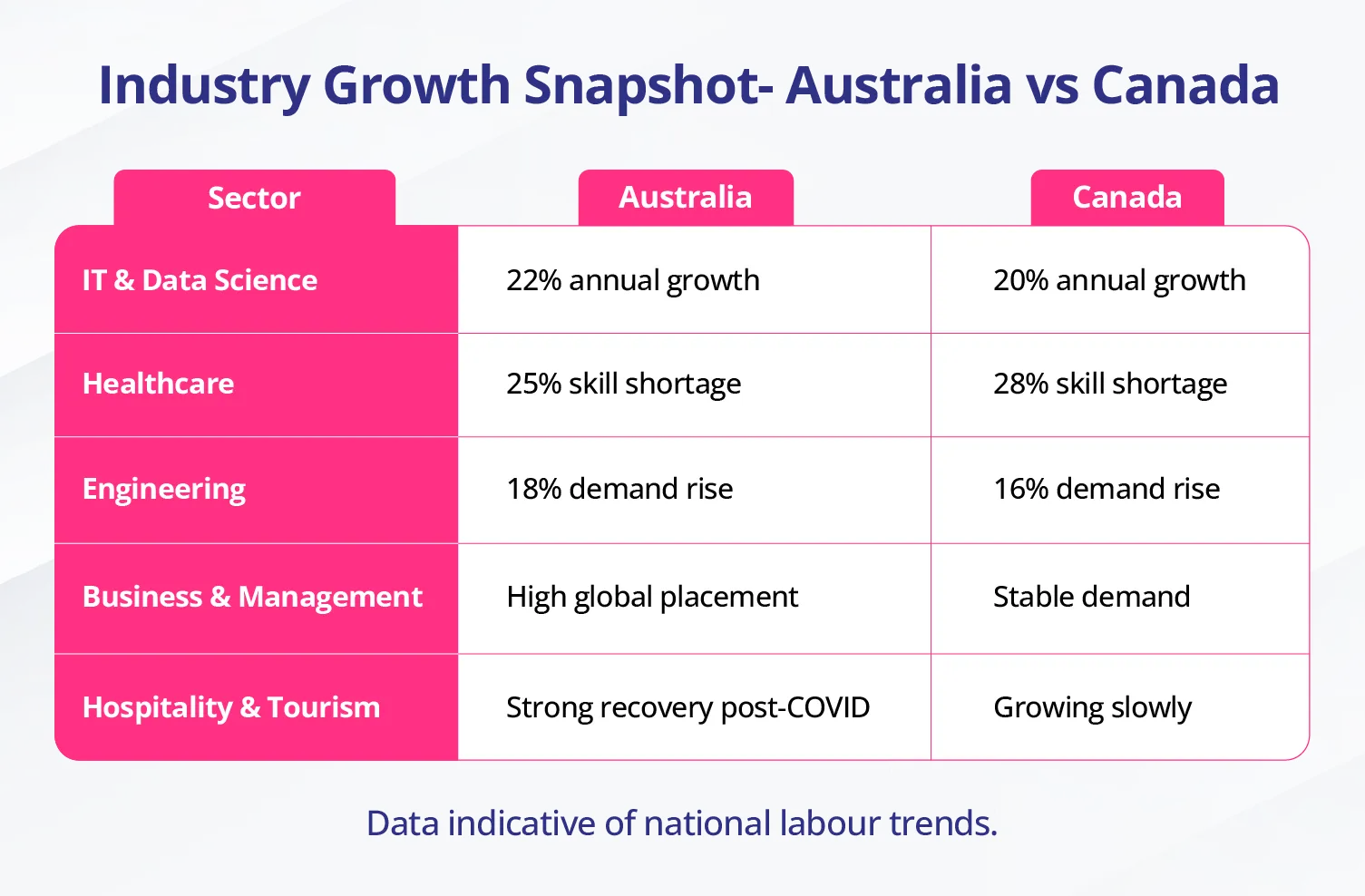
In Australia, fields like healthcare, business analytics, IT, engineering, and hospitality are booming, largely due to global skill shortages. Graduates often secure employment quickly after completing their degree.
In Canada, the job market thrives in technology, healthcare, finance, and renewable energy. The Canadian government frequently updates its immigration list to prioritise sectors facing talent shortages, which means your education could directly translate to PR eligibility.
PR Pathways: A Key Decision-Maker
This is often the deal-breaker for most international students.
Canada’s PR system is transparent and structured. Its Express Entry and Provincial Nominee Programs (PNPs) give clear pathways for students who have studied and worked in the country. Graduates with Canadian credentials get additional points, making the transition from student to resident seamless.
Australia’s PR system, while opportunity-rich, is competitive. It operates through a points-based model as well, but the required skill lists change frequently. However, graduates from regional universities or with in-demand qualifications still stand a strong chance.
In summary:
- Canada = Predictable PR
- Australia = Competitive but rewarding PR if strategically planned
Lifestyle and Cultural Integration
Lifestyle plays an underrated yet decisive role in the Study Abroad Experience.
Australia is vibrant, outdoorsy, and cosmopolitan cities like Sydney, Melbourne, and Brisbane are known for their sunny weather, beaches, and multicultural events. The environment is informal, inclusive, and student friendly.
Canada, on the other hand, offers a calmer pace with strong community values. Cities like Toronto, Vancouver, and Montreal combine urban sophistication with cultural warmth. Students find it easier to blend in due to Canada’s immigration-friendly social policies.
If you’re looking for fast-paced city energy and global exposure, Australia might appeal more. If you’re seeking comfort, safety, and long-term living, Canada is ideal.
Safety, Healthcare, and Student Wellbeing
Both countries rank high in global safety indexes, but their systems differ in structure.
- Australia mandates Overseas Student Health Cover (OSHC) for all international students.
- Canada offers provincial health coverage in some regions, while others require private insurance.
In terms of support systems, Canadian institutions are known for their emphasis on mental health, counselling, and academic support programmes. Australian institutions equally focus on employability and career development services.
Both are excellent, but if you’re someone who values long-term settlement support, Canada tends to edge ahead.
Climate and Living Preferences
This is a more personal factor, yet it influences day-to-day life.
Australia enjoys a warmer climate year-round, ideal for those who love the outdoors. Canada experiences a full range of seasons, including cold winters, a big change for students from tropical regions.
Your comfort matters because it affects your productivity, part-time work opportunities, and adaptability.
Student Experience and Part-Time Work
Australia recently increased its student work limit to 48 hours per fortnight, while Canada maintains 20 hours per week. However, both countries allow full-time work during holidays.
Australia’s minimum wage is higher, but job competition in major cities can be tough. Canada, though slightly lower in hourly pay, offers more community-based and consistent opportunities.
Tip: Consider regional towns in both countries; living costs drop, job availability increases, and you often qualify for extended PR benefits.
The Verdict: Which Country Should You Choose?
There’s no one-size-fits-all answer. The decision depends on your career goals, budget, preferred lifestyle, and long-term plans.
If you’re driven by immediate employability, global exposure, and faster returns, Australia might be your best pick.
If you’re motivated by stability, affordability, and immigration opportunities, Canada is a strong, future-proof choice.
The smartest approach? Connect with experts who can align your aspirations with real-world opportunities, so you choose not just a destination, but a direction.
At MetaApply IE, we don’t just guide; we personalise your entire study abroad journey. Whether you’re leaning towards Australia or Canada, our expert counsellors help you choose the right course, college, and country based on your career goals and financial plans. From application submission to securing scholarships, preparing for visa interviews, and offering TestPrep and Career Counselling, our team ensures your global education journey is seamless and successful.
So, if you’re serious about studying abroad and ready to take the next step, Connect with MetaApply IE Today, your future deserves the right direction.
Interested in Study Abroad?
MetaApply can help - fill the form
Enquire Now
Frequently Asked Questions
Both offer great options, but Australia allows up to 6 years for select regions and courses, while Canada offers 3 years under the PGWP.
Yes, on average. However, the higher minimum wage in Australia helps students offset costs through part-time jobs.
Canada offers a more structured and student-friendly PR process, while Australia’s system is competitive but achievable with the right skillset.
Both are among the safest destinations globally. Canada, however, ranks slightly higher for community inclusivity and lower crime rates.
It depends on your field. Australia offers faster access to global industries, while Canada focuses on long-term stability and research-driven careers.