
Learning Modules for IELTS: And How to Crack Each One
IELTS Exam Syllabus 2026 – Everything You Need to Know

If you’ve chosen to take the IELTS exam, chances are you’ve already browsed through countless “syllabus” pages that all seem to say the same monotonous things. But here’s what most of them miss: the IELTS Syllabus isn’t just a list of sections, it’s a skill blueprint. And the clearer you understand this blueprint, the easier it becomes to move from an average band 6 to a confident band 7 or above. So, let’s unpack it properly, in a way that helps you prepare with purpose.
Understanding the IELTS Test Format First
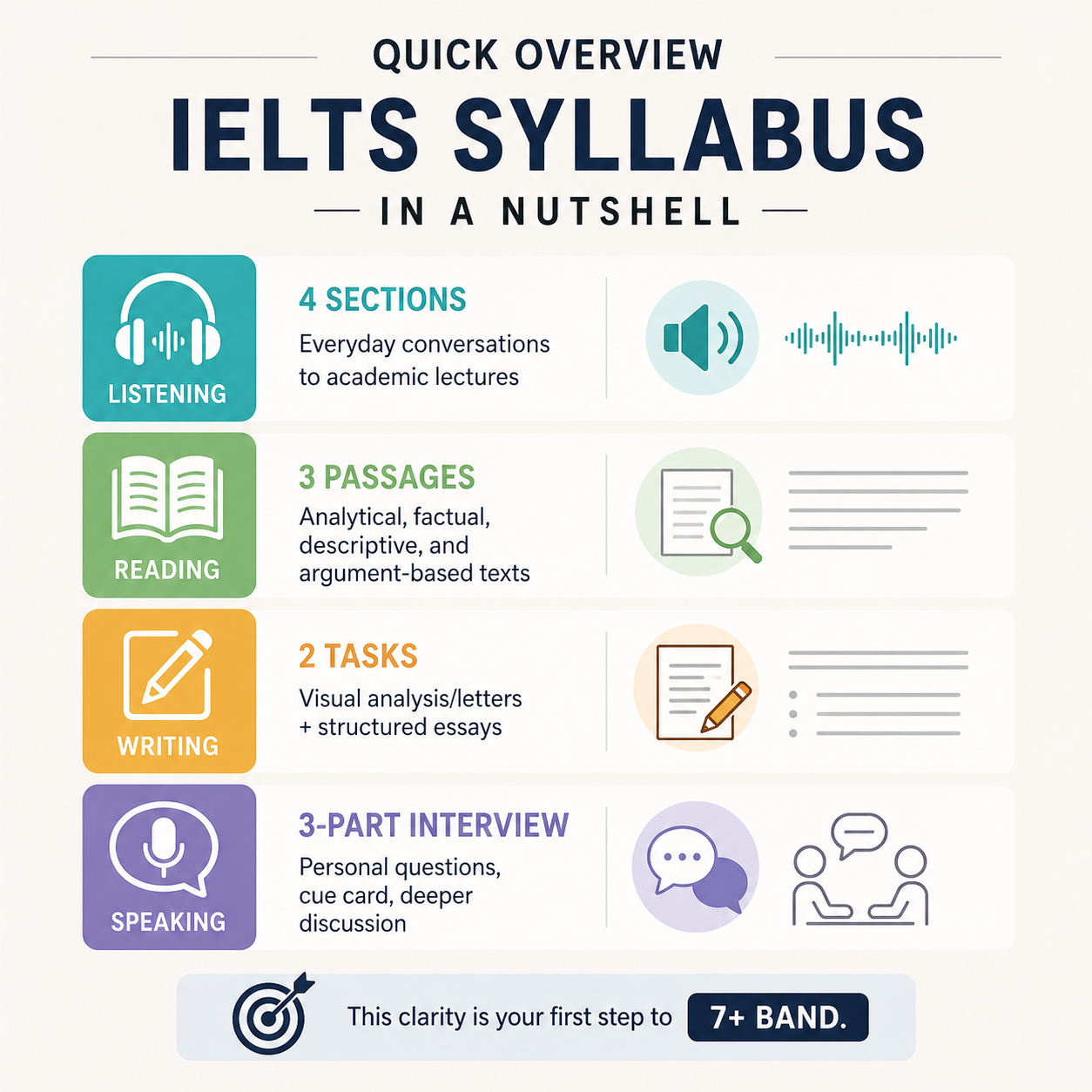
The IELTS Exam is divided into four core sections, Listening, Reading, Writing, and Speaking. However, what many students overlook is the purpose behind each of these components. While the test evaluates your English Proficiency, it also assesses how well you can function in real academic or professional settings.
Listening measures your ability to understand conversations and lectures, Reading evaluates how effectively you can process and interpret written information, Writing tests your ability to present ideas clearly and logically, and Speaking assesses your fluency, clarity, and confidence in real-life communication.
What IELTS Listening Covers: Conversations, Monologues & Academic Contexts
Listening has four parts, each becoming progressively more complex:
- Part 1: Everyday conversation (booking, enquiry, travel, accommodation)
- Part 2: Speech or monologue (maps, instructions, overviews)
- Part 3: Academic group discussion (students discussing projects, seminars)
- Part 4: University-style lecture (facts, research, academic ideas)
You’ll face multiple accents like the British, Australian, American, Canadian because that’s what real classrooms and workplaces sound like. The syllabus is designed to check your attention to detail, note-taking ability, and adaptability to changing contexts.
The IELTS Reading Syllabus: Three Sections, One Goal, Deep Comprehension
The Reading syllabus varies slightly for Academic and General Training, but the skill requirement remains the same: can you extract meaning quickly and accurately?
For Academic Reading, expect:
- Complex passages from journals, magazines, research papers, academic books
- 40 questions across formats like MCQs, headings match, True/False/Not Given, sentence completions
For General Training Reading, you’ll see:
- Everyday notices, ads, workplace documents
- One longer general-topic article for deeper comprehension
No matter the module, the real challenge is time pressure. The syllabus tests skimming, scanning, inference, vocabulary interpretation, and pattern recognition.
The IELTS Writing Syllabus: Task 1 + Task 2 Skill Assessment
Writing is the section where most students lose marks, not because it’s tough but because they misunderstand the expectations.
Academic Writing
- Task 1: Summarise visual data (graphs, charts, processes, maps)
- Task 2: Essay on an academic or global issue
General Training Writing
- Task 1: Write a formal/semi-formal/informal letter
- Task 2: Essay on a general-topic issue
The syllabus focuses on:
- Coherence and cohesion
- Grammar range and accuracy
- Lexical resource (vocabulary)
- Task achievement
Essentially, IELTS Writing checks if you can articulate complex ideas clearly and logically, just as you would in reports or university assignments.
The IELTS Speaking Syllabus: A Real Conversation, not a Test
Speaking is a face-to-face interview divided into three stages:
- Part 1: Introduction + familiar topics (home, hobbies, work, studies)
- Part 2: One-minute preparation + two-minute long turn on a cue card topic
- Part 3: Analytical follow-up questions exploring deeper ideas
The Speaking syllabus evaluates:
- Fluency and coherence
- Pronunciation (accent is NOT graded)
- Vocabulary range
- Ability to express opinions and expand ideas
It’s designed to mimic real, social, academic, and professional conversations where you need to think, respond, adapt, and explain.
Why the IELTS Syllabus Matters More Than the Test Format
Several candidates plunge themselves directly into practice exams without even having an idea of what the IELTS Test intends to measure, just like entering water without first checking its depth.
The syllabus will serve as a map for you as it will assist you in finding out where exactly you need to work hard to enhance your capabilities, what kind of questions you should expect in the exam, and how you can expedite the process.
After understanding your syllabus, you will find yourself well prepared for the test.
Should You Study the Syllabus First or Start Practising?
The ideal approach is both. Start with the syllabus to understand expectations, then immediately begin practising systematically. Mock tests without syllabus understanding leave you confused. Syllabus without practice leaves you unprepared. Smart preparation blends both.
Crack IELTS with the Right Syllabus Strategy – Prepare with MetaApply IE
Once you understand the IELTS syllabus, the test stops feeling unpredictable. You can plan better, practise smarter, and approach the exam with confidence and that’s exactly what helps students consistently reach Band 7 and above. At MetaApply IE, we offer expert counselling to help you find the right course, college, and destination. Our team supports you throughout the process, from application submission to securing financial aid and preparing for visa interviews. We ensure that every detail is taken care of, making your journey smooth and hassle-free. We also have TestPrep and Career Counselling, and our expert counsellors take care of all your study abroad needs. If you feel like you can make a difference and want to study abroad, or if pursuing your Education Abroad is the ideal choice, we offer expert counselling to help you find the right course, college, and destination. Our team supports you throughout the process, from application submission to securing financial aid and preparing for visa interviews.
Frequently Asked Questions
The IELTS syllabus covers four modules which include Listening, Reading, Writing, and Speaking. Each section evaluates different language skills needed for academic, professional, and everyday communication.
Yes. While Listening and Speaking are the same for both, Reading and Writing differ. Academic tests higher-level academic skills, while General Training focuses on every day and workplace communication.
Listening has 40 questions, Reading has 40 questions, Writing contains 2 tasks, and Speaking consists of a 3-part interview. The total test time is around 2 hours and 45 minutes.
IELTS doesn’t repeat exact questions, but the themes, formats, and skill types remain consistent. Understanding the syllabus helps you anticipate question patterns and prepare more effectively.
Start by understanding each module’s requirements, then practise with sample questions, timed mock tests, and structured preparation plans. Getting expert feedback on Writing and Speaking can significantly boost your score.
Related Blogs