
GMAT Exam Pattern: Detailed Guide for Indian Students
GMAT Exam Pattern: Detailed Guide for Indian Students

If you’re planning to study abroad for an MBA or a master’s programme, the GMAT is probably already on your checklist. But most students get confused about the exam pattern like how many sections does the GMAT have, how long is it, what’s the scoring pattern, and how tough is it really?
This guide breaks down the latest GMAT Exam Pattern (Focus Edition) in a simple and easy-to-understand way, so you know exactly what to expect on test day. As one of the most important Exams to Study Abroad, understanding the GMAT structure can help you prepare more confidently and improve your chances of getting into top international universities.
Let’s get started.
1. Understanding the GMAT: A Quick Overview
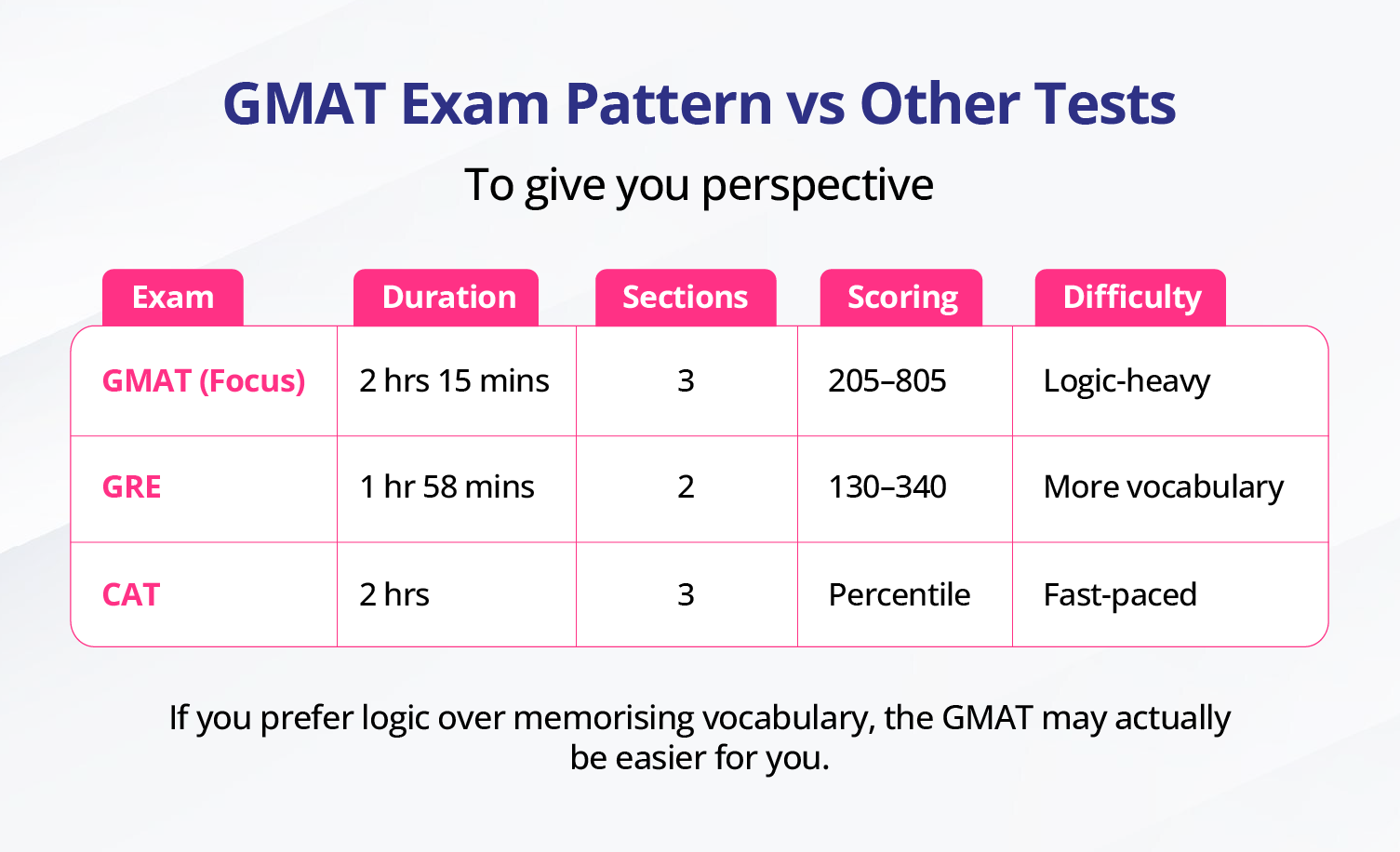
The GMAT (Graduate Management Admission Test) is a standardised test used by top business schools globally. In 2024, GMAC officially replaced the older version with the GMAT Focus Edition, making it shorter, more streamlined, and more relevant to modern business skills.
Here’s what changed:
- The test is now 2 hours and 15 minutes long (much shorter than before).
- It has 3 core sections instead of 4.
- The AWA (Essay) section has been removed.
- You can choose the order of sections.
- There’s a new Data Insights section combining data interpretation, reasoning, and visual data analysis.
- Scoring has been updated to a 205–805 scale.
Understanding the pattern is half the preparation; so, let’s dive into the structure.
2. GMAT Exam Pattern 2026: Section-Wise Breakdown
The GMAT Focus Edition consists of 3 sections:
- Quantitative Reasoning (QR)
- Verbal Reasoning (VR)
- Data Insights (DI)
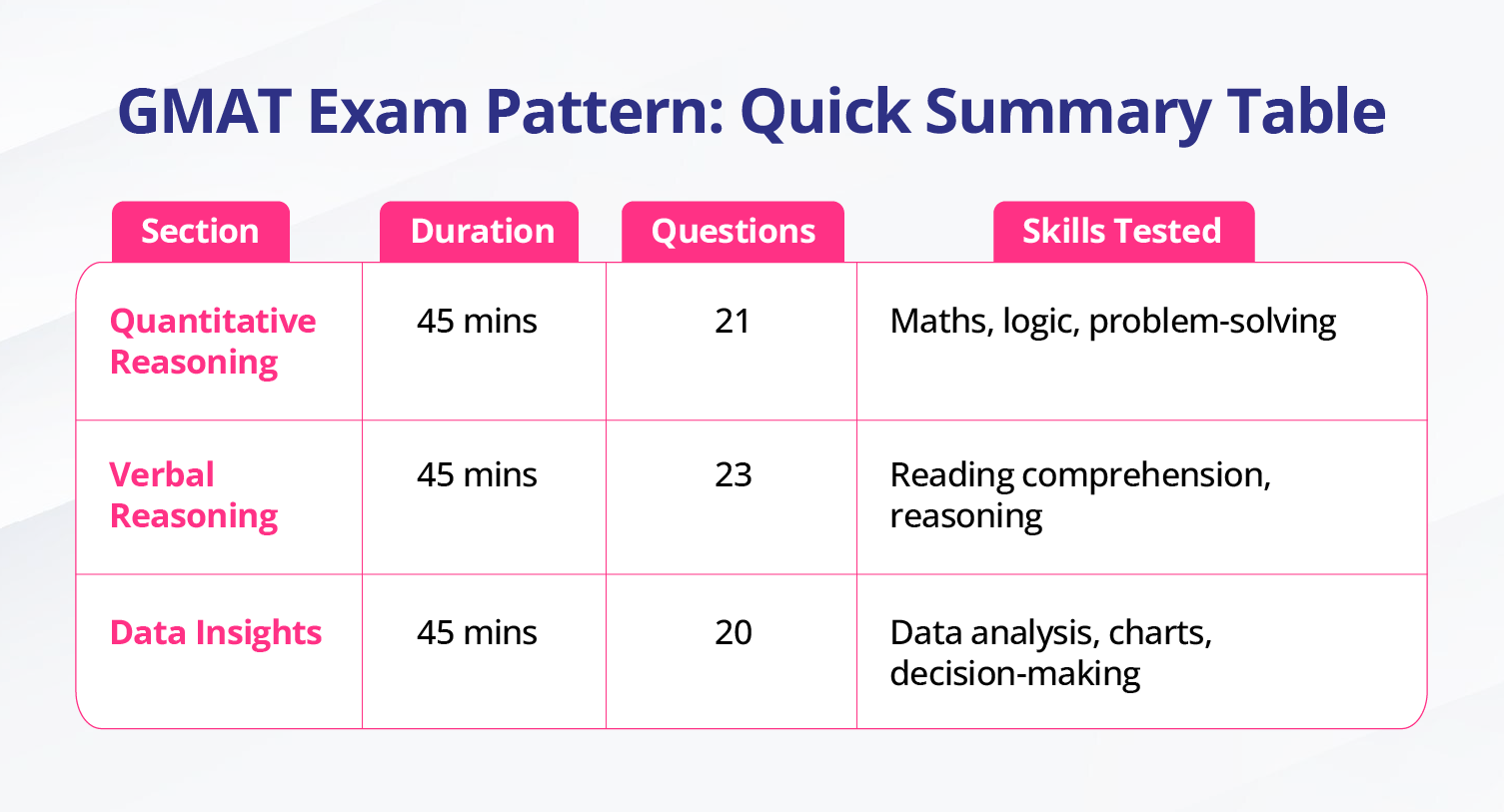
Each section is 45 minutes long, giving the full exam a total duration of 2 hours 15 minutes.
2.1 Quantitative Reasoning (QR)
Duration: 45 minutes
Number of Questions: 21
Question Types:
- Problem Solving
- Data Sufficiency (integrated within the question types)
What this section tests:
Your ability to analyse numerical problems, understand mathematical concepts, and make data-driven decisions.
Topics Covered:
- Arithmetic
- Algebra
- Word Problems
- Ratios & Percentages
- Probability & Statistics
- Geometry (very limited)
Key highlight:
You don’t need advanced mathematics. School-level maths is enough, but you must be fast and accurate.
2.2 Verbal Reasoning (VR)
Duration: 45 minutes
Number of Questions: 23
Question Types:
- Reading Comprehension
- Critical Reasoning
Removed:
Sentence Correction (this was part of the older GMAT)
What this section tests:
The ability to understand complex passages, evaluate arguments, and draw logical conclusions.
Topics Covered:
- Inference
- Main idea questions
- Strengthen/Weaken arguments
- Assumptions
- Logical structure
- Author’s tone and purpose
Pro tip:
VR is all about logic, not grammar. Even students who fear English can score well with smart practice.
2.3 Data Insights (DI)
This is the newest and most business-relevant section.
Duration: 45 minutes
Number of Questions: 20
Question Types:
- Data Sufficiency
- Table Analysis
- Graphics Interpretation
- Multi-Source Reasoning
- Two-Part Analysis
What it tests:
Your ability to interpret charts, graphs, spreadsheets, and mixed data formats.
Why it matters:
Business schools emphasise data literacy. This section reflects the analytical skills required in modern management roles.
3. GMAT Exam Flow: How the Test Works
You have the freedom to choose the order of sections. This is a big advantage.
You can pick any of the following sequences:
- QR → VR → DI
- VR → QR → DI
- DI → VR → QR
Choose the order that matches your strengths.
4. Adaptive Nature of the GMAT
The GMAT is a Question-Adaptive Test within each section.
Here’s what that means:
- The test adjusts to your performance.
- If you answer correctly, you get harder questions.
- If you answer incorrectly, the questions get easier.
- Your score depends on not just accuracy but also the difficulty level of the questions you reach.
This makes the exam smart and personalised but also means you need consistency.
5. GMAT Scoring Pattern (Latest)
The GMAT Focus Edition uses a 205–805 score scale.
Each section contributes equally to your final score.
Section Scores
- Quant: 60–90
- Verbal: 60–90
- Data Insights: 60–90
These combine to form your overall GMAT score.
Important:
There is no negative marking, but skipping questions or running out of time impacts your score.
6. Time Management Breakdown
Each section is only 45 minutes, perfecting your timing is crucial.
Here’s a smart time allocation suggestion:
Quantitative Reasoning
21 questions → approx. 2 minutes per question
(Use the on-screen calculator only in the DI section)
Verbal Reasoning
23 questions → ~2 minutes per question
(Focus on eliminating wrong options quickly)
Data Insights
20 questions → ~2–2.25 minutes per question
(Charts and graphs take slightly longer)
Time management can make or break your GMAT score.
7. What Makes the GMAT Pattern Unique?
- It rewards logic more than theory.
- It values clarity of thought over memorisation.
- It has no essay, making preparation quicker.
- It focuses on business-related skills like data reading and reasoning.
- You can choose your best five attempts to share with universities.
This exam pattern is designed for modern students and real-world decision-making.
8. How to Prepare According to the Pattern
Since the pattern is clear and predictable, you can plan accordingly:
Step 1: Master the concepts section-wise
Build strong basics in quant, verbal logic, and data interpretation.
Step 2: Practice adaptive mock tests
This helps you understand question difficulty progression.
Step 3: Learn timing techniques
Set a timer while practising questions.
Step 4: Build DI skills
This is the section most students find tricky.
Step 5: Track your performance
Notice which section drains your time and which needs more attention.
Why Choose MetaApply IE for Your Study Abroad Journey?
At MetaApply IE, we offer expert counselling to help you find the right course, college, and destination. Our dedicated counsellors take care of all your study-abroad needs, from application submission to securing financial aid and preparing for visa interviews. With added support through our TestPrep and Career Counselling services, we ensure every detail is managed with precision, making your journey smooth and stress-free. If you believe you can make a difference and feel that studying abroad is the right next step, MetaApply IE is here to guide you at every stage, helping you turn your ambitions into global opportunities.
Submit the given form to start your study abroad journey with us.
Frequently Asked Questions
There are three sections: Quantitative Reasoning, Verbal Reasoning, and Data Insights.
The exam lasts 2 hours and 15 minutes, making it one of the shortest global entrance tests.
It’s not conceptually difficult, but it is logic-intensive and requires smart time management.
No, there is no negative marking, but unanswered questions affect your score.
Yes, you can choose any one of the three section orders before starting the exam.
Related Blogs