
The Smartest Countries to Study Hotel Management in 2026 (Before Seats Fill Up)
Low-Cost MBBS Abroad in the UK: What Students Need to Know

The moment someone searches for low-cost MBBS abroad UK, the reaction is almost automatic, it cannot be affordable. The UK feels like a premium destination, something to consider only if budget is not a concern. But that assumption misses the bigger picture.
Because Low-cost MBBS Abroad UK is not about low tuition on paper, it is about reducing wasted years, avoiding uncertain pathways, and stepping into a structured medical career faster. When students begin to evaluate low-cost MBBS abroad UK through outcomes rather than just fees, it stops looking expensive and starts looking efficient.
And that shift in perspective changes everything.
The “Cheap” Trap Most Students Walk Into
Choosing a destination purely because it looks affordable often leads to decisions that feel right initially but become complicated later.
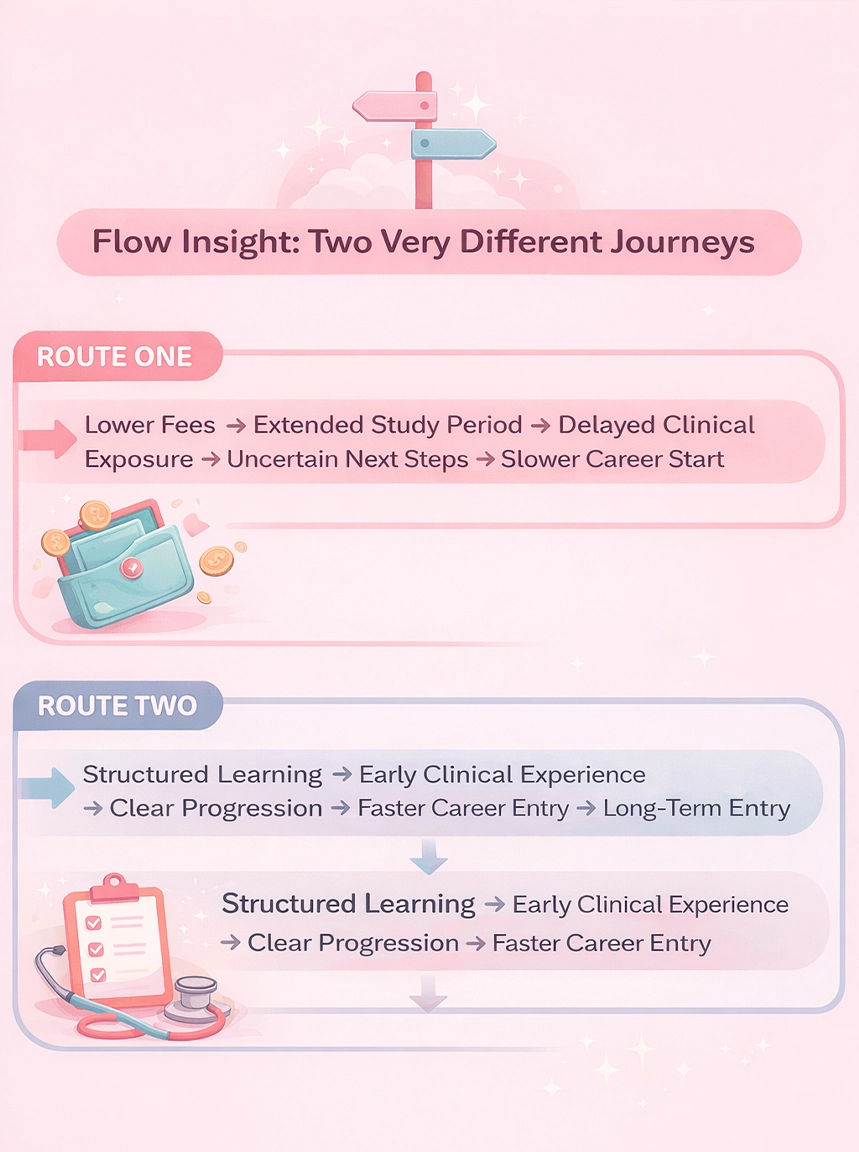
Lower tuition can come with longer course durations, inconsistent clinical exposure, and unclear next steps after graduation. What looks like savings in the beginning slowly turns into extended timelines and delayed career entry.
This is where low-cost MBBS abroad in UK begins to stand apart, not because it is the cheapest, but because it avoids these hidden setbacks entirely.
Time Is the Cost You Do Not See
Every additional year in Medical Education adds pressure: financially and professionally. Living expenses continue, academic timelines stretch, and the start of your career keeps getting pushed further away.
The UK follows a more structured and time-conscious approach. Students move through their education with a clear progression, ensuring that they do not lose years navigating uncertainty.
A Different Kind of Learning Curve
In many destinations, students spend years building theoretical knowledge before stepping into real clinical environments. This creates a gap between what is learned and what is practised.
The UK takes a different approach. Learning is closely connected with practical exposure, allowing students to engage with real healthcare settings much earlier. This builds confidence gradually and prepares students for the realities of the profession while they are still studying.
Core Medical Degree Pathways in the UK
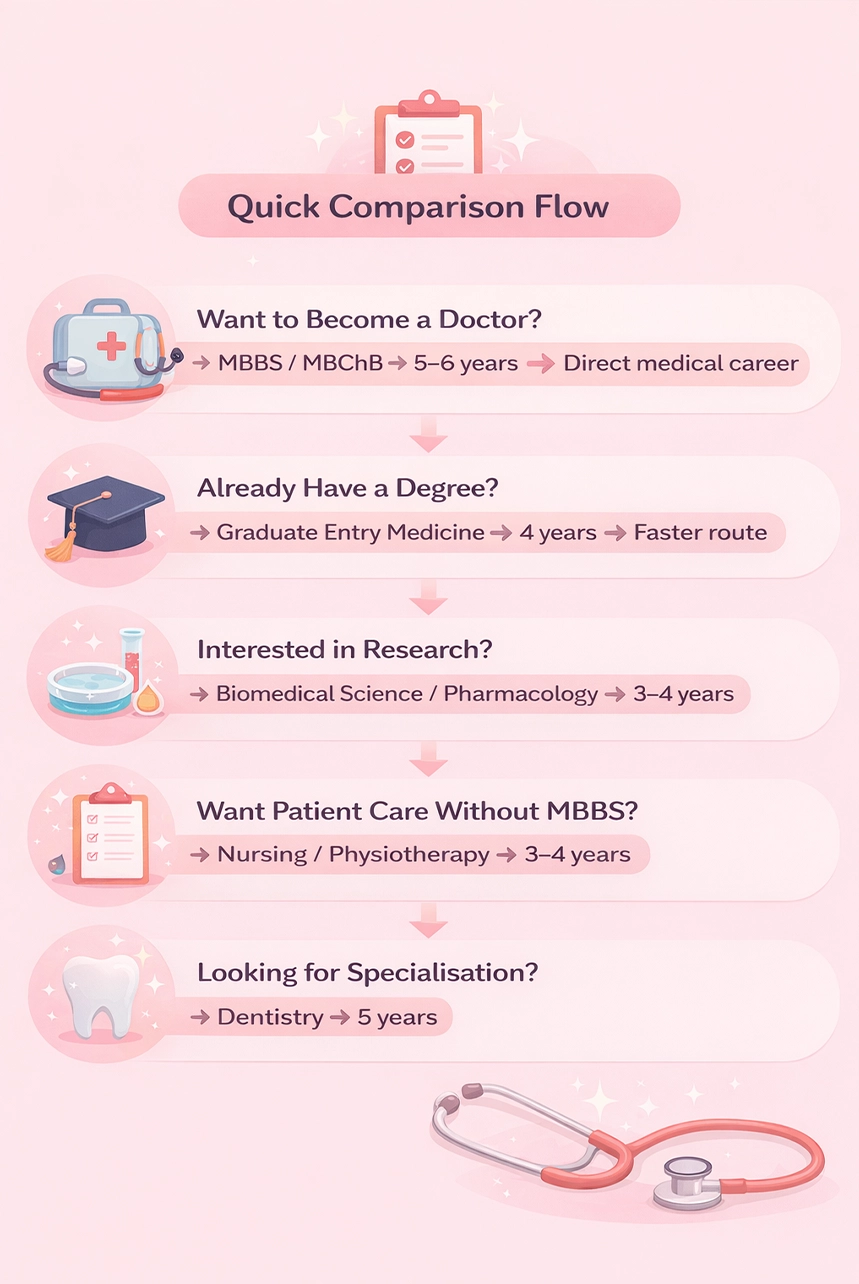
1. MBBS / MBChB (Bachelor of Medicine, Bachelor of Surgery)
Duration: 5–6 years
This is the primary Medical Degree in the UK and the foundation for Becoming a Doctor.
Why it stands out:
- Early and continuous clinical exposure
- Direct pathway into structured training after graduation
- Strong global recognition
- Integration of theory with real hospital experience
Best for:
Students who want to become practising doctors with a clear, structured career path.
Specialised & Alternative Medical Degrees (High-Value Options)
2. Graduate Entry Medicine (GEM)
Duration: 4 years
A fast-track medical degree designed for students who already hold a prior undergraduate degree (usually in a science-related field).
Why it stands out:
- Shorter duration compared to traditional MBBS
- Intensive and focused learning
- Faster entry into the medical profession
Best for:
Students looking to switch to medicine or accelerate their journey.
3. Biomedical Science
Duration: 3–4 years
Focuses on the science behind medicine: diseases, diagnostics, and research.
Why it stands out:
- Strong foundation for research and lab-based careers
- Pathway into medicine, healthcare, or postgraduate specialisation
- Opportunities in pharmaceuticals and clinical research
Best for:
Students interested in the science of medicine rather than direct patient care.
4. Medicine with Foundation Year
Duration: 6 years
Includes an additional preparatory year before the core medical programme.
Why it stands out:
- Ideal for students who need academic bridging
- Smooth transition into medical education
- Same end qualification as MBBS/MBChB
Best for:
Students who want a supportive entry into medicine without compromising on future outcomes.
5. Medical Pharmacology
Duration: 3–4 years
Focuses on how drugs work, development of medicines, and treatment mechanisms.
Why it stands out:
- Key role in drug development and clinical trials
- Strong demand in pharmaceutical industries
- Combines medicine with research and innovation
Best for:
Students interested in medicines, research, and the pharmaceutical sector.
6. Public Health / Global Health
Duration: 3–4 years (undergraduate) / 1 year (postgraduate)
Centred on population health, disease prevention, and healthcare systems.
Why it stands out:
- Focus on large-scale impact rather than individual treatment
- Opportunities in global organisations and policy-making
- Growing relevance in modern healthcare systems
Best for:
Students who want to work on healthcare at a community or global level.
7. Nursing (Adult / Mental Health / Child Health)
Duration: 3 years
A practical and patient-focused Healthcare Degree.
Why it stands out:
- High employability
- Hands-on clinical training from early stages
- Direct entry into healthcare roles
Best for:
Students who want a fast, practical route into patient care.
8. Physiotherapy
Duration: 3–4 years
Focuses on rehabilitation, movement, and physical recovery.
Why it stands out:
- Strong demand in hospitals, sports, and rehabilitation centres
- Hands-on, skill-based profession
- Opportunities in both clinical and private practice
Best for:
Students interested in recovery, movement science, and patient rehabilitation.
9. Dentistry (BDS)
Duration: 5 years
Focused on oral health and dental care.
Why it stands out:
- Early clinical exposure
- Opportunity for independent practice
- High demand globally
Best for:
Students interested in a specialised, patient-facing medical career.
How to Choose the Right Path
Instead of asking “which is best,” ask:
- Do you want direct patient care or research?
- Do you prefer a long-term structured path or faster entry into the workforce?
- Are you aiming for global mobility or specialised expertise?
The UK offers flexibility, whether you want to become a doctor, a specialist, or a healthcare professional with a focused skill set.
Clarity After Graduation Changes Everything
One of the most stressful phases for medical students is not studying, it is what comes after.
In several countries, students complete their degree only to face competitive exams, limited opportunities, and unclear progression pathways. This uncertainty often leads to delays and repeated attempts to secure the next step.
The UK offers a more defined transition. Students move into structured training phases that guide them into the healthcare system. This clarity removes the guesswork and allows students to focus on growth instead of navigating confusion.
The Emotional Side of the Decision
Studying Medicine Abroad is not just an academic journey. It is also about adapting to a new environment, managing pressure, and staying motivated through years of rigorous training.
A structured system, diverse communities, and familiar academic frameworks can make this transition smoother. Students are less likely to feel lost and more likely to stay focused on their goals.
This emotional stability is rarely discussed, yet it plays a major role in long-term success.
When looked at in isolation, tuition fees may seem higher. But when viewed in context, the UK offers:
- Faster progression into the medical field
- Reduced uncertainty after graduation
- Strong global recognition
- Earlier transition into structured roles
All of these factors contribute to a more efficient and outcome-driven journey.
Turn the Right Decision into a Stronger Future with MetaApply IE
In the end, the decision is not about comparing numbers, it is about understanding outcomes. It is also about avoiding delays, gaining the right exposure, and entering the medical profession with clarity and confidence. But making the right choice is only the beginning. What truly shapes your journey is how well each step is planned and executed.
At MetaApply IE, the focus is on helping you build a medical career that starts strong and stays strong. With expert counselling, you are guided towards the right course, the right college, and the right destination based on your goals. From shortlisting options to submitting applications, from securing financial aid to preparing for visa interviews, every stage is handled with precision and care.
With dedicated support in TestPrep and Career Counselling, the approach goes beyond admissions. It ensures that you are fully prepared, not just to study abroad, but to succeed in a global medical career.
If you are ready to make a decision that moves you forward, pursuing your education abroad can be the step that defines your future. And with the right guidance, your journey becomes not just possible, but seamless. Fill in the form today.
Frequently Asked Questions
Yes, when considering long-term value such as career progression and early earning potential, it becomes a cost-effective option.
Most programmes are completed within 5 to 6 years with integrated clinical exposure.
The UK offers structured progression, early clinical training, and clear pathways into the medical profession.
Yes, it is widely respected and allows for broader career opportunities.
Because it offers faster career entry, reduced uncertainty, and stronger long-term outcomes.
Related Blogs