Discover the Leading Universities in Switzerland
Study in Netherlands 2027: Why Indian Students Must Start in September 2026

The Netherlands has quietly become one of the smartest study-abroad choices for Indian students. Over 2,800 English-taught programmes, globally ranked universities, low tuition compared to the UK or USA, and a one-year post-study work permit make it a destination worth serious consideration. But here’s what most students miss — the application deadlines come early. Very early.
If you plan to Study in Netherlands 2027 for the September intake, the most competitive programmes close their applications by 15 January 2027, and most non-EU master’s deadlines fall by 1 April 2027. That means September 2026 is when you need to begin — IELTS, transcripts, motivation letter, and university shortlisting all happen in the final quarter of 2026, not in early 2027.
This guide walks you through which Dutch Universities to target, what they cost, which Holland scholarships you can actually win, and the exact week-by-week timeline you need to follow.
Want help building your Netherlands application from scratch? Talk to a MetaApply counsellor for free — we’ve guided hundreds of Indian students through this exact process.
Why Indian Students Choose to Study in Netherlands 2027
The Netherlands offers something rare: top European education, taught entirely in English, at prices significantly below the UK or USA.
Globally Ranked Dutch Universities
Thirteen Dutch universities feature in the QS World University Rankings 2026, with seven inside the global top 150. TU Delft (#56), University of Amsterdam (#60), and Utrecht University (#107) lead the pack. For technology, business, and life sciences, the Netherlands punches well above its weight.
English Is the Default
Over 2,800 programmes at Dutch universities are taught entirely in English, which is the highest count of any non-English-speaking country in Europe. You don’t need to learn Dutch to complete your degree or to work in tech, consulting, or finance roles afterward.
Lower Tuition Than UK or USA
Non-EU tuition at Public Dutch Universities ranges from €8,000 to €20,000 per year, which is 40–60% lower than equivalent programmes in the UK. Bachelor’s programmes start around €8,000–€12,000, master’s around €14,000–€22,000.
Strong Post-Study Career Path
After graduating from a Dutch university, you qualify for the Orientation Year (Zoekjaar) residence permit — one year of full-time work rights to find a graduate-level job. Average starting salaries in tech and engineering range from €45,000 to €60,000 per year, which translates to roughly ₹42–56 lakh annually.
Top Dutch Universities for International Students
These are the institutions Indian students should focus on for the September 2027 intake.
1. TU Delft (Delft University of Technology)
The Netherlands’ top technical university and one of Europe’s best for aerospace, civil engineering, Computer Science, and industrial design. Tuition for non-EU master’s students is around €22,000 per year. Non-EU master’s deadline for September 2027: typically 1 January or 1 April 2027 depending on programme.
2. University of Amsterdam (UvA)
A research-led university with strong programmes in business, economics, computer science, and humanities. Non-EU tuition: €15,000–€25,000 per year. Application deadline for non-EU applicants is 1 April 2027 for most master’s programmes.
3. Eindhoven University of Technology (TU/e)
A standout for electrical engineering, data science, AI, and automotive technology. Deeply linked with ASML, Philips, and the broader Brainport tech ecosystem. Tuition: around €18,000–€22,000 per year for non-EU students.
4. Utrecht University
One of the oldest Universities in the Netherlands with excellent programmes in life sciences, sustainability, and social sciences. Tuition: €17,000–€20,000 per year.
5. University of Groningen
Strong in life sciences, business, AI, and economics. Tuition is slightly lower at €14,000–€18,000 per year, and Groningen is one of the most affordable cities in the Netherlands.
6. Erasmus University Rotterdam
Globally respected for business, economics, and medicine. The Rotterdam School of Management is among Europe’s top business schools. Non-EU tuition: €15,000–€22,000 per year.
7. Maastricht University
Known for its Problem-Based Learning approach. Strong in business, European law, health sciences, and international relations. Tuition: €16,000–€20,000 per year.
For a broader European comparison, see our guide to top courses across European universities.
Cost of Studying in Netherlands 2027
Here’s a realistic breakdown of what an Indian student should budget for year one.
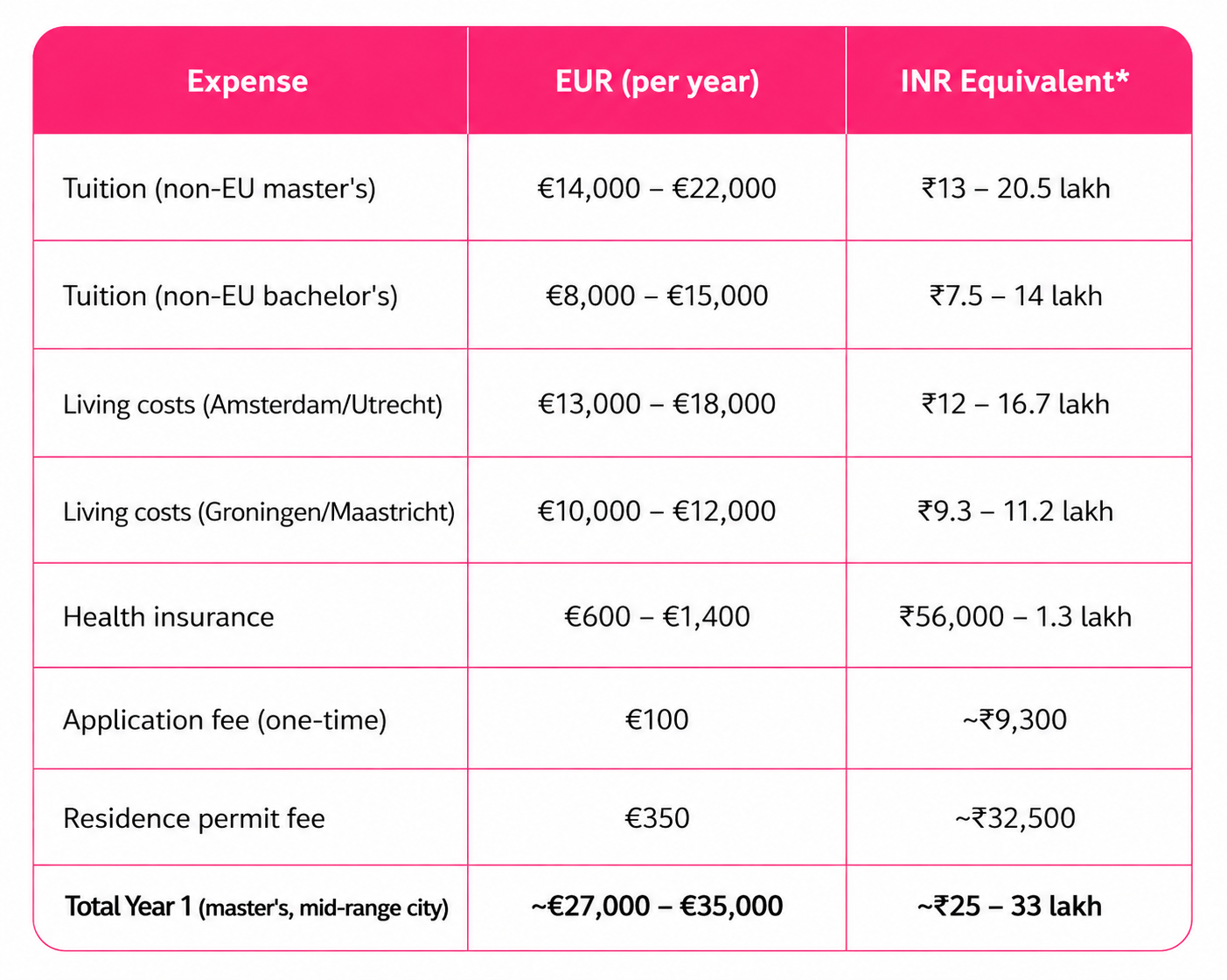
Approximate at €1 = ₹93. Use our Abroad Budget Calculator for live estimates.
Most Indian students fund this through a combination of family contribution, education loan, and scholarship. Indian banks offer Education Loans for Top Dutch Universities up to ₹50 lakh, often without collateral. Explore MetaFinance education loan options designed for Indian students going abroad.
Holland Scholarships and Other Funding Options
Scholarships in the Netherlands are competitive but worth applying for. Most are partial rather than fully funded, so plan to combine 2–3 sources.
NL Scholarship (formerly Holland Scholarship)
The most well-known Holland scholarship for non-EU students. Funded jointly by the Dutch Ministry of Education and over 47 participating Dutch universities and universities of applied sciences. The award is a one-time €5,000 grant (approximately ₹4.65 lakh) paid in the first year of study. It’s not a full-tuition scholarship, but it meaningfully reduces year-one costs. Apply directly through your chosen university by the deadline, usually 1 February or 1 May 2027 depending on the institution.
University-Specific Scholarships
- University of Twente Scholarship (UTS): €3,000 to €22,000 per year for master’s students. Deadline: 1 February 2027.
- Amsterdam Merit Scholarship: Partial or full tuition waivers for outstanding non-EU master’s students at UvA.
- VU Fellowship Programme (VUFP): Full tuition reduction to the lower EEA rate plus living allowance for top master’s applicants at VU Amsterdam.
- Maastricht University NL-High Potential Scholarship: Full tuition, monthly living allowance, travel allowance, and health insurance. Highly competitive — usually 10–15 awards per intake.
- Eric Bleumink Fund (University of Groningen): Tuition, living allowance, books, travel, and insurance for students from developing countries including India.
- Leiden University Excellence Scholarship (LExS): €10,000, €15,000, or full tuition minus the statutory rate for selected master’s students.
Erasmus Mundus Joint Masters
Several fully funded Erasmus Mundus programmes are coordinated by Dutch universities and cover tuition, living, and travel. These are awarded by the EU rather than individual universities and typically close in mid-January.
For the complete list of approved Dutch institutions and scholarship updates, visit the official Nuffic portal.
Netherlands Student Visa and Orientation Year
The Netherlands uses a streamlined visa process that runs through your university, not the embassy directly. This makes the system simpler than most European destinations.
Documents You Need
- Valid passport
- University admission letter
- Proof of financial means — approximately €14,500–€16,500 in your bank account or sponsored
- Health insurance
- IELTS 6.5+ or TOEFL 90+ (programme-specific minimums apply)
- Academic transcripts and certificates
- Statement of motivation
How the Visa Works
Your Dutch university acts as your sponsor. Once you accept your offer, the university initiates your MVV (entry visa) and residence permit application with Dutch immigration (IND). Processing usually takes 2 to 4 weeks – significantly faster than US or Canada visas.
The IND fee is around €350, and the residence permit covers your entire study duration.
The Orientation Year (Zoekjaar)
After graduation, you can apply for the Zoekjaar residence permit — a one-year permit to find a skilled job in the Netherlands. During this year, you have full work rights with no employer sponsorship required. Once you find qualifying employment, you transition to a regular work-based residence permit.
Application Timeline: Why September 2026 Is Your Starting Line
This is the single most important section of this guide. The Netherlands has earlier non-EU deadlines than most European destinations, and missing one closed door usually means waiting a full year.
Most Dutch universities open applications for the September 2027 intake between October 2026 and December 2026. Numerus Fixus programmes close on 15 January 2027, scholarship deadlines fall around 1 February 2027, and standard non-EU master’s deadlines close by 1 April 2027. Start preparing in September 2026 to increase your admit chances.
Here is the exact timeline to study in Netherlands 2027 (September 2027 intake):
- September 2026: Shortlist 5–7 programmes across 3–4 universities. Begin IELTS Preparation if not yet tested.
- October 2026: Take your IELTS or TOEFL. Request academic transcripts and letters of recommendation.
- November 2026: Draft your motivation letter for each university (each needs to be programme-specific). Get documents notarised.
- December 2026: Polish your CV. Finalise motivation letters. Open your Studielink account (the national application portal for Dutch universities).
- 15 January 2027: Hard deadline for Numerus Fixus programmes — medicine, dentistry, psychology, international business administration, and similar. No extensions.
- 1 February 2027: Deadline for several scholarship-linked applications including University of Twente, Maastricht NL-High Potential, and Erasmus Mundus.
- 1 April 2027: Standard non-EU deadline for most bachelor’s and master’s programmes at TU Delft, UvA, Radboud, and others.
- April – June 2027: Admission decisions. Accept your offer, pay tuition deposit.
- June – July 2027: Visa and residence permit processing through your university.
- August 2027: Travel, accommodation arrangements, IND registration.
- September 2027: Studies begin.
If you start in January 2027 instead of September 2026, you will miss the best programmes. We see this happen every single year with Indian applicants who underestimate the Dutch calendar.
How MetaApply Helps You Study in Netherlands 2027
Picking a Dutch university is the easy part. Writing a motivation letter that wins a scholarship, hitting the 15 January Numerus Fixus deadline, opening Studielink correctly, and clearing the IND residence permit process — that’s where most Indian students get stuck. MetaApply IE’s counsellors work with you through every stage.
We know exactly what TU Delft, UvA, Eindhoven, and Maastricht admission committees look for. We help with university shortlisting, scholarship strategy, motivation letter editing, application submission, and visa preparation. Your first counselling session is free.
Ready to Study in Netherlands 2027?
Thousands of Indian students have built international careers through MetaApply IE guidance. For the Netherlands specifically, we help you choose the right Dutch university, write a scholarship-worthy motivation letter, hit every deadline from 15 January onward, and clear the visa process well before your September 2027 start.
If you’re targeting the 2027 intake, your preparation starts now — not in January.
Talk to a MetaApply Counsellor — It’s Free
Frequently Asked Questions
Most Dutch universities open applications for the September 2027 intake between October 2026 and December 2026. Numerus Fixus programmes close on 15 January 2027, scholarship deadlines fall around 1 February 2027, and standard non-EU master's deadlines close by 1 April 2027. Start preparing in September 2026.
Plan for approximately ₹25–33 lakh in year one, including tuition (₹13–20 lakh), living costs (₹9–17 lakh), insurance, visa, and one-time fees. Scholarships and education loans can reduce this significantly, and cities like Groningen and Maastricht are cheaper than Amsterdam or Utrecht.
Yes. The NL Scholarship (formerly Holland Scholarship) is a €5,000 one-time grant for non-EEA students applying to participating Dutch universities for a bachelor's or master's. Indian students qualify if they have a strong academic record and apply by the university's set deadline, usually February or May 2027.
No. Over 2,800 programmes at Dutch universities are taught entirely in English, especially at master's level. You can complete your degree and find a graduate job in tech, business, or engineering without speaking Dutch — though learning the basics helps with daily life and long-term integration.
Yes. After graduating, you qualify for the Orientation Year (Zoekjaar) residence permit, which gives you one year of full work rights to find a skilled job. Once employed, you can transition to a work-based residence permit and eventually apply for permanent residency.
Related Blogs