
Study Abroad Programs in 2026: A Complete Guide for Indian Students
Study Abroad Roadmap 2026 – Your Complete Strategic Guide

Well, you cannot navigate your life with a Google Map. If only it were that simple. Many people wish that, just like road signs on a motorway, there were clear directions guiding their choices in education and career. Imagine signboards that read, “Turn here for better opportunities” or “Next exit for global exposure.”
But life does not come with such instructions. That is exactly why so many students feel uncertain when planning to study abroad. They scroll endlessly, compare countries without real context, worry about finances, postpone important decisions, and eventually miss critical deadlines.
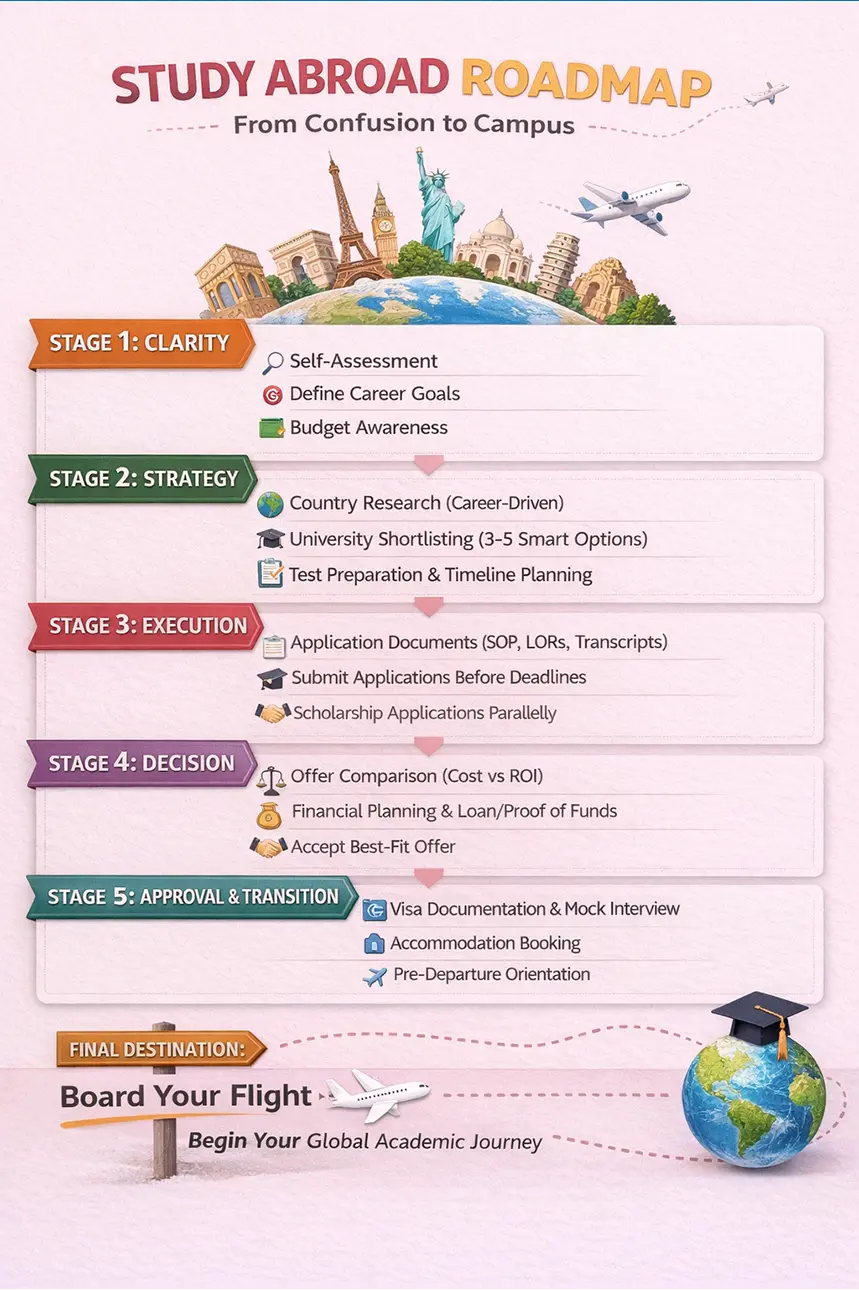
The problem is not a lack of ambition or ability. It is a lack of structure. Without a clear plan, even the most capable student can feel overwhelmed. This blog offers that structure; a practical, value-driven roadmap that highlights where students usually fall behind, which mistakes cost them time and money, and what you must do differently to move from confusion to departure with clarity and confidence.
The Real Problem No One Admits
The biggest mistake students make is treating Study Abroad as an emotional decision instead of a strategic one. They follow trends, choose destinations based on popularity, and assume that a top-ranked university automatically guarantees success. When decisions are driven by excitement rather than clarity, the result is confusion. Deadlines are missed, documentation is rushed, finances are miscalculated, and visa anxiety takes over. The solution is not more information. It is structured direction. Once you replace randomness with planning, the entire process becomes manageable.
Start With Self-Clarity Before Anything Else
Most students begin their journey by searching for universities. That is the wrong starting point. The right starting point is self-clarity. You must ask yourself why you want to study abroad. Is it for career acceleration, research exposure, migration prospects, or global networking? What kind of role do you see yourself in five years from now? What subjects genuinely interest you, and what is your realistic financial capacity? Without these answers, you are building your future on uncertainty. When clarity comes first, every decision that follows becomes easier and more logical.
Choose a Country Based on Career, Not Hype
Students often ask, “Which country is the best?” The better question is, “Which country is best for my long-term career?” Each destination has strengths in specific industries, different post-study work rights, and varying employment ecosystems. Ignoring these factors can result in a degree that does not align with your ambitions. A strategic approach means analysing job markets, internship availability, industry growth, and visa policies before making a decision. The right country is not the most popular one; it is the one that aligns with your professional direction.
Shortlist Smartly, Not Broadly
Applying to too many universities without strategy does not increase your chances; it increases confusion. A focused shortlist of three to five well-matched institutions is far more effective than a random list of twelve. When shortlisting, evaluate course curriculum, industry connections, internship opportunities, alumni outcomes, total cost of study, and scholarship availability. A university’s brand name matters less than the value it offers in terms of skills and employability. Precision is always more powerful than volume.
Treat Tests as Positioning Tools
Language and entrance examinations such as IELTS, TOEFL, PTE, GRE, or GMAT are often viewed as barriers. In reality, they are positioning tools. A strong score can expand your options, increase scholarship potential, and strengthen your visa profile. Students usually lag here because they delay preparation or underestimate the strategic element of these tests. Preparing in alignment with application timelines ensures that exam results support your overall roadmap instead of disrupting it.
Your Application Is Your Narrative
Universities are not simply evaluating grades; they are evaluating direction and potential. Your Statement of Purpose must connect your academic background, professional experiences, and future ambitions into a coherent story. Many applicants make the mistake of writing generic essays that fail to stand out. Admissions committees look for authenticity, clarity, and purpose. A compelling application demonstrates why you are choosing that course, why you are ready for it, and how it fits into your long-term plan. Treat your application as your personal brand presentation.
Scholarships Are Strategy, Not Luck
A common misconception is that scholarships are rare or unattainable. In reality, thousands of students receive financial aid each year because they approach it strategically. Scholarship planning should begin alongside university applications, not after receiving an offer letter. Comparing tuition fees, living costs, and funding opportunities across institutions helps you calculate the true return on investment. Smart financial decisions at this stage can significantly reduce long-term pressure.
Financial Planning and Visa Precision
Financial preparation and visa documentation are two areas where mistakes can be costly. A comprehensive budget should include tuition fees, accommodation, insurance, travel, daily expenses, and emergency reserves. Currency exchange variations should also be considered. Visa applications require meticulous attention to detail, as even minor errors can lead to delays. Planning finances early and preparing documentation systematically reduces anxiety and increases the likelihood of approval.
Accommodation Shapes Experience
Where you live abroad influences your academic and personal experience. Options may include on-campus housing, private rentals, shared apartments, or homestays. Safety, commute time, cost, and contract terms must all be evaluated carefully. Last-minute housing decisions often result in higher expenses or limited options. Early planning ensures comfort and stability from the beginning.
Pre-Departure Preparation Is More Than Packing
Preparing to move abroad is not just about booking flights. It involves understanding cultural expectations, budgeting habits, academic systems, and legal responsibilities. Students who mentally prepare for independence and cultural adaptation adjust more quickly and perform better academically. This phase marks the shift from planning to execution.
Where Students Usually Lag
Delays often occur because students start too late, rely on scattered online research, underestimate documentation requirements, or assume they can manage everything alone. Information overload creates paralysis rather than progress. The difference between students who successfully depart and those who remain stuck often lies in structured guidance and early action.
Why Structure Changes Everything
When you break the Study Abroad Journey into clear stages, self-assessment, country selection, university shortlisting, Test Preparation, application building, scholarship planning, financial preparation, visa processing, accommodation booking, and pre-departure readiness, the process becomes systematic. Instead of reacting to deadlines, you anticipate them. Instead of fearing rejection, you prepare strategically. A roadmap transforms uncertainty into direction.
Stop Drifting. Start Executing.
Studying abroad is one of the most transformative decisions you will make. It shapes your professional network, career trajectory, and worldview. But transformation does not happen by accident. It happens through planning. If you are serious about studying abroad in the coming intake, the best time to begin is now. Every month of delay reduces options and increases pressure.
At MetaApply IE, the approach is not about pushing destinations; it is about mapping careers. From career-first counselling and strategic university shortlisting to TestPrep mentorship, application assistance, scholarship guidance, financial planning, visa preparation, accommodation support, and pre-departure orientation, the process is structured end to end. You are not navigating alone. You are following a roadmap designed around your goals.
The difference between dreaming and departing is action. If you believe your future deserves a global stage, start building your roadmap today. Fill in the form and our expert counsellors will get in touch with you.
Frequently Asked Questions
Ideally, you should start 12 to 18 months before your intended intake to allow enough time for exams, applications, and visa procedures.
Choose a country based on career opportunities, industry demand, post-study work options, and your financial capacity rather than popularity.
Scholarships are competitive but achievable if you apply early and align your academic profile strategically.
Most universities require IELTS, TOEFL, or PTE scores, though some may waive the requirement depending on your previous education.
MetaApply IE provides structured guidance across counselling, TestPrep, applications, scholarships, visa assistance, accommodation, and pre-departure preparation, ensuring a smooth and strategic study abroad journey.
Related Blogs