
Discover the Leading Universities in Switzerland
IELTS Cue Card: Topics, Format, and Tips to Prepare

Whenever someone talks about the IELTS exam, it is always talked about as a whole. Where Reading, Writing, Listening, and Speaking are all combined together. But do you know what? When you plan to study abroad and aim for a good band score, it is not only the total band score that is considered but how you have scored in each of the IELTS sections. While someone maybe good in Writing other can ace Reading, and people still assume Listening is just luck, but Speaking, it is one of the sections where your actual abilities of English language skills are tested.
As you are planning to study abroad in an English-speaking nation, one thing you need to be fluent in is speaking English. This is why, today, in this blog, we are giving you a complete breakdown of the IELTS speaking section especially the IELTS cue card. So, if you are completely clueless about the IELTS cue cards then read till the end because we are not only giving you the know, but we are also sharing how you can ace your IELTS Speaking. Hence, without further ado, let’s get started.
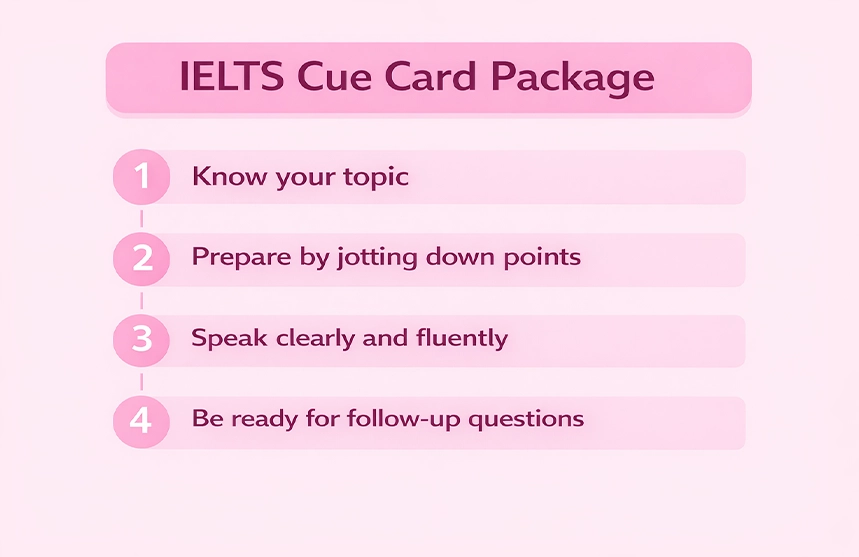
If you are new to the IELTS Speaking test, the cue card is the part that often feels the most confusing, but once you understand it, it is actually one of the easiest sections to score well in.
The IELTS Cue Card is a part of Speaking Part 2, where you are asked to speak on a given topic for a short time.
Here is how it works:
- You are given a card with a topic
- The card includes 3-4 prompts (questions to guide your answer)
- You get 1 minute to prepare
- Then you have to speak for 1-2 minutes continuously
What Does a Cue Card Look Like?
You will receive something like this:
Describe a memorable trip you had
You should say:
- Where you went
- Who you went with
- What you did there
- And explain why it was memorable
What is the Examiner Checking?
This is not about giving the “perfect” answer. Instead, the examiner wants to see:
- How fluently you speak
- Your vocabulary
- Your grammar usage
- How well you can organise your thoughts
Why is the IELTS Cue Card Important?
Many students think Speaking is just casual conversation, but the cue card is where your real speaking ability is tested.
- You have to speak without interruption
- You need to develop your ideas clearly
- It directly impacts your overall speaking band score
IELTS Cue Card Format
Now that you understand what an IELTS cue card is, it is equally important to understand its format. This helps you know exactly what to expect during the test, so there are no surprises.
The IELTS Cue Card is part of Speaking Part 2 and follows a fixed structure.
Here is how the format works:
- You are given a cue card with a specific topic
- The card includes 3-4 bullet points to guide your response
- You get 1-minute to prepare your thoughts
- You are given a pen and paper for rough notes
- You must then speak for 1-2 minutes continuously
- After you finish, the examiner may ask 1-2 follow-up questions
What Do the Prompts Mean?
The bullet points on the cue card are not separate questions, but guidelines to help you structure your answer.
They actually cover:
- Basic details (what, where, when)
- People involved (who)
- Description or actions (what happened)
- Your opinion or feelings (why or how)
- You are expected to cover all these points naturally while speaking.
What Happens After You Speak?
Once your 1-2 minutes are over, the examiner may ask a couple of related questions based on your topic.
These are not as long as the cue card response and are meant to:
- Continue the conversation
- Check your ability to respond spontaneously
IELTS Cue Card Topics
After understanding the format, the next thing students often wonder is—what kind of topics are asked in the IELTS cue card?
The good news is that IELTS topic are usually predictable and based on everyday situations, so you do not need any specialised knowledge.
Common Types of IELTS Cue Card Topics
Most topics fall into a few broad categories:
- People- Topics about someone you know or admire
- Places- Locations you have visited or would like to visit
- Experiences- Personal events, memories, or situations
- Objects/Things- Items you own, like, or find useful
- Events- Celebrations, occasions, or important days
Nature of IELTS Cue Card Topics
The topics are designed to:
- Be simple and relatable
- Encourage you to talk about personal experiences
- Test how well you can describe, explain, and express opinions
You are not judged on how unique your story is, but on how clearly and fluently you express it.
Examples of IELTS Cue Card Topics
Here are some common examples you might come across:
- Describe a memorable journey you had
- Describe a person who inspires you
- Describe a place you would like to visit
- Describe a useful object you own
- Describe a happy event in your life
How to Prepare for IELTS Cue Card Section
Now that you clearly understand the format and types of topics, the next step is knowing how to prepare effectively for the IELTS cue card section. The key here is not memorisation, but building confidence, clarity, and the ability to speak naturally. With the right approach, you can turn this section into one of your strongest scoring areas. Here are seven practical and effective ways to prepare:
1. Practice Speaking Daily
The most important step in preparing for the IELTS cue card is to practise speaking every single day. Since this section tests your fluency, regular speaking helps you become comfortable expression your thoughts in English without hesitation. You can pick random topics and speak for 1-2 minutes while timing yourself. This builds confidence and reduces nervousness during the actual exam. Over time, you will notice that you can speak more naturally, with fewer pauses, and with better clarity. Consistency is her here, even 15-20 minutes of daily practice can make a significant difference in your performance.
2. Focus on Fluency Over Perfection
Many students hesitate while speaking because they try to form perfect sentences. However, IELTS examiners are more interested in how smoothly you can communicate rather than how perfect your grammar it. While accuracy matters, fluency plays a bigger role in this section. It is completely fine to make small mistakes as long as you keep speaking. Try to avoid long pauses or overthinking your answers. The goal is to keep the conversation flowing naturally. The more you focus on expressing ideas clearly instead of being perfect, the more confident and natural your responses will sound.
3. Build a Strong Vocabulary Base
Having a good range of vocabulary can help you express your ideas more effectively and make your answers sound more impressive. Instead of memorising difficult words, focus on learning useful and commonly used vocabulary that fits different topics. For example, words related to emotions, experiences, places, and people can be used across multiple cue cards. Try to use synonyms and avoid repeating the same words again and again. This shows language flexibility to the examiner. However, make sure you use words you are comfortable with, as incorrect usage can affect your score.
4. Learn to Structure Your Answers
A well-structured answer makes it easier for both you and the examiner to follow your response. Instead of speaking randomly, try to organise your thoughts into a simple flow: introduction, main details, and conclusion. This helps you cover all the points mentioned in the cue card without missing anything important. It also makes your answer sound more organised and coherent. Even if your vocabulary is basic, a clear structure can significantly improve your overall speaking performance and help you maintain your speaking time confidently.
5. Use the 1-Minute Preparation Time Wisely
The one-minute preparation time is your opportunity to plan what you are going to say. Instead of writing full sentences, quickly jot down keywords related to each prompt. This helps you remember your ideas while speaking without wasting time. You can also think of a small story or example to make your answer more engaging. Planning properly ensures that you do not run out of ideas midway. Many students ignore this step, but using this time effectively can make a big difference in how smoothly you deliver your response.
6. Record and Evaluate Yourself
One of the most effective ways to improve your speaking skills is by recording yourself while practising cue cards. When you listen to your recordings, you can identify areas where you hesitate, repeat words, or make frequent mistakes. This self-evaluation helps you understand your strengths and weaknesses clearly. You can then work on improving specific areas such as pronunciation, fluency, or vocabulary usage. It also helps you track your progress over time, which can boost your confidence and motivation as you prepare for the IELS speaking test.
7. Practise with Real IELTS Topics
Using real IELTS cue card topics during practice can give you a better understanding of what to expect in the exam. It helps you become familiar with the type of questions and improves your ability to think and respond quickly. Try practising a variety of topics from different categories such as people, places, experiences, and events. This ensures that you are prepared for any topic you may get on the test day. The more exposure you have to real questions, the more comfortable and confident you will feel during the actual speaking test.
Prepare for Your IELTS Exam with MetaApply TestPrep
Preparing for the IELTS cue card section may seem challenging at first, but with the right understanding of the format, topics, and a consistent practice approach, it becomes much more manageable. More importantly, it helps you build real-life communication skills that go beyond just the exam and prepare you for your study abroad journey.
This is where MetaApply TestPrep plays a crucial role. With expert guidance, structure preparation, and personalised support, students are trained not only to excel in English language tests like IELTS but also in academic aptitude exams such as SAT, ACT, GRE, and GMAT. From building strong fundamentals to mastering test strategies, the focus is always on helping students achieve their best possible scores.
So, if you want to score high in your exams to study abroad, connect with us and take the first step towards your global academic journey.
Frequently Asked Questions
Cue cards are part of IELTS Speaking Part 2, where you receive a topic with prompts and must speak for 1-2 minutes. They assess your fluency, vocabulary, grammar, and ability to organise ideas while speaking continuously without interruption.
Prepare by practising speaking daily, focusing on fluency, building vocabulary, and using real IELTS topics. Learn to structure answers, use the one-minute preparation wisely, and record yourself to evaluate and improve your performance over time.
To speak for 2 minutes, follow a clear structure: introduction, main points, and conclusion. Expand each prompt with examples and details. Keep speaking naturally, avoid long pauses, and add personal experiences to maintain flow and content.
No, memorising answers is not recommended as examiners can easily identify it. Instead, focus on understanding topics, developing ideas, and speaking naturally. This helps you adapt to any question and impoves your fluency and overall performance.
Practise daily, focus on fluency, use simple vocabulary, structure answers clearly, utilise preparation time wisely, avoid memorisation, and practise with real topics. These tips help build confidence, improve clarity, and enhance your overall IELTS speaking performance.
Related Blogs