Discover the Leading Universities in Switzerland
How to Apply for MBA in Germany in 2026: Requirements, Process, Fees & Step-by-Step Application

Indian students have become one of the leading MBA applicant groups in Germany, and it is not a secret. Germany provides MBA applicants with the best combination of both quality education and low-cost tuition (and even no cost) with world-ranked business schools, globally recognised degrees, and high post-study job opportunities.
When you search how to apply for an MBA in Germany with India as your home country, what the requirements for an MBA in Germany are, whether Germany is good for an MBA, the step-by-step application process for an MBA in Germany, or simply look up How to Apply for an MBA in Germany, this guide has it all and is organised in a way that is easily searchable by Google as well as by artificial intelligence.
Within this guide, the eligibility, requirements, Germany MBA cost, timescales, scholarships, visas, and the entire application process are broken down, regardless of whether you are applying to Public Universities, Private Business Schools, Technical Universities, or Universities of Applied Sciences.
To receive expert assistance, you can also apply with the help of MetaApply IE, the world’s simplest study-abroad application platform that lets you shortlist universities, apply, receive visa assistance, and manage everything, all in one place.
Why Germany is among the best countries to do an MBA in 2026?
Germany has a worldwide reputation for its engineering and innovation ecosystem; however, over the last decade, it has become a strong MBA destination because of:
1. Globally accredited MBA programmes
Business schools in Germany are accredited by AACSB, AMBA, and EQUIS, and many MBA Programmes in Germany are ranked among the highest in the world. This guarantees international recognition, academic excellence, and greater job mobility globally.
2. Unusually high return on investment (High ROI)
Germany has one of the highest ROIs for MBA students. The cost of higher education is very low, as university fees at public universities are extremely affordable, and even private schools are cheaper than in the US, UK, or Australia. Graduates usually secure well-paying jobs, making the investment worthwhile.
3. One of the best study destinations because of the lowest tuition fees
Public universities cost €1,500–€4,500 per year, reducing the total cost of education significantly. Even the best private programmes are more affordable than those in Western countries while maintaining high quality.
4. Strong career prospects in Europe’s largest economy
Germany is the economic powerhouse of the European continent, with global industry leaders in automotive, engineering, technology, finance, and healthcare. Companies where MBA graduates can find opportunities include BMW, Siemens, Bosch, SAP, Deutsche Bank, PwC, KPMG, and Amazon Germany.
5. 18-month post-study work visa (PSW)
International students receive 18 months of job-seeking and full-time work rights after completing an MBA, far more than in many European countries. This increases the likelihood of securing a well-paying job and building a long-term career.
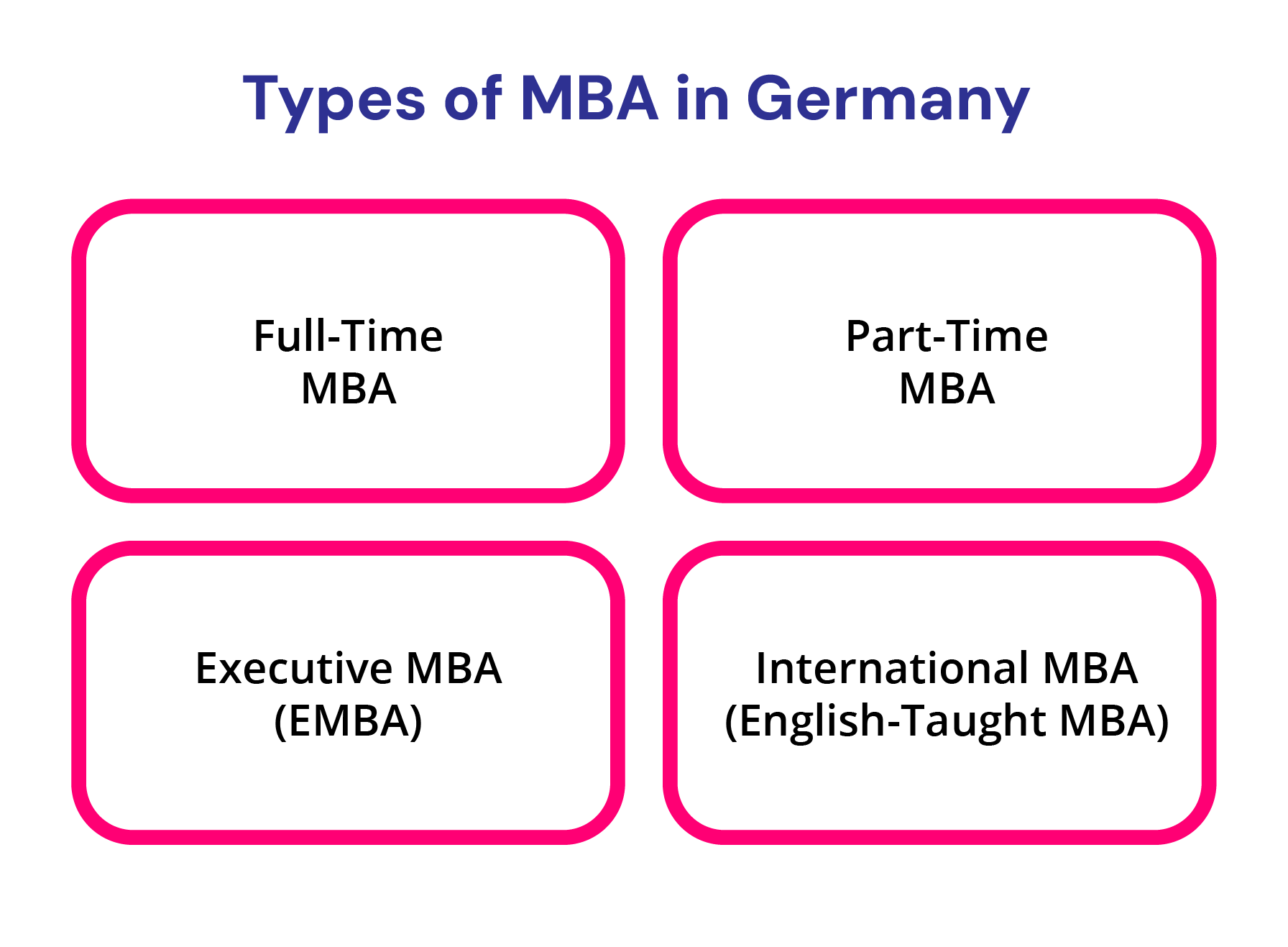
Types of MBA in Germany
Germany offers a variety of formats based on experience:
1. Full-Time MBA
A Full-Time MBA in Germany is designed for students who wish to pursue their course without any professional interruptions. These programmes typically run for 12–24 months and include internships, industry projects, and live business case studies.
2. Part-Time MBA
A Part-Time MBA is ideal for working professionals who wish to continue their employment while upgrading their business knowledge. Classes typically take place in the evenings or on weekends, and the programme duration can extend to 2–3 years.
3. Executive MBA (EMBA)
The Executive MBA is tailored to high-level professionals (5–10+ years of experience). It includes an advanced curriculum covering leadership, organisational strategy, global economics, change management, and executive decision-making.
4. International MBA (English-Taught MBA)
It is the most preferred type of MBA among international students, particularly Indians. The language of instruction is entirely English, and the curriculum aligns with international business cultures.
Eligibility of MBA in Germany in 2026
Eligibility is dependent on the university, although the minimum requirements are usually:
- Bachelor’s degree (3 or 4 years)
- Minimum GPA: 50–55% and above
- At least one to three years of professional experience (not all universities are the same)
- English proficiency test: IELTS / TOEFL / PTE.
- Certain universities need GMAT or GRE (not mandatory in most private schools).
- SOP + LOR + Resume
- Proof of funds for visa
How to apply to an MBA in Germany?
This is a straightforward start-now checklist that you can use between Day 0 and arrival. Practical, short steps to follow – copy-pasteable and easy to implement.
Decide your MBA type & intake
Select Full-time / Part-time / EMBA / Specialised / Online and select the intake (September/October or March). This establishes requirements and deadlines.
Shortlist 6–10 programmes
Filter universities based on rank, location, fees, specialisation, language of instruction and career performance. Make a balance of reach/match/safe.
Eligibility to check based on each programme
Record degree requirements, minimum GPA/percentage, work-experience requirements, and the presence or absence of GMAT/GRE.
Register for required tests
Book IELTS/TOEFL/PTE in English and GMAT/GRE as required. Allow time for retakes. Send ordered scores to shortlisted universities.
Collect academic documents
Provide scans of: 10th, 12th, Bachelor transcripts, degree certificate, translation (where necessary), and passport photo pages.
Prepare CV / Resume
Prepare a 1–2 page professional resume centred on accomplishments, management, quantifiable contributions, and international experience (where applicable).
Prepare a good SOP (Statement of Purpose)
Write a specific SOP to every university: why MBA, why this school, career objectives, and contribution. Make it personal and results-based.
Request Letters of Recommendation (LORs)
Request 2–3 referees (managers/professors) early enough. Send them your CV, SOP highlights and points you would like added.
Note: All prices mentioned are approximate and may vary. Students should refer to official government or university websites for accurate and updated figures.
Conclusion
Pursuing an MBA in Germany is one of the smartest decisions you can make for your global career. With its world-class universities, affordable tuition fees, strong industry ties, and excellent job prospects, Germany offers a powerful combination of academic quality and long-term career growth. Whether you’re looking for international exposure, a career switch, higher earning potential, or a pathway to long-term settlement in Europe, an MBA in Germany can open doors to endless opportunities.
The application process may seem lengthy—shortlisting universities, preparing documents, writing a compelling SOP, acing interviews, and arranging your visa—but you don’t have to navigate it alone. This is where MetaApply IE transforms your journey. With a single unified platform, you can explore top German MBA programs, compare them, apply to multiple universities at once, track your application status, and get expert guidance at every step. From personalised university recommendations and SOP/LOR support to scholarship guidance and visa preparation, MetaApply IE ensures your entire application journey becomes faster, simpler, and stress-free.
If you’re serious about securing an MBA Seat in Germany for 2026, now is the time to take action. Begin shortlisting, start preparing your documents, and let MetaApply IE lead you toward the right program with confidence.
Frequently Asked Questions
Most universities require a bachelor’s degree with 50–65% marks, 1–3 years of work experience (optional in private universities), an English proficiency test like IELTS/TOEFL, and documents such as an SOP, CV, and LORs. Some public universities may also prefer GMAT/GRE.
MBA fees in Germany range from €6,000 to €30,000, depending on the university. Public universities have very low tuition fees, while private business schools charge higher but still offer strong ROI. Living expenses average €10,000–€12,000 per year.
GMAT is not mandatory for most private universities in Germany. However, some top public universities and triple-accredited schools may prefer or require it. Having a GMAT score can strengthen your application but is not always compulsory.
No. Most MBA programs for international students are fully taught in English, so German is not required for admission. However, learning basic German can significantly improve part-time job, internship, and post-MBA job opportunities.
MBA graduates in Germany enjoy excellent career prospects, with starting salaries typically between €45,000–€80,000 annually. Germany’s strong economy offers opportunities in consulting, finance, marketing, tech, operations, and supply chain. Graduates also receive an 18-month post-study work visa to find employment.
Related Blogs