
Why Study in Albania in 2026?
Scholarship to Study Abroad: Making Global Education More Accessible

Studying abroad has long been associated with world-class education, global exposure, cultural immersion, and international career opportunities. However, for many students, the financial commitment required to pursue education overseas often feels overwhelming. Tuition fees, living expenses, travel costs, insurance, and daily living can add up quickly, making international education seem out of reach. This is precisely where Scholarships to Study Abroad play a transformative role. Scholarships are not merely financial aids; they are gateways that allow deserving and ambitious students to access global education without being burdened by excessive financial stress.
Across the world, governments, universities, private organisations, and international institutions offer a wide range of scholarships designed to support international students. These scholarships are created to recognise academic excellence, leadership potential, social impact, professional merit, research capability, and even financial need. Whether a student is aiming to pursue undergraduate studies, postgraduate programmes, doctoral research, or short-term professional courses, there are scholarship opportunities available globally that can significantly reduce the cost of studying abroad.
Understanding Scholarships for Studying Abroad
Scholarships to study abroad are structured financial awards that help students fund part or all of their Education in a Foreign Country. Unlike education loans, scholarships do not require repayment, making them one of the most desirable funding options for international students. Scholarships may cover tuition fees fully or partially, living expenses, travel costs, health insurance, or a combination of these. Some scholarships are one-time awards, while others provide funding throughout the duration of the course.
Globally recognised scholarships are often competitive, with selection criteria that extend beyond academic scores. Many programmes assess a student’s overall profile, including extracurricular involvement, leadership experience, community contribution, clarity of goals, and future impact. This holistic approach ensures that scholarships are awarded to students who not only perform well academically but also demonstrate the potential to contribute meaningfully to society and their chosen field.
Why Scholarships Matter in Global Education
Scholarships play a critical role in democratising access to international education. They allow students from diverse socio-economic backgrounds to compete on a global stage. For host countries, scholarships help attract talented international students who bring fresh perspectives, cultural diversity, and intellectual capital. For students, scholarships reduce financial anxiety, enabling them to focus on academic excellence, skill development, and career planning rather than worrying about costs.
In many cases, scholarship recipients also become cultural ambassadors, strengthening diplomatic and educational ties between countries. This global exchange of knowledge, ideas, and experiences is one of the most powerful outcomes of scholarship-driven education.
Types of Scholarships Available Globally
Scholarships to study abroad are broadly categorised based on funding sources, eligibility criteria, and academic level. Understanding these categories helps students identify opportunities that align best with their profiles.
Merit-Based Scholarships
Merit-based scholarships are awarded to students who demonstrate outstanding academic achievement, intellectual capability, or exceptional talent. These scholarships often consider academic records, standardised test scores, research potential, and achievements in specific fields such as science, technology, arts, or sports. Many Top Universities across the UK, USA, Europe, Australia, and Asia offer merit-based scholarships to attract high-performing international students.
Need-Based Scholarships
Need-based scholarships focus on providing financial support to students who have limited economic resources but strong academic potential. These scholarships assess a student’s financial background, family income, and economic circumstances alongside academic performance. Need-based funding ensures that financial limitations do not prevent talented students from accessing quality education abroad.
Government-Funded Scholarships
Many governments invest heavily in scholarships to attract international students and foster global collaboration. These scholarships are often prestigious, highly competitive, and comprehensive in coverage. Government-funded Scholarships usually support postgraduate and research-based programmes and are designed to develop future leaders, policymakers, researchers, and professionals.
University-Specific Scholarships
Universities across the globe offer their own scholarships to international students as part of their recruitment strategy. These scholarships may be merit-based, need-based, or programme-specific. University scholarships are often easier to access than large government programmes and can sometimes be combined with other funding options.
Subject-Specific Scholarships
Subject-specific scholarships are designed to promote education in particular disciplines such as engineering, medicine, business, sustainability, technology, social sciences, or creative arts. These scholarships are often supported by industry bodies, professional organisations, or research institutions that aim to develop talent in critical or emerging fields.
Research and Doctoral Scholarships
For students pursuing PhD or research-focused programmes, scholarships are often provided in the form of research grants, fellowships, or assistantships. These awards typically cover tuition fees and provide a monthly stipend to support living expenses. Research scholarships are particularly common in Europe, the UK, and North America.
Globally Recognised Scholarships for International Students
Several scholarship programmes have gained global recognition due to their prestige, impact, and long-standing legacy. These scholarships are often highly competitive and attract applicants from around the world.
Chevening Scholarships, supported by the UK government, are among the most well-known scholarships globally. They are designed to support outstanding students with leadership potential to pursue postgraduate studies in the UK. Similarly, Commonwealth Scholarships aim to support students from Commonwealth countries, focusing on academic excellence and development impact.
In the United States, Fulbright Scholarships are globally respected for promoting academic exchange and cross-cultural understanding. These scholarships support students, researchers, and professionals across a wide range of disciplines. Australia’s Endeavour Scholarships and similar government initiatives aim to attract global talent and strengthen international education ties.
European countries also offer a variety of prestigious scholarship programmes, particularly for postgraduate and research studies. Many of these scholarships are aligned with innovation, sustainability, and international collaboration goals.
Eligibility Criteria for Studying Abroad with Scholarships
While eligibility criteria vary across scholarship programmes, there are common factors that most providers consider. Academic performance remains a key requirement, but it is rarely the sole deciding factor. Students are often assessed on their overall profile, including motivation, career goals, leadership experience, and alignment with the scholarship’s objectives.
Language proficiency is another important consideration, especially for programmes taught in English or other foreign languages. Standardised tests, academic references, personal statements, and interviews are commonly used to evaluate candidates. For research-based scholarships, the quality of the research proposal and alignment with institutional priorities are particularly important.
The Application Process for Scholarships
Applying for scholarships to study abroad requires careful planning, preparation, and attention to detail. Successful applications are rarely last-minute efforts. Students need to research scholarship options well in advance, understand deadlines, and prepare strong supporting documents.
A well-written personal statement or statement of purpose is often the most critical component of a scholarship application. This document allows students to articulate their academic journey, career aspirations, and reasons for choosing a particular course or country. Letters of recommendation, academic transcripts, and evidence of extracurricular involvement further strengthen an application.
Given the competitive nature of global scholarships, even highly qualified students benefit from professional guidance to ensure that their applications are strategically positioned and aligned with scholarship expectations.
Common Challenges Faced by Scholarship Applicants
Despite the availability of numerous scholarships, many students struggle to secure funding due to lack of awareness, improper guidance, or weak application strategies. Common challenges include missing deadlines, choosing unsuitable scholarships, writing generic personal statements, and failing to highlight their unique strengths.
Additionally, many students are unaware that scholarships can often be combined with partial funding, fee waivers, or institutional grants. Without proper counselling, students may assume that scholarships are limited to top academic performers, when in reality, many programmes value diverse backgrounds and experiences.
The Long-Term Impact of Studying Abroad with a Scholarship
Receiving a scholarship to study abroad often has a lasting impact on a student’s academic and professional journey. Scholarship recipients gain access to global networks, prestigious institutions, and diverse learning environments. The confidence and credibility associated with being a scholarship holder often open doors to better career opportunities, research collaborations, and leadership roles.
Moreover, many scholarship programmes emphasise giving back to society, encouraging students to use their education to create positive change in their home countries or globally. This focus on impact makes scholarships not just a financial benefit but a powerful tool for personal and societal growth.
Planning Your Study Abroad Journey Strategically
Securing a scholarship should not be treated as a separate process from applying to universities. Instead, scholarship planning should be integrated into the overall study abroad strategy. Choosing the right country, course, and institution significantly influences scholarship eligibility and success rates.
Students who approach their study abroad journey with clarity, realistic expectations, and professional guidance are far more likely to access funding opportunities. Understanding timelines, aligning academic goals with scholarship objectives, and building a strong profile early can make a decisive difference.
How MetaApply IE Helps You Access Scholarships to Study Abroad
Navigating the global scholarship landscape can be complex, especially when combined with university admissions, visa processes, and career planning. This is where expert guidance becomes invaluable. MetaApply IE provides end-to-end support to students aspiring to study abroad, ensuring that scholarship opportunities are identified, evaluated, and pursued strategically.
With personalised counselling, MetaApply IE helps students understand which scholarships align with their academic background, career goals, and destination preferences. From shortlisting suitable programmes and institutions to crafting compelling personal statements and preparing strong applications, MetaApply IE ensures that students present their best possible profile.
Beyond scholarships, MetaApply IE also supports students with university admissions, Test Preparation, Visa Assistance, and long-term career planning. This integrated approach ensures that students are not just admitted to global institutions but are also financially prepared and strategically positioned for success.
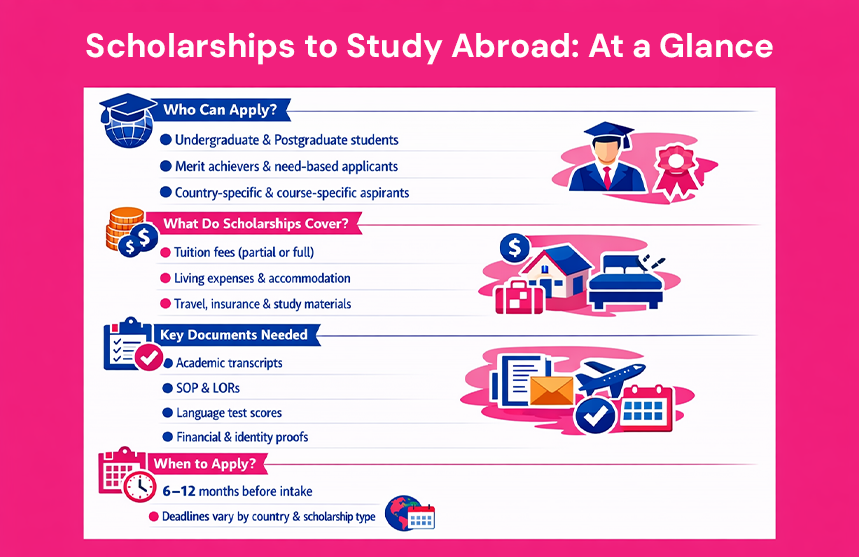
Why Should You Go for Scholarships to Study Abroad
Scholarships to study abroad are no longer rare opportunities reserved for a select few. With the right information, preparation, and guidance, they are achievable pathways to global education. As international education continues to evolve, scholarships remain one of the most powerful tools enabling students to pursue their ambitions without financial barriers.
For students who dream of studying abroad, the journey should begin with clarity, strategy, and expert support. With structured planning and the right mentorship, scholarships can turn aspirations into reality and open doors to a truly global future.
Frequently Asked Questions
Yes, international students can apply for a wide range of scholarships offered by governments, universities, and global organisations across popular study destinations.
Some scholarships fully cover tuition, living costs, and travel, while others offer partial funding such as fee waivers or monthly stipends.
No, many scholarships consider overall profiles, including leadership skills, career goals, extracurricular activities, and financial need, not just grades.
It is advisable to start researching and preparing scholarship applications at least 8–12 months before your intended intake.
Yes, students can apply for multiple scholarships simultaneously, as long as they meet the eligibility criteria and follow each programme’s guidelines.
Related Blogs