Think Studying Abroad Is Only for the Rich? Think Again. These Affordable Countries Prove Otherwise
Think Studying Abroad Is Only for the Rich? Think Again. These Affordable Countries Prove Otherwise

Let’s start with a hard truth. For most Indian students, the dream of studying abroad often collides with one big fear: money. Sky-high tuition fees, expensive accommodation, fluctuating exchange rates, and stories of massive education loans can make global education feel out of reach.
But here’s the shift in perspective that changes everything; Studying Abroad is not about choosing the most famous country. It’s about choosing the smartest one.
If your goal is global exposure, better career opportunities, international work experience, and a strong return on investment, you do not have to pick the most expensive destination. In fact, some of the most rewarding study destinations today are also surprisingly affordable.
This blog explores some of the most Affordable Countries to Study Abroad for Indian Students, not just from a tuition perspective, but from a long-term ROI lens. Because affordability is not about what you spend today. It’s about what you gain tomorrow.
Germany – World-Class Education Without World-Class Fees
When people hear “Germany,” they think engineering excellence, research strength, and economic stability. What they don’t immediately realise is that it is also one of the Most Affordable Study Destinations in the World.
Why Germany Is Financially Smart
- Most Public Universities in Germany charge no tuition fees
- Students pay only a semester contribution (around €150–€350)
- Living costs average €850–€1,200 per month
- 18-month post-study job search visa
For Indian students in STEM, automotive, AI, data science, and manufacturing fields, Germany offers something powerful: low entry cost + strong employment ecosystem.
Yes, you will need to show proof of funds for your visa. Yes, living costs must be managed carefully. But compared to English-speaking countries with tuition fees crossing ₹15–25 lakh per year, Germany feels like a financial reset button.
France – Affordable, Elegant, and Surprisingly Accessible
France is often perceived as expensive. Paris, fashion, art; it sounds elite.
But public universities in France charge relatively modest tuition fees compared to other Western countries.
Cost Snapshot
- Public university tuition: approx. €2,770–€3,770 per year
- Living costs: €800–€1,200 per month
- Multiple government-backed scholarships
- Increasing number of English-taught programmes
France also offers subsidised student housing and transport benefits, reducing overall expenses.
From business schools to culinary arts, AI to luxury brand management, France blends affordability with global prestige, especially for students willing to explore beyond just Paris.
Hungary – Europe’s Underrated Budget Champion
If you are searching for European education at half the expected price, Hungary deserves attention.
Why Indian Students Are Choosing Hungary
- Tuition: €4,000–€8,000 per year
- Living cost: €600–€900 per month
- English-taught medicine and engineering programmes
- Access to the Schengen region
Budapest offers a high-quality European student lifestyle without Western European expenses. For medical aspirants especially, Hungary provides structured English-medium pathways at costs significantly lower than private medical colleges in India.
Hungary proves one thing: affordable does not mean academically weak.
Poland – Quality Degrees at a Sensible Price
Poland has steadily built a reputation as a practical, budget-conscious European study destination.
Financial Overview
- Tuition: €3,000–€6,000 per year
- Living cost: €500–€800 per month
- Growing IT and manufacturing sectors
- Safe student cities
Poland’s cost of living is among the lowest in the European Union. Cities like Warsaw and Kraków offer modern infrastructure without overwhelming expenses.
For Indian students looking for engineering, business, and IT programmes within a manageable budget, Poland balances cost and quality effectively.
Ireland – Higher Tuition, Higher ROI
Ireland is not the cheapest on this list, but it is one of the smartest long-term investments.
What Makes Ireland Worth It
- Tuition: €9,000–€15,000 per year
- Living cost: €900–€1,200 per month
- 2-year post-study work visa
- European tech headquarters hub
Major global technology and pharmaceutical companies operate here. For students in data analytics, cybersecurity, finance, and life sciences, Ireland offers strong salary prospects after graduation.
Affordability is not just low fees, it is earning potential after graduation. Ireland scores high in that category.
Malaysia – Asian Comfort with Global Curriculum
If Europe feels culturally distant or financially uncertain, Malaysia offers a balanced alternative.
Why Malaysia Makes Sense
- Tuition: approx. ₹3–8 lakh per year
- Living cost: ₹25,000–₹40,000 per month
- English widely spoken
- Twinning programmes with UK and Australian universities
For Indian students wanting global exposure without extreme financial pressure, Malaysia provides affordability, safety, and proximity to home.
Uzbekistan & Kyrgyzstan – Budget-Friendly Medicine Pathways
For students who could not secure MBBS seats in India due to NEET competition or private college costs, Central Asian countries like Uzbekistan and Kyrgyzstan offer alternatives.
Why Students Consider Them
- Lower tuition fees compared to Indian private medical colleges
- Affordable living expenses
- Increasing number of Indian students
However, this is where careful research becomes essential. Students must verify accreditation, clinical exposure quality, and long-term licensing requirements in India.
These destinations can be affordable, but only when chosen strategically.
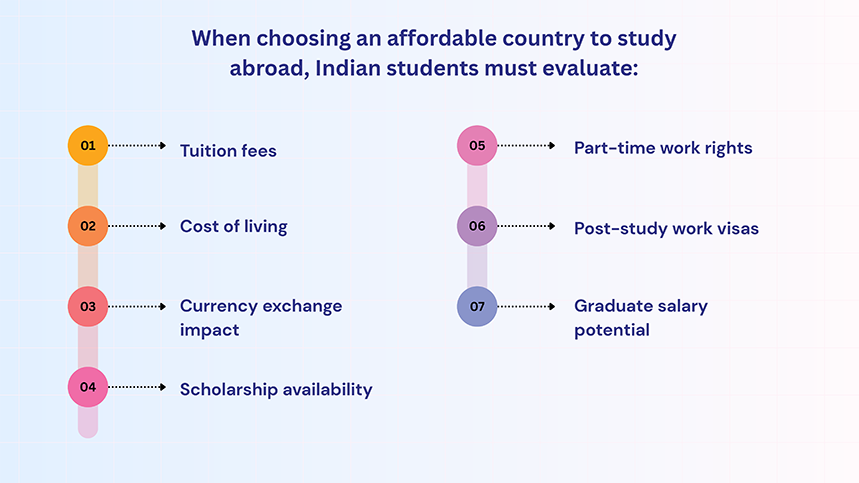
Affordability Is Not Just Tuition Fees
Here is the perspective many students overlook.
A country can have low tuition but:
- Limited job opportunities
- Weak post-study visa policies
- Low salary benchmarks
- Difficult language barriers
On the other hand, a country with moderate tuition but strong employment pathways can deliver better long-term value.
Note: All prices mentioned are approximate values. Students should check official government websites or the respective university websites for exact figures.
How Indian Students Can Reduce Study Abroad Costs Further
Even in affordable countries, strategy matters.
Choose Public Over Private Institutions
Public Universities often offer lower tuition and better research facilities.
Apply Early for Scholarships
Many European countries provide merit-based and need-based funding opportunities.
Work Part-Time
Most countries allow international students to work 20 hours per week during term time.
Pick Smaller Cities
Capital cities are always more expensive. Smaller towns often offer the same degree at lower Living Costs.
Plan Currency Management Smartly
Exchange rate fluctuations impact your total budget. Financial Planning is essential before departure.
The Smart Indian Student’s Mindset in 2026
The old approach was:
“Which country is trending?”
The new approach should be:
“Which country gives me maximum global exposure with minimum financial stress?”
The smartest Indian students today are not blindly chasing the USA, UK, or Australia. They are comparing options, calculating ROI, and thinking long term.
Sometimes, Studying in Germany or Poland can cost less than pursuing a private degree in India, but with international exposure and better career mobility.
That is not just affordability. That is strategic thinking.
So, Which Country Is the Most Affordable?
If you are purely looking at tuition, Germany often wins.
If you are considering overall living expenses, Poland and Hungary are extremely competitive.
If you are calculating post-study earning potential, Ireland becomes attractive.
If you want cultural familiarity and lower cost in Asia, Malaysia works well.
There is no single “cheapest” country for everyone.
The right affordable country depends on:
- Your course
- Your career goal
- Your financial background
- Your long-term migration plans
Affordability is personal.
Global Dreams, Sensible Decisions
Studying abroad should expand your horizons, not create lifelong financial pressure.
The good news? There are multiple affordable countries that offer international degrees, safe environments, career pathways, and quality education without overwhelming costs. The key is planning smartly, researching thoroughly, and choosing strategically.
Because the real question is not:
“Can I afford to study abroad?”
It is:
“Can I afford to miss the right opportunity?”
Don’t Just Choose a Country. Choose the Right Strategy with MetaApply IE.
Finding an affordable country to study abroad is only half the journey. Choosing the right University, securing scholarships, preparing a strong SOP, managing visa documentation, and planning finances smartly, that’s where the real difference is made.
At MetaApply IE, students are not just guided towards popular destinations; they are strategically matched with countries and universities that align with their budget, academic goals, and long-term career vision. From profile evaluation and university shortlisting to application support and Visa Assistance, every step is handled with clarity and precision.
Because studying abroad should be an informed investment. Your global journey deserves more than guesswork. It deserves strategy.
Frequently Asked Questions
Germany is often the cheapest due to minimal or no tuition fees at public universities.
In many cases, yes. Several European countries offer lower tuition and living costs.
Most countries allow part-time work up to 20 hours per week during academic sessions.
Depending on the country, it can range from ₹8 lakh to ₹18 lakh annually.
Compare tuition, living costs, job prospects, visa policies, and long-term ROI before deciding.
Related Blogs