Study Abroad vs Study in India: What Smart Students Are Choosing in 2026
Study Abroad vs Study in India: What Smart Students Are Choosing in 2026

Study abroad; the very phrase creates a dilemma for many. A seesaw of emotions builds up whenever the question arises. It is no surprise if you feel that emotional rush in your stomach while discussing it, because most people feel the same.
The simple truth is that choosing to study abroad is not about rejecting your home country. As you grow, you must explore options and more importantly, opportunities; to advance your career.
Let us simplify what you can truly gain if you decide to Study Abroad.
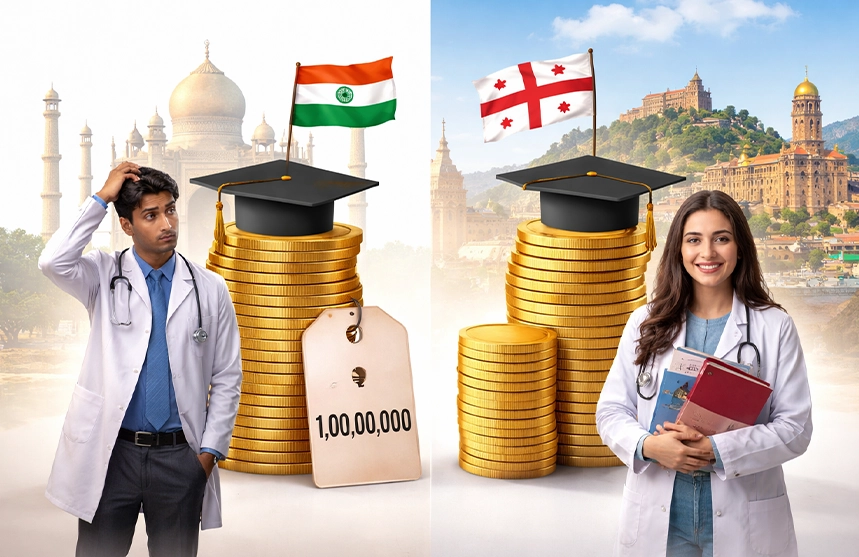
Now that we have said it out loud, let’s address the elephant in the room. The debate between Studying Abroad and Studying in India is not about patriotism versus ambition. It is about exposure versus familiarity, risk versus comfort, and sometimes, dreams versus practicality. This is not a battle. It is a comparison of two journeys that start at the same point but may lead to very different destinations.
Let’s unpack this conversation, one layer at a time.
The Comfort of Home vs The Courage of Change
Studying in India comes with a certain emotional safety net. You understand the culture, the language, the social cues. Your family is just a train ride away. Festivals feel like festivals. Food tastes like home.
There is deep comfort in this predictability.
On the other hand, studying abroad means stepping into the unknown. New accents. New weather. New expectations. You may find yourself explaining where you are from more times than you can count. Yet, in that discomfort lies growth.
When you choose to study abroad, you are not rejecting home. You are temporarily expanding it.
The Education System: Structured Familiarity vs Global Exposure
India has some of the most respected institutions in the world.
Indian Institutes of Technology
Indian Institutes of Management
All India Institute of Medical Sciences
These institutions produce world-class engineers, managers and doctors. The competition is intense, and earning a seat itself feels like winning a medal.
However, studying abroad often introduces a different academic philosophy. Instead of rote learning or exam-heavy structures, many International Universities emphasise research, discussion, case studies, and practical application.
Consider globally recognised institutions for example such as:
University of Oxford
University of Toronto
University of Melbourne
Here, classrooms are often interactive. Professors encourage debate. You are expected to challenge ideas, not just memorise them.
It is not about one being superior to the other. It is about learning style. Do you thrive in structured competitiveness, or in exploratory independence?
Cost: Investment vs Expense
Let’s speak honestly. Studying abroad is expensive. Tuition fees, accommodation, living costs, travel – it adds up. Studying in India is generally far more affordable, especially in Public Universities. Even private institutions, while costly, often do not reach international tuition levels.
But here’s the shift in perspective.
When families consider study abroad, they increasingly see it as an investment rather than an expense. Exposure to global markets, international internships, and higher starting salaries in some sectors can balance the equation over time.
Yet this is not guaranteed. Financial planning, Scholarships, and realistic expectations are crucial.
The key question is not “Is it expensive?” The real question is “What is the return on this experience?”
Career Opportunities: Local Strength vs Global Leverage
India is one of the fastest-growing major economies in the world. Opportunities in technology, healthcare, finance and entrepreneurship are expanding rapidly. Cities like Bengaluru, Hyderabad and Mumbai have become innovation hubs.
Staying in India can mean tapping into a growing domestic market with strong networks and familiarity.
However, studying abroad can open doors to global career pathways. Multinational companies value cross-cultural competence. Employers often look for candidates who can adapt across borders.
If you study in countries like the UK, Canada or Australia, post-study work visas may allow you to gain international experience before deciding where to settle.
The broader benefit? You become globally employable, not just locally competitive.
Cultural Exposure: Diversity Beyond Textbooks
In India, diversity already exists in abundance. Different languages, cuisines, traditions and festivals coexist within one nation.
But studying abroad adds another layer. You might share a flat with someone from Brazil, collaborate on projects with classmates from Germany, and present ideas to professors from Japan.
This experience subtly reshapes your worldview. It teaches empathy. It builds confidence. It forces independence. You begin to see the world not as “us” and “them”, but as a connected network of stories.
Personal Growth: Independence Accelerated
When you study in India, independence grows gradually. When you study abroad, it grows rapidly.
From managing rent and cooking meals to understanding foreign banking systems and part-time jobs, every task builds resilience.
You learn to solve problems without calling home first. You learn to navigate ambiguity. You discover strengths you did not know you possessed. It is not always glamorous. There are lonely evenings. There are moments of doubt. But those moments shape character.
The Social Perception Factor
Let’s not ignore this. In many Indian households, studying abroad carries prestige. Relatives talk about it. Social media celebrates it. Yet prestige should never be the sole reason to choose it.
Studying in India, especially in top institutions, commands immense respect too. A graduate from IIT or IIM carries significant credibility both nationally and internationally.
The real prestige lies in what you make of your education, not where the campus is located.
Network: Depth vs Breadth
If you study in India, your network is deeply rooted within the country. This can be incredibly powerful for careers that are India-centric.
If you study abroad, your network becomes geographically diverse. You build connections across continents. These relationships can open unexpected doors years later.
In a globalised economy, networks are currency. The question is: where do you want your currency to circulate?
The Emotional Cost
No brochure talks about homesickness. When you study in India, family events, weddings, festivals – you are present. Support systems are accessible.
When you study abroad, time zones create distance. Missing Diwali at home feels different when you are watching fireworks through a phone screen.
But this distance often strengthens relationships. You learn appreciation in absence. Emotional maturity becomes part of the curriculum.
Quality of Life and Lifestyle
Countries such as the UK, Canada and Australia often rank highly in quality of life indices. Public infrastructure, work-life balance, research funding and student facilities can be appealing.
Yet India offers something unique – vibrancy. Energy. Entrepreneurial spirit. A rapidly evolving ecosystem.
One offers structured systems. The other offers dynamic momentum.
Neither is wrong. They are simply different lifestyles.
Risk Appetite: Safe Bet or Bold Move?
Studying in India can feel like the safer route. You understand the job market. You know the cultural expectations.
Studying abroad is a bold move. Visa rules change. Job markets fluctuate. Immigration policies evolve. But bold moves often come with bold rewards. It depends on your appetite for uncertainty.
The Broader Benefit of Studying Abroad
Here is where perspective shifts. Studying abroad is not just about a degree. It is about transformation.
You gain global exposure, cross-cultural communication skills, international work experience, broader professional networks, enhanced adaptability.
When you return to India, if you choose to, you do not return the same. You bring global insight into local markets. You become a bridge between systems. That bridge is valuable.
So, Study Abroad or Study in India?
This is not a verdict. It is a reflection. If your goals are strongly rooted in India’s domestic ecosystem, studying in India may serve you brilliantly. If your ambitions stretch across borders, if you crave international exposure and personal reinvention, studying abroad might offer broader horizons.
Neither path defines your success. Your mindset does. But one path may expand your lens wider than the other. And sometimes, widening your lens is the biggest education of all.
Your Global Journey, Structured the Right Way with MetaApply IE
Choosing between studying abroad and studying in India is not just about preference, it is about clarity. And clarity rarely comes from Google searches or random advice. This is where MetaApply IE steps in. From Personalised Counselling and Psychometric Profiling to university shortlisting, application management, visa preparation and pre-departure support, the process becomes structured rather than stressful. You are not left guessing which country fits you or which course aligns with your career. Instead of confusion, you get direction. Instead of pressure, you get a plan. Because when the decision shapes your future, you deserve more than opinions, you deserve expertise. Fill in the form today to start you study abroad journey.
Frequently Asked Questions
Not necessarily. It depends on your career goals, financial situation and willingness to adapt to a new environment.
No degree guarantees success. However, international exposure can enhance employability in global markets.
Generally yes, especially in public institutions. Studying abroad requires careful financial planning.
Most students experience homesickness at some point, but it often becomes part of personal growth.
Absolutely. Many students return with international experience and find excellent opportunities in India.
Related Blogs