Why Do Early Planning Matters to Study Abroad?
MBBS in Georgia VS MBBS in Russia—Which is better?
Imagine preparing for an exam from dusk till dawn, leaving everything behind just to focus on getting better scores, and when the results are out, you even fail to secure a seat in India. Yes, the preparations for the NEET exam are not that easy. You give your all to secure a medical seat in India but due to tough competition and hefty donations, your dream of becoming a doctor crash into a million little pieces of hope.
To find a way out from there, it is tougher than one can think of. But when the world seems to have come to an end, it is your MBBS abroad option that comes as the only ray of hope in your life to fulfil your MBBS dream. Although, as we suggest MBBS Abroad, we are sure you must think that even that is not affordable because obviously, education abroad is an expensive adventure. However, what you don’t know is, there are two such destinations where you can complete your dream to be a doctor without having to break banks.
Today, in this blog, we are going to talk about two such affordable destinations to study MBBS abroad. So, if you are ready, then let’s explore together, MBBS in Georgia vs MBBS in Russia.
Journey to Be a Doctor—In Georgia vs Russia
Before we start why you must think or studying MBBS in Georgia vs MBBS in Russia, allow us to help you understand what your MBBS journey would look like in either nation. So, let’s a have a quick glance of the same.
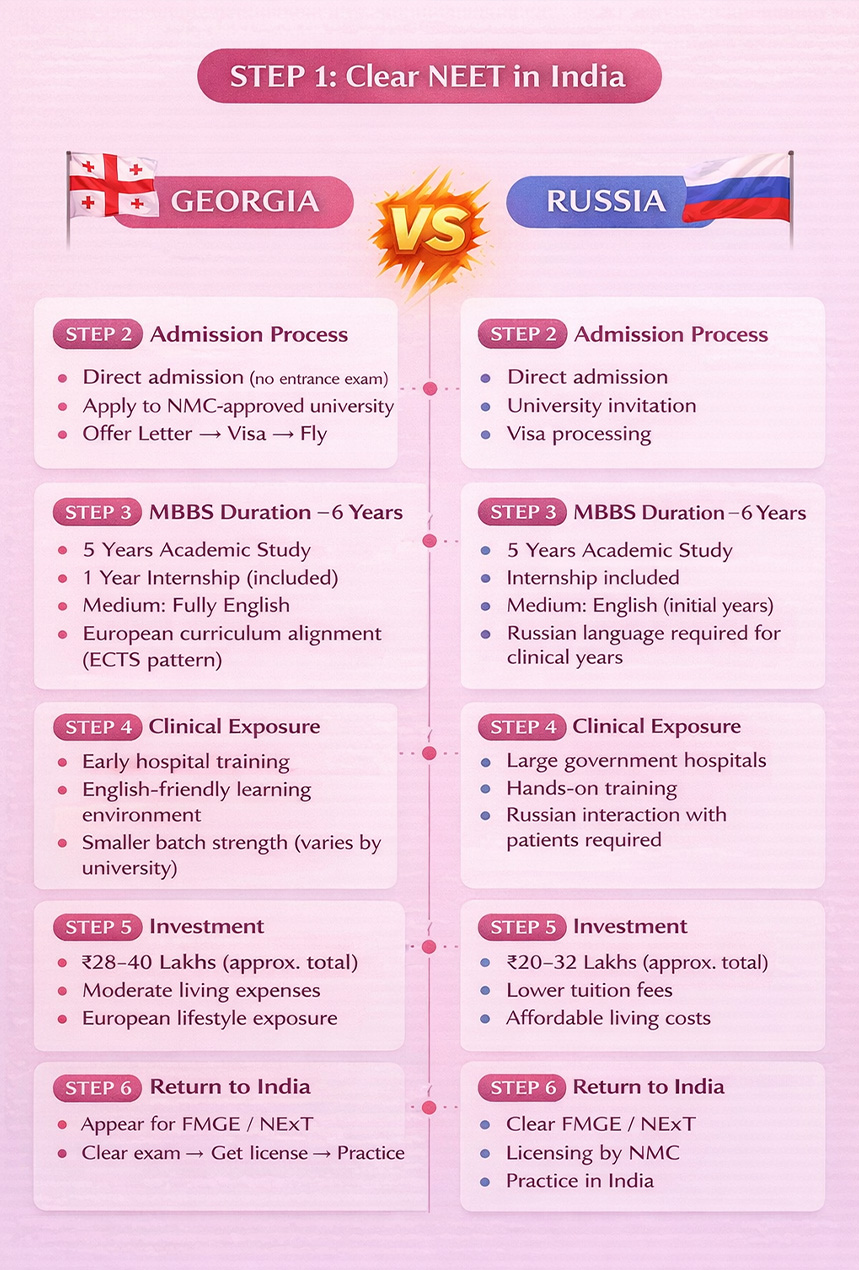
MBBS in Georgia VS MBBS in Russia
Now that you have the knowledge of what your MBBS journey will look like in Georgia vs Russia, it is time to see why you consider Studying MBBS in Georgia vs MBBS in Russia. So, without further ado, let’s get to the point.
Why Study MBBS in Georgia?
1. Medium of Instruction: English
One of the biggest advantages of pursuing MBBS in Georgia is that the entire course is taught in English. For Indian students, this removes the stress of learning a new language just to understand core medical subjects. From classroom lectures to practical training, everything is delivered in English, making it easier to grasp complex medical concepts and prepare confidently for licensing exams like FMGE/NExT. Although students may learn basic Georgia for patient interaction, it is not the primary medium of instruction. This English-friendly environment ensures smoother academic adaptation, better communication with faculty, and a stronger focus on building medical knowledge without language barriers slowing you down.
2. Cost of Study
When it comes to cost, MBBS in Georgia is slightly on the higher side compared to some other affordable destinations. The tuition fees generally range between $4,000 to $8,000 per year, which approximately converts to ₹3.3 lakh to ₹6.6 lakh annually, depending on the university and exchange rate. Over six years, the total tuition investment can range between ₹28-40 lakhs. While this may seem significant, students benefit from European-standard education, modern infrastructure, and a fully English-medium programme. Living expenses are moderate, making the overall cost manageable for Indian medical aspirants seeking quality Education Abroad without the burden of heavy donations that are somewhat a major requirement in India.
3. Quality of Education
MBBS in Georgia is widely appreciated for its modern, European-style education system and well-developed infrastructure. Many universities are equipped with advanced laboratories, simulation centres, digital libraries, and technologically upgraded classrooms that enhance the overall learning experience. The curriculum generally follows European standards, ensuring a balanced mix of theoretical knowledge and practical exposure. The programme typically spans 5 to 6 years, including academic study and clinical training, giving students adequate time to build a strong medical foundation. Smaller class sizes in several Universities also allow better interaction with professors. This structured, quality-driven approach makes Georgia an attractive destination for students seeking globally aligned Medical Education.
4. FMGE/NExT Pass Rate
One of the key reasons why Indian students consider MBBS in Georgia is its relatively better performance in licensing exam like FMGE, and soon, NExT. Over the years, several Georgia Universities have recorded comparatively stable pass percentages, which builds confidence among Indian aspirants planning to return and practise in India. The fully English-medium curriculum, structured academic training, and clinical exposure aligned with international standards help students prepare more effectively for these screening exams. While success ultimately depends on individual preparation and consistency, Georgia’s academic environment often gives students a stronger foundation, making it a preferred destination for those focused on clearing FMGE/NExT.
5. Easy Admission Process
Securing Admission for MBBS in Georgia is far more straightforward than many students expect. The process is deigned to be simple and transparent, without the pressure of additional entrance exams or complicated counselling rounds. Once you have qualified NEET and meet he basic Eligibility Criteria, you can apply directly to the university of your choice. After document submission and verification, you receive your admission letter, followed by vias processing and departure. There are no donation demands or hidden capitation fees involved. With clear documentation requirements and guided support throughout, the admission journey remains smooth, organised, and stress-free for aspiring doctors planning their education abroad.
Why Study MBBS in Russia
1. Medium of Instruction: English & Russia
MBBS in Russia offers both English-medium and Russian-medium programmes, giving students flexibility while choosing their preferred mode of study. Many universities provide the initial years in English, especially for international students, ensuring they can comfortably understand core medical subject. However, as students progress to clinical training, learning the Russian language becomes essential for interacting with patients in hospitals. This bilingual exposure helps students gain practical communication skills and better clinical understanding. For those willing to adapt and learn a new language, this system can be highly beneficial. The availability of both mediums makes Russian an accessible and adaptable option for Indian medical aspirants.
2. Affordable & Budget-friendly
MBBS in Russia is widely known for begin highly budget-friendly, making it one of the most popular choices among Indian students. The tuition fees generally range between ₹3 to ₹5 lakh per year, depending on the university and city. Over six years, the total tuition cost typically falls between ₹20 to ₹32 lakhs, which is significantly lower compared to many private medical colleges in India. In addition to affordable tuition, accommodation costs are also economical, with hostel expenses averaging ₹8,000 to ₹15,000 per month. The overall living expenses remain manageable, allowing students to pursue their medical education without placing excessive financial pressure on their families.
3. Quality of Education
Russia is home to several long-established and reputable medical universities that have been delivering medical education for decades. Many institutions have a strong academic legacy, experienced faculty members, and well-equipped teaching hospitals that provide extensive clinical exposure. The curriculum is structured, comprehensive, and focused on building strong theoretical foundations along with practical skills. Students benefit from large government hospital tie-ups, where they observe and assist in real patient cases during clinical years. The emphasis on disciplined learning and hands-on practice helps students develop confidence in medical settings. With a history of producing thousands of international graduates, Russia continues to maintain its reputation as a trusted destination for pursuing MBBS abroad.
4. FMGE/NExT Pass Rate
When it comes to FMGE and the upcoming NExT examination, students graduating from Russian Universities continue to clear the screening tests successfully with the right preparation. While outcomes vary by university and individual effort, Russia’s strong theoretical foundation equips students with solid medical knowledge. Since students also learn Russian for clinical interaction, they develop deeper practical understanding, which can be an added advantage in real-world practice. With consistent self-study, strategic exam-focused preparation and guidance from coaching support when needed, many Indian students confidently qualify FMGE/NExT. Dedication, discipline, and early preparation play a key role in turning a Russian MBBS degree into a successful medical career in India.
5. Admission Process
The Admission Process for MBBS in Russia is simple, structured, and student-friendly. After qualifying NEET and meeting the basic eligibility criteria in 12th grade (Physics, Chemistry, and Biology), students can apply directly to their chosen university. There is no separate entrance exam required for admission. Once academic documents are submitted and verified, the university issues an official admission letter followed by an invitation letter, which is essential for visa processing. After securing the Student Visa, students can finalise travel arrangements. The process is transparent, with clear documentation requirements and timelines. With proper guidance and careful university selection, admission to Russian Medical Universities can be smooth and well-organised.
Quick Comparison—MBBS in Georgia vs MBBS in Russia
For your simple understanding, here’s a quick overview of MBBS in Georgia vs MBBS in Russia.
| Parameter | MBBS in Georgia | MBBS in Russia |
|---|---|---|
| Eligibility | NEET required, 50% PCB in 12th | NEET required, 50% PCB in 12th |
| Admission Process | Direct admission, no entrance exam | Direct admission, university invitation required |
| Course Duration | 6 years (including internship) | 6 years (including internship) |
| Medium of Instruction | Fully English | English (initial years) + Russian for clinical years |
| Tuition Fees (Per Year) | ₹3.3–6.6 lakhs ($4,000–$8,000) | ₹3–5 lakhs per year |
| Total Cost (Approx.) | ₹28–40 lakhs | ₹20–32 lakhs |
| Living Expenses | Moderate | More affordable |
| Infrastructure | Modern, European-style campuses | Long-established universities with strong hospital tie-ups |
| Clinical Exposure | Early exposure, English-friendly | Large government hospitals, strong practical exposure |
| FMGE/NExT Outlook | Generally favourable trend | Strong outcomes with focused preparation |
| Language Requirement | Basic Georgian for patients | Russian required for hospital interaction |
| Climate | Moderate European climate | Very cold winters |
| Indian Student Presence | Growing Indian community | Large Indian student population |
| Global Recognition | NMC, WHO recognised (university dependent) | NMC, WHO recognised (university dependent) |
MBBS in Georgia vs MBBS in Russia- Decide with MApply Counsellors
Now that you have got a clear understanding of what your academic journey and further career would like when you either decide to pursue MBBS in Georgia or MBBS in Russia, the confusion now is which one of these destinations to pick.
While MBBS in Georgia gives you the edge to explore the European education and other such benefits, MBBS in Russia gives you the opportunity to Study MBBS Abroad at affordable, pocket-friendly price.
To compare between the two destinations and even other options, it is only the MApply counsellors that help you pick the right destination aligning with your budget, ambitions, and future global opportunities.
So, if MBBS in India is somehow feels difficult, pursue MBBS abroad at the right destination with right guidance. Connect with our counsellors today.
Frequently Asked Questions
Both countries offer affordable MBBS programmes with NMC recognition. Georgia is preferred for fully English-medium education and European-style infrastructure, while Russia is popular for lower costs and long-established universities. The better option depends on your budget, language comfort, and career goals.
Yes, a Georgia MBBS degree is valis in India if the university is recognised by the National Medical Commission (NMC). Graduates must clear FMGE or NExT to obtain a licence and practise medicine legally in India.
An MBBS doctor in Georgia typically earns around ₹8 to ₹15 lakhs per year (approx.), depending on experience, hospital type, and specialisation. Salaries may be higher with postgraduate qualifications and professional experience.
MBBS in Russia generally costs between ₹3 to ₹5 lakhs per year for tuition. The total expense over six years usually ranges from ₹20 to ₹32 lakhs, with affordable hostel and living costs compared to many countries.
Yes, a Russian MBBS degree is valid in India if obtained from an NMC-approved university. Graduate must qualify FMGE or the upcoming NExT examination to receive a medical licence and practise in India.
Related Blogs