
All You Need to Know Before You Decide to Study in Spain
All You Need to Know Before You Decide to Study in Spain

Spain is more than just the Tomatina festival and flamenco dance. It is a nation rich with history and culture, that also has a great emphasis on valuable education. When you decide to study abroad, we know your preferred countries are always either the UK, USA, Canada, or Australia. But today, when students are seeking global education at affordable prices, they are going beyond the big four and Spain, it is one of the new favourites of students.
There are several European nations that are emerging as the new popular destinations when it comes to study abroad and Spain is one of them. Today, in this blog, we are going to share everything you need to know before you decide to Study in Spain. We believe that by the end of this blog, if you had your doubts whether to pick Spain or not for your higher education, you would surely have a changed decision. So, let’s explore everything you need to know before deciding to study in Spain.
Why Study in Spain?
The study abroad experience has always been proportional to countries like the UK, USA, Canada, or Australia. However, today, the definition of studying abroad has changed. As students are looking for most opportunities that just practical knowledge, this is why they are inclining towards Spain. Here are all your reasons on why you should study abroad in Spain.
1. Globally Recognised Education at Affordable Costs
One of the biggest reasons students are now choosing to study in Spain is the perfect balance between quality and affordability. While countries like the UK or USA may offer great education, they often come with high tuition fees and expensive living costs. Spain, on the other hand, provides globally recognised degrees at much lower costs, especially in Public Universities. Whether you are planning to study business, arts, technology, or hospitality, you will find high academic standards combined with practical learning approaches. The cost of living is also comparatively reasonable, making it ideal for students looking for a European Education without financial strain. Simply put, Spain allows you to experience world-class education without the pressure of overwhelming expenses.
2. A Gateway to European Opportunities
When you decide to Study Abroad in Spain, you are not just choosing one country—you are opening doors to Europe. Being part of the Schengen Zone, Spain allows students to travel across multiple European countries with ease. This means exposure to different cultures, networking opportunities, global internships, and broader career prospects. Many Spanish Universities have strong industry collaborations and exchange partnerships across Europe, giving students international exposure during their degree itself. In today’s globalised world, learning inside the classroom is not enough; international exposure maters more than ever. Studying in Spain helps you build a truly global perspective, making your profile stronger and more competitive in the international job market.
3. Wide Range of English-taught Programmes
A common concern students have while considering Spain is the language barrier. However, what many don’t realise is that Spanish universities today offer a wide range of programmes taught entirely in English, particularly at the master’s level and across many in-demand disciplines. Fields like business, international relations, hospitality management, technology, data science, marketing, and finance have numerous English-medium options designed specifically for international students. This means you can comfortably pursue your degree without being fluent in Spanish from day one. At the same time, Living in Spain naturally gives you the opportunity to learn Spanish—one of the most widely spoken languages in the world—which can significantly enhance your global employability and cultural adaptability.
4. Strong Focus on Practical Learning & Industry Exposure
Today’s students are not just looking for degrees; they are looking for skills, internships, and real-world experience that make them job-ready from day one. Spain’s education system strongly emphasises practical learning through case studies, live projects, research assignments, group collaborations, and mandatory internships. Many universitise have strong partnerships with multinational companies, growing startups, tourism giants, sports organisations, and emerging tech firms, creating valuable industry connections for students. This ensures that learners gain hands-on exposure well before they graduate. Particularly in fields like hospitality, business management, sports management, and technology, Spain offers immense practical relevance. Instead of limiting education to theory, universities focus on application, innovation, and problem-solving, helping students build industry-ready skills and confidently step into competitive global careers.
5. Vibrant Student Life and Cultural Experience
Studying Abroad is not only about academics—it is about personal growth, independence, and life-changing experiences that shape your future. Spain offers one of the most vibrant and enriching student lifestyles in Europe, making it an exciting destination for international students. From historic architecture and sunny beaches to world-famous festivals, art scenes, music, and delicious cuisine, the country provides a culturally immersive environment. The warm and welcoming nature of people, along with a relaxed yet lively lifestyle, helps student adapt comfortably to a new country. Cities like Madrid and Barcelona are dynamic, student-friendly, and well-connected. When you study in Spain, you gain not only a degree but unforgettable experiences and global perspectives.
6. Cost of Studying in Spain
One of the major reasons students consider Spain is its affordability compared to other Popular Study Destinations. Tuition fees at public universities are significantly lower than in countries like the UK or USA, especially for bachelor’s and master’s programmes. On average, public university fees can range between €1,000 to €3,500 per year, while private institutions may charge higher on the course and reputation. Apart from tuition, the cost of living is also manageable. Students typically spend between €700 to 1,200 per month, depending on the city and lifestyle. Accommodation, food, transportation, and health insurance are reasonably priced. With proper financial planning and possible part-time work opportunities, Studying in Spain becomes a budget-friendly gateway to quality European education.
7. Spain Student Visa Process
Once you receive your admission letter, the next important step is applying for a Spain Student Visa. Non-EU students planning to study for more than 90 days must apply for a long-stay Type D student visa through the Spanish consulate in their home country. The process generally requires an official university acceptance letter, proof of accommodation, financial proof to support your stay, health insurance, academic documents, and a valid passport. Some students may also be asked to provide a medical certificate and police clearance. Visa processing times can vary, so it is always advisable to apply well in advance. With proper documentation and timely preparation, the visa process for Spain is structured, transparent, and manageable for international students.
8. Scholarships & Financial Aid
Financing your education abroad becomes easier when you explore the wide range of options available for Financial Aid and Scholarships to Study in Spain. Many Spanish universities offer merit-based and need-based scholarships specifically for international students, helping reduce tuition costs significantly. In addition to university-specific grants, students can also apply for government-funded programmes and European funding opportunities such as Erasmus+, which supports international mobility and academic exchange. Some autonomous regions in Spain also provide Financial Assistance depending on the course and eligibility criteria. Apart from scholarships, students can manage expenses through part-time work opportunities. With the right research and timely applications, studying in Spain can become even more affordable and financially manageable.
9. Language Requirements
One of the most common questions students ask before choosing Spain is about language requirements. The good news is that many universities offer programmes entirely in English, especially at the postgraduate level. For such courses, students are usually required to submit proof of English proficiency through exams like IELTS or TOEFL. However, if you plan to enrol in a Spanish-taught programme, you may need to demonstrate Spanish language proficiency through exams such as DELE or SIELE. While knowing Spanish is not always mandatory for admission, learning the language can greatly enhance your life, networking opportunities, and job prospects. Having basic Spanish skills also makes part-time work and social integration much easier and more comfortable.
10. Work Opportunities for Students
For many international students, studying abroad also means gaining work experience alongside academics. Spain allows non-EU students to work part-time for up to 30 hours per week, provided the job does not interfere with their studies. This gives studens the opportunity to manage living expenses while gaining valuable professional exposure. Popular part-time roles include hospitality, retail, administrative support, tutoring, and internships related to your field of study. Many universities also have career support services that help students find internships and placement opportunities. In addition, Spain’s growing sectors such as tourism, business, and technology create pathways for post-study employment. With the right balance, students can build both financial independence and a strong international work profile.
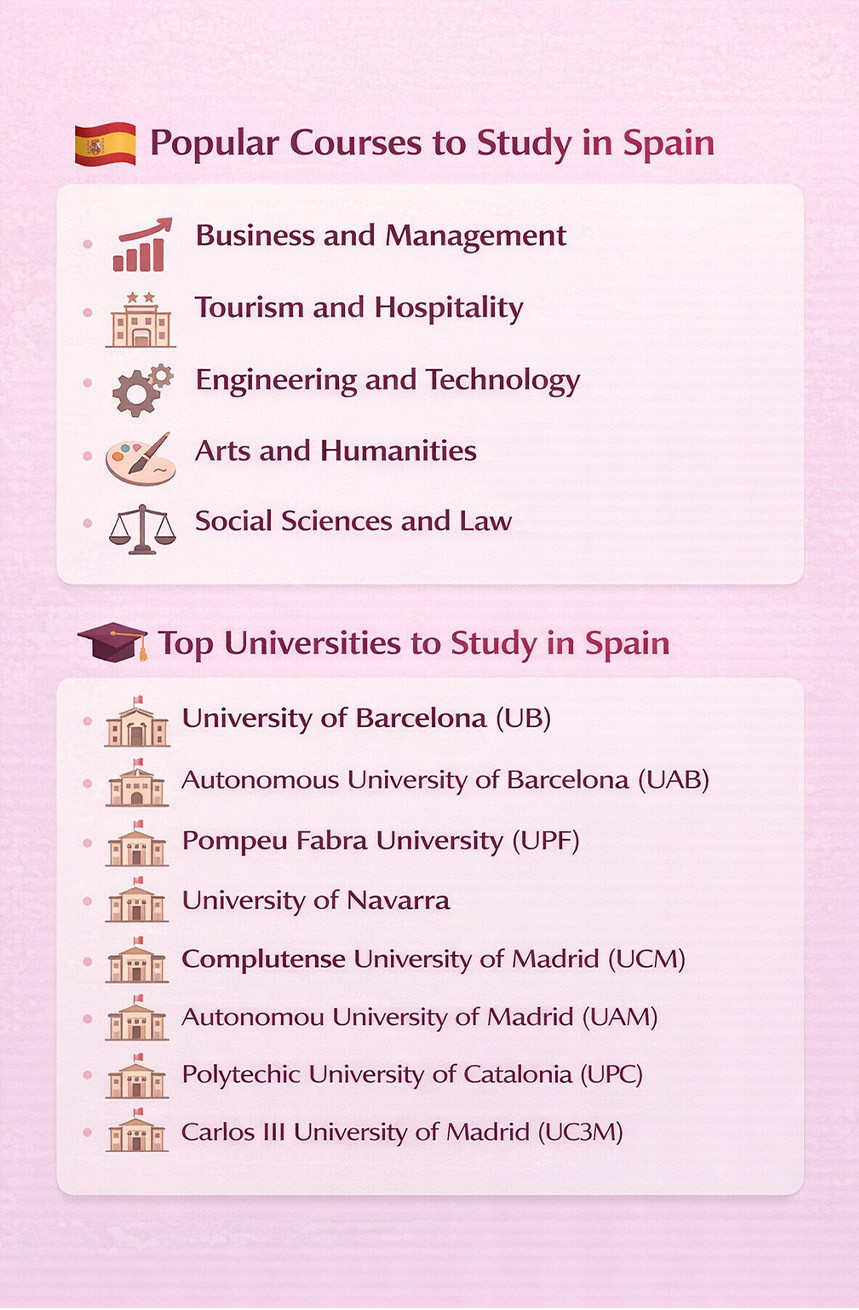
Here is a list of popular courses and Top Universities to Study in Spain that students prefer:
Plan Your Higher Education in Spain with MetaApply IE
As you are planning to study abroad and don’t know which destination to pick, we would suggest pursuing higher education in Spain. From offering globally recognised degree in various couses that too in English, to offering post-study work opportunities, easy visa process, and affordable education, study in Spain is the best option for those who wants access to EU nations without having to spend huge bucks on education.
However, deciding to study in Spain is one thing and getting to study there is a whole new journey you need to get on. So, from helping you shortlist the right university and courses to helping you apply there and preparing you for the Student Visa, Education Loan, or even accommodation, MetaApply IE experts are here for your assistance at every step.
To explore more about your study in Spain options, connect with our counsellors today.
Frequently Asked Questions
The cost of studying in Spain ranges from €1,000 to €3,500 per year in public universities, while private universities may charge more. Monthly living expenses typically range between €700 to €1,200, depending on the city and lifestyle.
Yes, Spain is a great option for Indian students seeking affordable European education, global exposure, and quality universities. With English-taught programmes, reasonable living costs, and strong career prospects, Spain is becoming an increasingly popular destination among Indian students.
Yes, you can study in Spain without IELTS if the university accepts alternative proof of English proficiency, such as previous education in English. However, requirements vary by institution, so it is important to check specific university criteria before applying.
Yes, after completing your studies, you can apply for a job search visa and later transition to a work permit. After legally residing and working in Spain for a required number of years, you may become eligible to apply for permanent residency.
Yes, international students in Spain can work part-time for up to 30 hours per week alongside their studies. The job must not affect academic performance. Part-time roles help students manage expenses and gain valuable international work experience.
Related Blogs