
The MBA Window Is Closing: Study MBA Abroad and Know the Requirements
The MBA Window Is Closing: Study MBA Abroad and Know the Requirements

Every year, thousands of ambitious professionals dream of studying an MBA abroad. Yet only a small percentage actually understand what makes an international MBA truly valuable.
An MBA today, is a career accelerator that connects students with global industries, leadership networks, and international opportunities. The right MBA programme can transform a professional trajectory in just a few years.
But here is the reality many applicants discover too late: not all MBA programmes offer the same outcomes. Some focus heavily on theory. Others are deeply integrated with global industries and leadership development.
The difference between an average MBA and a powerful one often comes down to the country, the programme structure, and the entry requirements that shape the quality of the cohort.
Students who choose wisely gain access to global companies, international salaries, and leadership roles. Those who do not may simply end up with another qualification.
This guide explains how to Study MBA Abroad, the key requirements you must prepare for, and which countries offer the greatest advantages depending on your career goals.
Why Studying an MBA Abroad Is No Longer Optional for Global Careers
The world of business is changing at an immense pace. Companies are expanding across continents, digital transformation is redefining industries, and leadership roles increasingly require professionals who understand global markets, multicultural teams, and international strategy.
Studying MBA Abroad exposes students to this environment from day one.
Instead of learning business concepts in isolation, students experience:
- Global case studies
- International business simulations
- Industry consulting projects
- Diverse professional networks
These experiences help MBA graduates build the strategic thinking and leadership skills modern businesses demand.
For many professionals, an international MBA becomes the moment when a career shifts from local experience to global leadership potential.
What Makes an International MBA Different
Not all MBA programmes follow the same philosophy. Many international programmes focus on experiential learning rather than traditional classroom teaching. Students analyse real business challenges, work with companies, and collaborate with classmates who often have several years of professional experience.
The result is an environment where learning becomes practical, collaborative, and deeply connected to the real world. Students are exposed to professionals from different industries such as finance, technology, consulting, healthcare, and entrepreneurship.
This diversity transforms the classroom into something far more powerful than a lecture hall. It becomes a global business laboratory.
Where Should You Study Your MBA Abroad?
The best MBA destination depends largely on the career outcomes students want to achieve. Different countries have built education systems that support specific industries and leadership pathways.
United Kingdom – The Fast Track to Global Business Leadership
The UK has become one of the most popular destinations for MBA programmes because of its one-year intensive structure.
Instead of spending two years Studying MBA in UK, students can complete their MBA quickly and return to the workforce sooner.
The UK education system also places strong emphasis on strategic thinking, leadership development, and global business analysis.
Students gain exposure to international markets while studying in one of the world’s most influential financial and business ecosystems.
Best for students who want
- A shorter MBA duration
- Global exposure in finance and consulting
- Faster return on investment
United States – The Innovation and Entrepreneurship Hub
The United States has long been associated with entrepreneurial thinking and business innovation.
MBA programmes in USA often encourage students to explore technology, venture capital, and startup ecosystems.
Many courses include case studies drawn directly from real companies, allowing students to analyse complex business problems and propose solutions.
Students also benefit from exposure to large corporate networks and emerging technology industries.
Best for students who want
- Careers in consulting or technology
- Exposure to startup culture
- Leadership roles in multinational companies
Canada – The Practical MBA Experience
Canada has gained popularity among international students because of its practical and industry-aligned approach to management education.
Many MBA Programmes in Canada include internships, consulting projects, or work placements that allow students to apply what they learn in real business environments.
Students also benefit from a welcoming international environment and opportunities to gain global work experience after graduation.
Best for students who want
- Hands-on learning experiences
- Work placements during study
- Long-term international career opportunities
Australia – The Career-Oriented MBA
Australia has built an education system that emphasises career readiness and leadership development.
MBA programmes in Australia often include collaborative projects, leadership workshops, and networking opportunities with industry professionals.
Students benefit from an academic environment that combines global business theory with practical management skills.
Best for students who want
- Leadership development
- International business exposure
- A balanced academic and lifestyle experience
Europe – The Strategic Global Business Gateway
Many European Countries have become attractive MBA destinations because they offer diverse business environments and strong connections to global markets.
Students Studying MBA in Europe often gain exposure to international trade, multinational corporations, and cross-border business strategy.
In addition, the multicultural environment helps students develop adaptability and global management perspectives.
Best for students who want
- Exposure to international markets
- Multicultural leadership experience
- Careers in global strategy and consulting
Choosing the right destination becomes easier when students understand their career priorities.
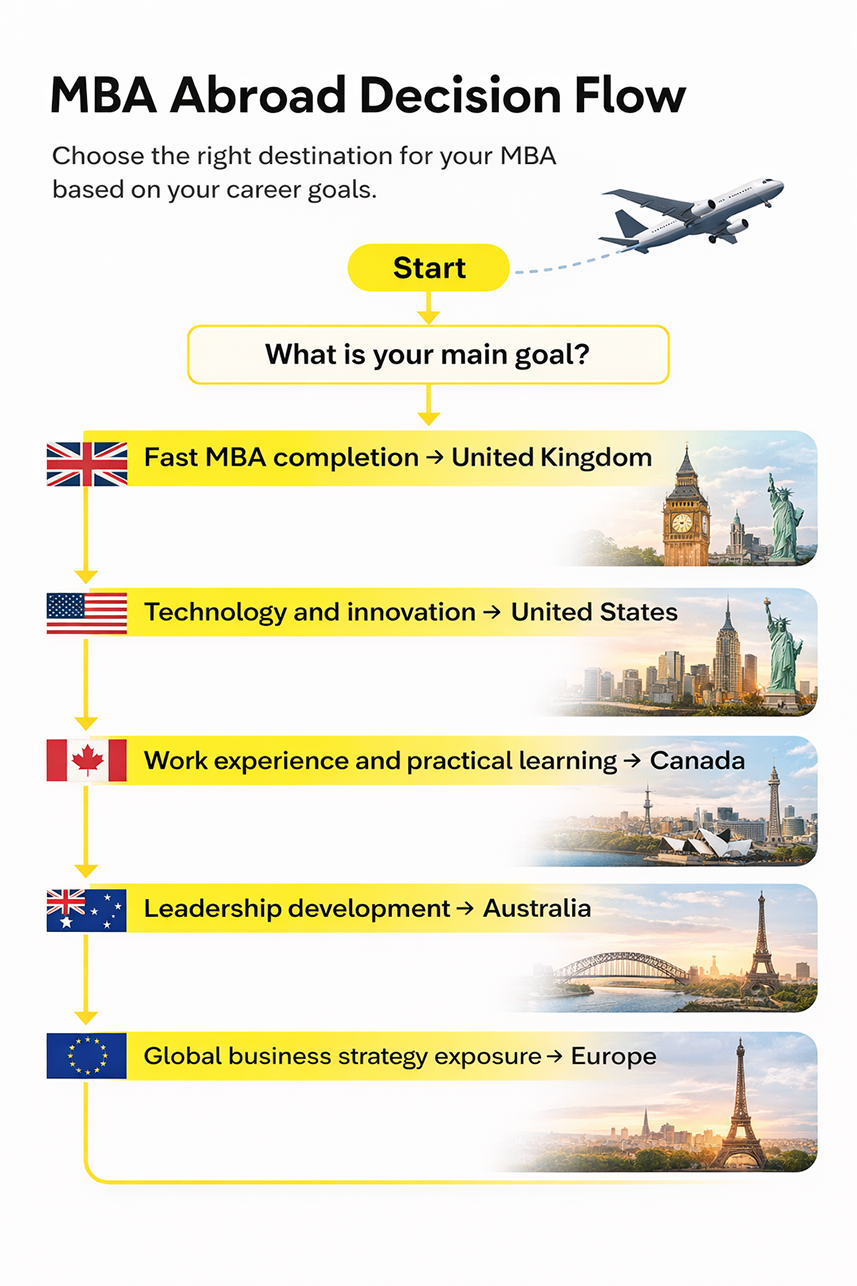
This simple framework helps students match their career goals with the strengths of each education system.
Key Requirements to Study an MBA Abroad
Applying for MBA Abroad requires careful preparation. Most programmes look for applicants who combine academic capability with real professional experience.
Below are the most common requirements.
Academic Qualification
Applicants typically need a recognised undergraduate degree.
The degree does not always need to be in business or management. Many MBA cohorts include students from fields such as engineering, economics, science, or humanities.
What matters more is the applicant’s ability to demonstrate analytical thinking and academic readiness.
Professional Work Experience
One of the defining characteristics of an MBA programme is the level of professional experience students bring into the classroom.
Most programmes expect two to five years of full-time work experience.
This experience allows students to contribute real business insights during discussions and collaborative projects.
English Language Proficiency
For international students, proof of English language ability is usually required.
Applicants may need to demonstrate proficiency through recognised English Language Tests or academic qualifications completed in English.
Strong communication skills are essential because MBA programmes involve presentations, group discussions, and leadership simulations.
Standardised Management Tests
Some MBA programmes require a standardised management aptitude test that evaluates:
- Analytical reasoning
- Quantitative ability
- Problem-solving skills
These tests help institutions assess whether applicants are prepared for the academic rigour of an MBA programme.
Statement of Purpose
A compelling personal statement is often one of the most important parts of an MBA application.
Applicants must explain:
- Why they want to pursue an MBA
- What career goals they aim to achieve
- How the programme fits into their long-term professional plans
Admissions committees often evaluate clarity of ambition and leadership potential through this Statement of Purpose.
Letters of Recommendation
Professional references provide insight into an applicant’s leadership ability, teamwork skills, and professional achievements.
Most programmes require at least one or two Letter of Recommendations from supervisors or professional mentors.
These references help institutions understand the real-world impact of an applicant’s work experience.
The MBA Application Preparation Timeline
Planning ahead significantly increases the chances of admission.
Students often follow a preparation timeline similar to this.
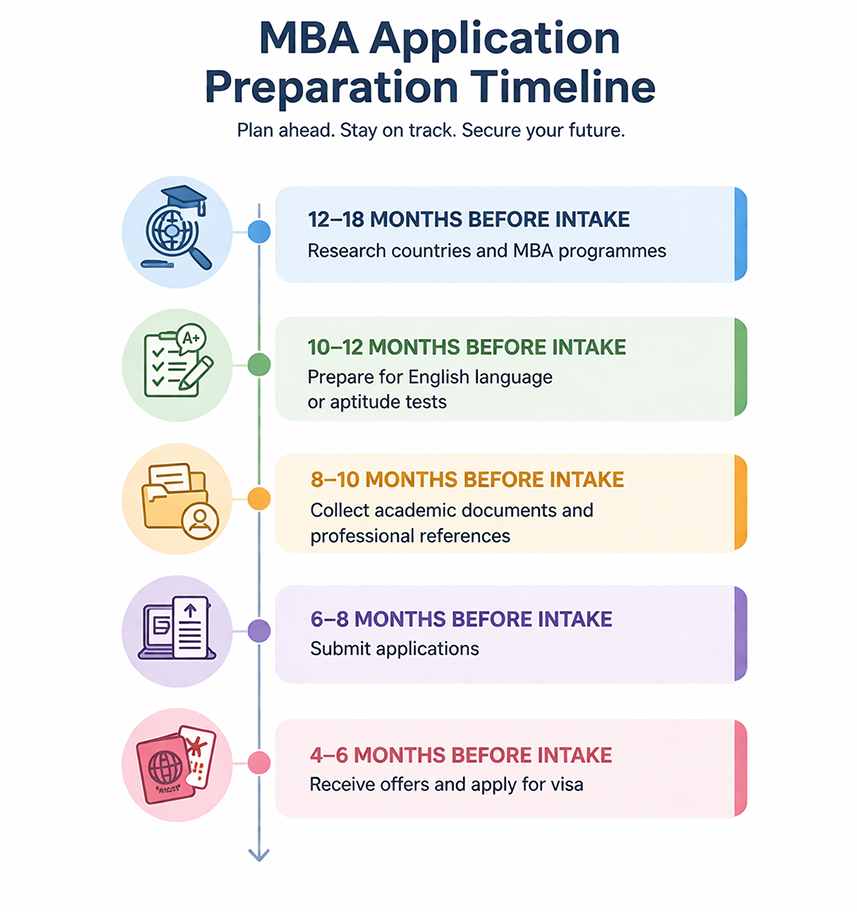
Following a structured timeline ensures that students do not miss critical application deadlines.
Skills Students Gain from an International MBA
The real value of an MBA Abroad lies not only in the degree but in the skills students develop during the programme.
MBA graduates typically gain expertise in:
- Strategic decision-making
- Financial analysis
- Leadership and team management
- Business communication
- Data-driven problem solving
These competencies are increasingly valuable as organisations look for professionals who can lead teams, interpret data, and manage complex global challenges.
The Real ROI of Studying an MBA Abroad
Students often evaluate MBA programmes based on tuition fees alone. However, the real return on investment comes from career acceleration and global mobility.
An international MBA can open doors to:
- Senior management roles
- Consulting and advisory careers
- International corporate leadership
- Entrepreneurial ventures
The exposure to international networks also helps graduates build long-term professional relationships that can influence careers for decades.
The Future of MBA Education
Business schools around the world are redesigning MBA programmes to reflect modern industry trends.
Future-focused MBA programmes increasingly include topics such as:
- Artificial intelligence and business analytics
- Sustainability and responsible leadership
- Digital transformation
- Global supply chain strategy
- Entrepreneurship and innovation
Students graduating from these programmes are better prepared to navigate the rapidly evolving global business landscape.
Turn Global Business Ambitions into Reality With MetaApply IE
Applying for an MBA abroad can often feel overwhelming. With multiple countries to consider, complex requirements to meet, and highly competitive admissions processes, many students struggle to identify the opportunities that truly align with their career goals. This is where MetaApply IE simplifies the entire journey by helping students move from uncertainty to clarity. With expert guidance, students receive support in choosing the right MBA destination, understanding admission requirements, preparing strong application documents, navigating visa processes, and planning every step of their study abroad journey. Instead of trying to manage everything alone, students gain a structured roadmap that connects their career ambitions with the right international opportunities. For professionals ready to transform their future, the path to a global MBA begins with the right guidance and the right strategy. Fill in the form today and take the first step towards your international MBA journey.
Frequently Asked Questions
Most MBA programmes require a recognised undergraduate degree, professional work experience, English language proficiency, and a strong application including a statement of purpose and professional references.
Most international MBA programmes prefer applicants with two to five years of full-time professional experience.
Popular destinations include the United Kingdom, United States, Canada, Australia, and several European countries, each offering different advantages depending on career goals.
An international MBA can provide global exposure, leadership development, professional networks, and access to international career opportunities.
MBA programmes typically take one to two years to complete depending on the country and programme structure.
Related Blogs